LEADER 03748nam a22004935i 4500
001 808823
003 TR_AnAIT
005 20260131025048
007 cr nn 008mamaa
008 100825s2011 ne | s |||| 0|eng d
020 |a9789048192984|9978-90-481-9298-4
024 7 |a10.1007/978-90-481-9298-4|2doi
041 |aeng
049 |aTürk Tarih Kurumu Kütüphanesi
050 4|aHB848-3697
072 7|aJHBD|2bicssc
072 7|aSOC006000|2bisacsh
072 7|aJHBD|2thema
082 04|a304.6|223
090 |aDK/10112
100 1 |aCharbit, Yves.|eauthor.|4aut|4http://id.loc.gov/vocabulary/relators/aut
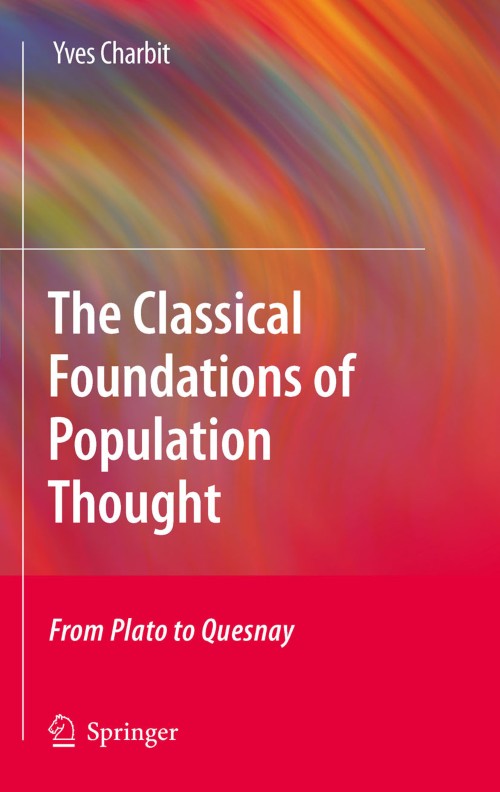
245 14|aThe Classical Foundations of Population Thought|h[electronic resource] :|bFrom Plato to Quesnay /|cby Yves Charbit.
250 |a1st ed. 2011.
264 1|aDordrecht :|bSpringer Netherlands :|bImprint: Springer,|c2011.
300 |aVII, 179 p.|bonline resource.
336 |atext|btxt|2rdacontent
337 |acomputer|bc|2rdamedia
338 |aonline resource|bcr|2rdacarrier
347 |atext file|bPDF|2rda
505 0 |a1: Interpreting Ideas on Population -- 2: History and Utopia -- The Platonic City -- The Demography of the City -- Religion and Politics -- Space and Order -- Moderation and Excess -- A Totalitarian System? -- 3: There are no Riches other than Men -- Jean Bodin on Sovereignty -- Demographic Interpretations of Jean Bodin -- The Theory of Absolute Sovereignty and Population -- Bodin on Aristotle and Plato -- 4: The Prince and his Population -- From Montchrétien to Colbert and Fénelon -- Merchantilism and Populationism -- About Population -- A National Economic Policy -- International Trade and the Colonies -- The Decline of Merchantilism: Political and Economic Factors -- For Want of Political Arithmetic -- 5: The Political Failure of an Economic Theory -- Quesnay and the Physiocracy -- Agriculture and Prosperity -- On population -- A failure and its Causes -- 6: Towards Demography -- The Prince, The Father , The Landlord -- The Conflict of Interests -- The Emergence of Individualism -- From Homo Eoconomicus to Homo Demographicus -- Bibliography -- Index.
520 |aWhereas the history of demography as a social science has been amply explored, that of the construction of the concept of population has been neglected. Specialists systematically ignore a noteworthy paradox: strictly speaking, the great intellectual figures of the past dealt with in this book have not produced demographic theories or doctrines as such, but they have certainly given some thought to population at both levels. First, the central epistemological and methodological orientation of the book is presented. Ideas on population, far from being part of the harmonious advancement of knowledge are the product of their context, that is evidently demographic, but also economic, political and above all intellectual. Then the ideas on population of Plato, Bodin, the French mercantilists, Quesnay and the physiocrats are examined under this light. The last chapter addresses the implicit philosophical, economic and political issues of population thought.
650 0|aDemography.
650 0|aPopulation.
650 0|aPhilosophy, Ancient.
650 14|aPopulation and Demography.
650 24|aAncient Philosophy / Classical Philosophy.
710 2 |aSpringerLink (Online service)
773 0 |tSpringer Nature eBook
776 08|iPrinted edition:|z9789048192977
776 08|iPrinted edition:|z9789048192991
776 08|iPrinted edition:|z9789401783279
776 08|iPrinted edition:|z9789402422894
856 40|uhttps://doi.org/10.1007/978-90-481-9298-4
912 |aZDB-2-SHU
912 |aZDB-2-SXS
950 |aHumanities, Social Sciences and Law (SpringerNature-11648)
950 |aSocial Sciences (R0) (SpringerNature-43726)