LEADER 03826nam a22005415i 4500
001 808864
003 TR_AnAIT
005 20260131024940
007 cr nn 008mamaa
008 110516s2011 ne | s |||| 0|eng d
020 |a9789048193103|9978-90-481-9310-3
024 7 |a10.1007/978-90-481-9310-3|2doi
041 |aeng
049 |aTürk Tarih Kurumu Kütüphanesi
050 4|aBJ1-1725
072 7|aHPQ|2bicssc
072 7|aPHI005000|2bisacsh
072 7|aQDTQ|2thema
082 04|a170|223
090 |aDK/10153
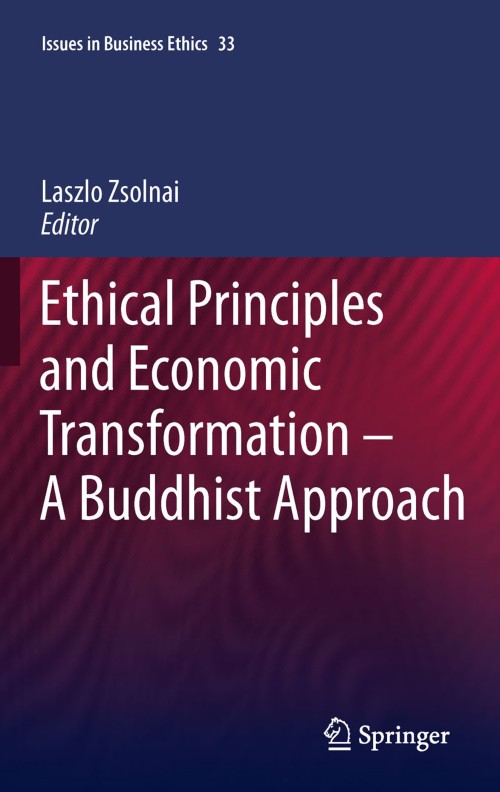
245 10|aEthical Principles and Economic Transformation - A Buddhist Approach|h[electronic resource] /|cedited by Laszlo Zsolnai.
250 |a1st ed. 2011.
264 1|aDordrecht :|bSpringer Netherlands :|bImprint: Springer,|c2011.
300 |aXII, 216 p.|bonline resource.
336 |atext|btxt|2rdacontent
337 |acomputer|bc|2rdamedia
338 |aonline resource|bcr|2rdacarrier
347 |atext file|bPDF|2rda
490 1 |aIssues in Business Ethics,|x2215-1680 ;|v33
505 0 |aPreface -- Acknowledgement.-Introduction -- Why Buddhist Economics? Laszlo Zsolnai -- Part 1 Buddhist EthicsApplied to Economics -- The Relational Economy; Julie A. Nelson -- Buddhism andSustainable Consumption; Peter Daniels -- Economic Sufficiency and Santi Asoke; Julia Essen -- Pathways to aMindful Economy; Joel C. Magnuson -- Part 2 Achieving Happiness and Peace -- DoOur Economic Choices Make Us Happy? Colin Ash -- Gross National Happiness; SanderTideman -- The Application of Buddhist Theory andPractice in Modern Organizations; Bronwen Rees and Tamas Agocs -- Leadershipthe Buddhist Way; Laurens van den Muyzenberg -- Conclusion -- The Contributionsof Buddhist Economics; Laszlo Zsolnai. Bibliography of Buddhist Economics -- About the Authors -- Index. .
520 |aBuddhism points out that emphasizing individuality and promoting the greatest fulfillment of the desires of the individual conjointly lead to destruction. The book promotes the basic value-choices of Buddhism, namely happiness, peace and permanence. Happiness research convincingly shows that not material wealth but the richness of personal relationships determines happiness. Not things, but people make people happy. Western economics tries to provide people with happiness by supplying enormous quantities of things and today’s dominating business models are based on and cultivates narrow self-centeredness.But what people need are caring relationships and generosity. Buddhist economics makes these values accessible by direct provision. Peace can be achieved in nonviolent ways. Wanting less can substantially contribute to this endeavor and make it happen more easily. Permanence, or ecological sustainability, requires a drastic cutback in the present level of consumption and production globally. This reduction should not be an inconvenient exercise of self-sacrifice. In the noble ethos of reducing suffering it can be a positive development path for humanity.
650 0|aEthics.
650 0|aDevelopment economics.
650 0|aReligion.
650 0|aPhilosophy, Modern.
650 14|aMoral Philosophy and Applied Ethics.
650 24|aDevelopment Economics.
650 24|aReligion.
650 24|aPhilosophical Traditions.
700 1 |aZsolnai, Laszlo.|eeditor.|4edt|4http://id.loc.gov/vocabulary/relators/edt
710 2 |aSpringerLink (Online service)
773 0 |tSpringer Nature eBook
776 08|iPrinted edition:|z9789048193097
776 08|iPrinted edition:|z9789048193110
776 08|iPrinted edition:|z9789400736153
830 0|aIssues in Business Ethics,|x2215-1680 ;|v33
856 40|uhttps://doi.org/10.1007/978-90-481-9310-3
912 |aZDB-2-SHU
912 |aZDB-2-SXPR
950 |aHumanities, Social Sciences and Law (SpringerNature-11648)
950 |aPhilosophy and Religion (R0) (SpringerNature-43725)