

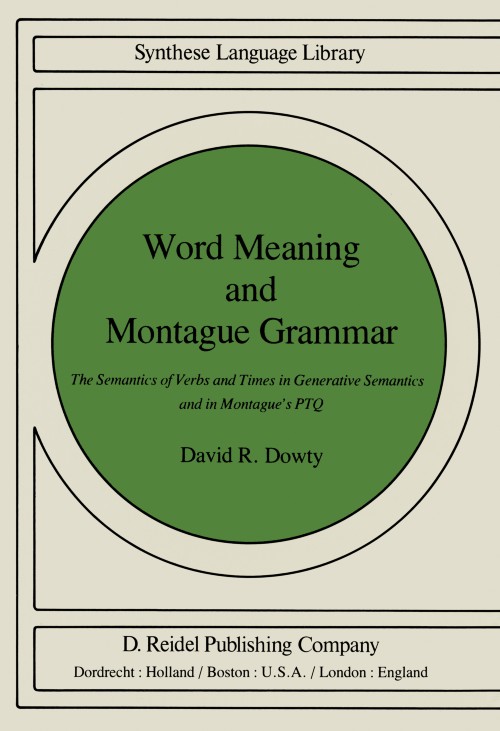
Word Meaning and Montague Grammar [electronic resource] : The Semantics of Verbs and Times in Generative Semantics and in Montague's PTQ / by D. R. Dowty.
Erişim Adresi
ISBN
9789400994737
Dil Kodu
İngilizce
Yer Numarası
DK/10179
Yazar
Basım Bildirimi
1st ed. 1979.
Yayın Bilgisi
Dordrecht : Springer Netherlands : Imprint: Springer, 1979.
Fiziksel Niteleme
XXV, 418 p. online resource.
Dizi
Studies in Linguistics and Philosophy, 2215-034X ; 7
İçindekiler Notu
1. Montague’s General Theory of Languages and Linguistic Theories of Syntax and Semantics -- 1.1 The meaning of “Universal” in “Universal Grammar” -- 1.2 Syntax in the UG Theory and in Linguistic Theories -- 1.3 Semantics in UG -- 1.4 Interpretation by Means of Translation -- 1.5 Preliminaries to the Analysis of Word Meaning -- Notes -- 2. The Semantics of Aspectual Classes of Verbs in English -- 2.1 The Development of Decomposition Analysis in Generative Semantics -- 2.2The Aristotle-Ryle-Kenny-Vendler Verb Classification -- 2.3 An Aspect Calculus -- 2.4The Aspect Calculus as Restricting Possible Word Meanings -- Notes -- 3. Interval Semantics and the Progressive Tense -- 3.1 The Imperfective Paradox -- 3.2 Truth Conditions Relative to Intervals, not Moments -- 3.3 Revised Truth Conditions for BECOME -- 3.4 Truth Conditions for the Progressive -- 3.5 Motivating the Progressive Analysis Independently of Accomplishment Sentences -- 3.6 On the Notion of ‘Likeness’ Among Possible Worlds -- 3.7 Extending the Analysis to the “Futurate Progressive” -- 3.8 Another Look at the Vendler Classification in an Interval-Based Semantics -- Notes -- 4. Lexical Decomposition in Montague Grammar -- 4.1 Existing “Lexical Decomposition” in the PTQ Grammar -- 4.2 The General Form of Decomposition Translations: Lambda Abstraction vs. Predicate Raising -- 4.3 Morphologically Derived Causatives and Inchoatives -- 4.4 Prepositional Phrase Accomplishments -- 4.5 Accomplishments with Two Prepositional Phrases -- 4.6 Prepositional Phrase Adjuncts vs. Prepositional Phrase Complements -- 4.7 Factitive Constructions -- 4.8 Periphrastic Causatives -- 4.9 By-Phrases in Accomplishment Sentences -- 4.10 Causative Constructions in Other Languages -- Notes -- 5. Linguistic Evidence for the Two Strategies of LexicalDecomposition -- 5.1 Arguments that Constraints on Syntactic Rules Rule Out “Impossible” Lexical Items -- 5.2 Arguments that Familiar Transformations Also Apply Pre-Lexically -- 5.3 Pronominalization of Parts of Lexical Items -- 5.4 Scope Ambiguities with Almost -- 5.5 Scope Ambiguities with Adverbs: Have-Deletion Cases -- 5.6 Scope Ambiguities with Adverbs: Accomplishment Cases -- 5.7 Arguments from Re- and Reversative Un- -- 5.8 Accommodating the Adverb Scope Data in a PTQ Grammar -- 5.9 Overpredictions of the Generative Semantics Hypothesis -- 5.10 Concluding Evaluation -- Notes -- 6. The Syntax and Semantics of Word Formation: Lexical Rules -- 6.1 Montague’s Program and Lexical Rules -- 6.2 A Lexical Component For a Montague Grammar -- 6.3 Lexical Rules and Morphology -- 6.4 Lexical Rules and Syntax -- 6.5 Examples of Lexical Rules -- 6.6 Problems for Research in the Pragmatics and in the Semantics of Word Formation -- Notes -- 7. The Syntax and Semantics of Tenses and Time Adverbials in English: An English Fragment -- 7.1 The Syncategorematic Nature of Tense-Time Adverbial Interaction -- 7.2 Rules for “Main Tense” Adverbials -- 7.3 Aspectual Adverbials: For an Hour and In an Hour -- 7.4 The Syntactic Structure of the Auxiliary -- 7.5 The Present Perfect -- 7.6 Negation -- 7.7 An English Fragment -- Notes -- 8. Intensions and Psychological Reality -- Notes -- References.
Özet, vb.
The most general goal of this book is to propose and illustrate a program of research in word semantics that combines some of the methodology and results in linguistic semantics, primarily that of the generative semantics school, with the rigorously formalized syntactic and semantic framework for the analysis of natural languages developed by Richard Montague and his associates, a framework in which truth and denotation with respect to a model are taken as the fundamental semantic notions. I hope to show, both from the linguist's and the philosopher's point of view, not only why this synthesis can be undertaken but also why it will be useful to pursue it. On the one hand, the linguists' decompositions of word meanings into more primitive parts are by themselves inherently incomplete, in that they deal only in distinctions in meaning without providing an account of what mean ings really are. Not only can these analyses be made complete by a model theoretic semantics, but also such an account of these analyses renders them more exact and more readily testable than they could ever be otherwise.
Konu
Semiotics.
Language and languages __ Philosophy.
Semiotics.
Philosophy of Language.
Language and languages __ Philosophy.
Semiotics.
Philosophy of Language.
Kurum Adı
Eseri Alıntıla
Referansları kullanmadan önce gözden geçirmeniz ve varsa gerekli düzeltmeleri yapmanız önerilir.
Dijital Kaynak
MARC Görünümü
LEADER 06929nam a22005535i 4500
001 808890
003 TR_AnAIT
005 20260131024856
007 cr nn 008mamaa
008 121227s1979 ne | s |||| 0|eng d
020 |a9789400994737|9978-94-009-9473-7
024 7 |a10.1007/978-94-009-9473-7|2doi
041 |aeng
049 |aTürk Tarih Kurumu Kütüphanesi
050 4|aP99-99.4
072 7|aGTE|2bicssc
072 7|aLIT006000|2bisacsh
072 7|aGTD|2thema
082 04|a401.4|223
090 |aDK/10179
100 1 |aDowty, D. R.|eauthor.|4aut|4http://id.loc.gov/vocabulary/relators/aut
245 10|aWord Meaning and Montague Grammar|h[electronic resource] :|bThe Semantics of Verbs and Times in Generative Semantics and in Montague's PTQ /|cby D. R. Dowty.
250 |a1st ed. 1979.
264 1|aDordrecht :|bSpringer Netherlands :|bImprint: Springer,|c1979.
300 |aXXV, 418 p.|bonline resource.
336 |atext|btxt|2rdacontent
337 |acomputer|bc|2rdamedia
338 |aonline resource|bcr|2rdacarrier
347 |atext file|bPDF|2rda
490 1 |aStudies in Linguistics and Philosophy,|x2215-034X ;|v7
505 0 |a1. Montague’s General Theory of Languages and Linguistic Theories of Syntax and Semantics -- 1.1 The meaning of “Universal” in “Universal Grammar” -- 1.2 Syntax in the UG Theory and in Linguistic Theories -- 1.3 Semantics in UG -- 1.4 Interpretation by Means of Translation -- 1.5 Preliminaries to the Analysis of Word Meaning -- Notes -- 2. The Semantics of Aspectual Classes of Verbs in English -- 2.1 The Development of Decomposition Analysis in Generative Semantics -- 2.2The Aristotle-Ryle-Kenny-Vendler Verb Classification -- 2.3 An Aspect Calculus -- 2.4The Aspect Calculus as Restricting Possible Word Meanings -- Notes -- 3. Interval Semantics and the Progressive Tense -- 3.1 The Imperfective Paradox -- 3.2 Truth Conditions Relative to Intervals, not Moments -- 3.3 Revised Truth Conditions for BECOME -- 3.4 Truth Conditions for the Progressive -- 3.5 Motivating the Progressive Analysis Independently of Accomplishment Sentences -- 3.6 On the Notion of ‘Likeness’ Among Possible Worlds -- 3.7 Extending the Analysis to the “Futurate Progressive” -- 3.8 Another Look at the Vendler Classification in an Interval-Based Semantics -- Notes -- 4. Lexical Decomposition in Montague Grammar -- 4.1 Existing “Lexical Decomposition” in the PTQ Grammar -- 4.2 The General Form of Decomposition Translations: Lambda Abstraction vs. Predicate Raising -- 4.3 Morphologically Derived Causatives and Inchoatives -- 4.4 Prepositional Phrase Accomplishments -- 4.5 Accomplishments with Two Prepositional Phrases -- 4.6 Prepositional Phrase Adjuncts vs. Prepositional Phrase Complements -- 4.7 Factitive Constructions -- 4.8 Periphrastic Causatives -- 4.9 By-Phrases in Accomplishment Sentences -- 4.10 Causative Constructions in Other Languages -- Notes -- 5. Linguistic Evidence for the Two Strategies of LexicalDecomposition -- 5.1 Arguments that Constraints on Syntactic Rules Rule Out “Impossible” Lexical Items -- 5.2 Arguments that Familiar Transformations Also Apply Pre-Lexically -- 5.3 Pronominalization of Parts of Lexical Items -- 5.4 Scope Ambiguities with Almost -- 5.5 Scope Ambiguities with Adverbs: Have-Deletion Cases -- 5.6 Scope Ambiguities with Adverbs: Accomplishment Cases -- 5.7 Arguments from Re- and Reversative Un- -- 5.8 Accommodating the Adverb Scope Data in a PTQ Grammar -- 5.9 Overpredictions of the Generative Semantics Hypothesis -- 5.10 Concluding Evaluation -- Notes -- 6. The Syntax and Semantics of Word Formation: Lexical Rules -- 6.1 Montague’s Program and Lexical Rules -- 6.2 A Lexical Component For a Montague Grammar -- 6.3 Lexical Rules and Morphology -- 6.4 Lexical Rules and Syntax -- 6.5 Examples of Lexical Rules -- 6.6 Problems for Research in the Pragmatics and in the Semantics of Word Formation -- Notes -- 7. The Syntax and Semantics of Tenses and Time Adverbials in English: An English Fragment -- 7.1 The Syncategorematic Nature of Tense-Time Adverbial Interaction -- 7.2 Rules for “Main Tense” Adverbials -- 7.3 Aspectual Adverbials: For an Hour and In an Hour -- 7.4 The Syntactic Structure of the Auxiliary -- 7.5 The Present Perfect -- 7.6 Negation -- 7.7 An English Fragment -- Notes -- 8. Intensions and Psychological Reality -- Notes -- References.
520 |aThe most general goal of this book is to propose and illustrate a program of research in word semantics that combines some of the methodology and results in linguistic semantics, primarily that of the generative semantics school, with the rigorously formalized syntactic and semantic framework for the analysis of natural languages developed by Richard Montague and his associates, a framework in which truth and denotation with respect to a model are taken as the fundamental semantic notions. I hope to show, both from the linguist's and the philosopher's point of view, not only why this synthesis can be undertaken but also why it will be useful to pursue it. On the one hand, the linguists' decompositions of word meanings into more primitive parts are by themselves inherently incomplete, in that they deal only in distinctions in meaning without providing an account of what mean ings really are. Not only can these analyses be made complete by a model theoretic semantics, but also such an account of these analyses renders them more exact and more readily testable than they could ever be otherwise.
532 8 |aAccessibility summary: This PDF is not accessible. It is based on scanned pages and does not support features such as screen reader compatibility or described non-text content (images, graphs etc). However, it likely supports searchable and selectable text based on OCR (Optical Character Recognition). Users with accessibility needs may not be able to use this content effectively. Please contact us at accessibilitysupport@springernature.com if you require assistance or an alternative format.
532 8 |aInaccessible, or known limited accessibility
532 8 |aNo reading system accessibility options actively disabled
532 8 |aPublisher contact for further accessibility information: accessibilitysupport@springernature.com
650 0|aSemiotics.
650 0|aLanguage and languages|xPhilosophy.
650 14|aSemiotics.
650 24|aPhilosophy of Language.
710 2 |aSpringerLink (Online service)
773 0 |tSpringer Nature eBook
776 08|iPrinted edition:|z9789027710086
776 08|iPrinted edition:|z9789027710093
776 08|iPrinted edition:|z9789400994744
830 0|aStudies in Linguistics and Philosophy,|x2215-034X ;|v7
856 40|uhttps://doi.org/10.1007/978-94-009-9473-7
912 |aZDB-2-SHU
912 |aZDB-2-SXS
912 |aZDB-2-BAE
950 |aHumanities, Social Sciences and Law (SpringerNature-11648)
950 |aSocial Sciences (R0) (SpringerNature-43726)
001 808890
003 TR_AnAIT
005 20260131024856
007 cr nn 008mamaa
008 121227s1979 ne | s |||| 0|eng d
020 |a9789400994737|9978-94-009-9473-7
024 7 |a10.1007/978-94-009-9473-7|2doi
041 |aeng
049 |aTürk Tarih Kurumu Kütüphanesi
050 4|aP99-99.4
072 7|aGTE|2bicssc
072 7|aLIT006000|2bisacsh
072 7|aGTD|2thema
082 04|a401.4|223
090 |aDK/10179
100 1 |aDowty, D. R.|eauthor.|4aut|4http://id.loc.gov/vocabulary/relators/aut
245 10|aWord Meaning and Montague Grammar|h[electronic resource] :|bThe Semantics of Verbs and Times in Generative Semantics and in Montague's PTQ /|cby D. R. Dowty.
250 |a1st ed. 1979.
264 1|aDordrecht :|bSpringer Netherlands :|bImprint: Springer,|c1979.
300 |aXXV, 418 p.|bonline resource.
336 |atext|btxt|2rdacontent
337 |acomputer|bc|2rdamedia
338 |aonline resource|bcr|2rdacarrier
347 |atext file|bPDF|2rda
490 1 |aStudies in Linguistics and Philosophy,|x2215-034X ;|v7
505 0 |a1. Montague’s General Theory of Languages and Linguistic Theories of Syntax and Semantics -- 1.1 The meaning of “Universal” in “Universal Grammar” -- 1.2 Syntax in the UG Theory and in Linguistic Theories -- 1.3 Semantics in UG -- 1.4 Interpretation by Means of Translation -- 1.5 Preliminaries to the Analysis of Word Meaning -- Notes -- 2. The Semantics of Aspectual Classes of Verbs in English -- 2.1 The Development of Decomposition Analysis in Generative Semantics -- 2.2The Aristotle-Ryle-Kenny-Vendler Verb Classification -- 2.3 An Aspect Calculus -- 2.4The Aspect Calculus as Restricting Possible Word Meanings -- Notes -- 3. Interval Semantics and the Progressive Tense -- 3.1 The Imperfective Paradox -- 3.2 Truth Conditions Relative to Intervals, not Moments -- 3.3 Revised Truth Conditions for BECOME -- 3.4 Truth Conditions for the Progressive -- 3.5 Motivating the Progressive Analysis Independently of Accomplishment Sentences -- 3.6 On the Notion of ‘Likeness’ Among Possible Worlds -- 3.7 Extending the Analysis to the “Futurate Progressive” -- 3.8 Another Look at the Vendler Classification in an Interval-Based Semantics -- Notes -- 4. Lexical Decomposition in Montague Grammar -- 4.1 Existing “Lexical Decomposition” in the PTQ Grammar -- 4.2 The General Form of Decomposition Translations: Lambda Abstraction vs. Predicate Raising -- 4.3 Morphologically Derived Causatives and Inchoatives -- 4.4 Prepositional Phrase Accomplishments -- 4.5 Accomplishments with Two Prepositional Phrases -- 4.6 Prepositional Phrase Adjuncts vs. Prepositional Phrase Complements -- 4.7 Factitive Constructions -- 4.8 Periphrastic Causatives -- 4.9 By-Phrases in Accomplishment Sentences -- 4.10 Causative Constructions in Other Languages -- Notes -- 5. Linguistic Evidence for the Two Strategies of LexicalDecomposition -- 5.1 Arguments that Constraints on Syntactic Rules Rule Out “Impossible” Lexical Items -- 5.2 Arguments that Familiar Transformations Also Apply Pre-Lexically -- 5.3 Pronominalization of Parts of Lexical Items -- 5.4 Scope Ambiguities with Almost -- 5.5 Scope Ambiguities with Adverbs: Have-Deletion Cases -- 5.6 Scope Ambiguities with Adverbs: Accomplishment Cases -- 5.7 Arguments from Re- and Reversative Un- -- 5.8 Accommodating the Adverb Scope Data in a PTQ Grammar -- 5.9 Overpredictions of the Generative Semantics Hypothesis -- 5.10 Concluding Evaluation -- Notes -- 6. The Syntax and Semantics of Word Formation: Lexical Rules -- 6.1 Montague’s Program and Lexical Rules -- 6.2 A Lexical Component For a Montague Grammar -- 6.3 Lexical Rules and Morphology -- 6.4 Lexical Rules and Syntax -- 6.5 Examples of Lexical Rules -- 6.6 Problems for Research in the Pragmatics and in the Semantics of Word Formation -- Notes -- 7. The Syntax and Semantics of Tenses and Time Adverbials in English: An English Fragment -- 7.1 The Syncategorematic Nature of Tense-Time Adverbial Interaction -- 7.2 Rules for “Main Tense” Adverbials -- 7.3 Aspectual Adverbials: For an Hour and In an Hour -- 7.4 The Syntactic Structure of the Auxiliary -- 7.5 The Present Perfect -- 7.6 Negation -- 7.7 An English Fragment -- Notes -- 8. Intensions and Psychological Reality -- Notes -- References.
520 |aThe most general goal of this book is to propose and illustrate a program of research in word semantics that combines some of the methodology and results in linguistic semantics, primarily that of the generative semantics school, with the rigorously formalized syntactic and semantic framework for the analysis of natural languages developed by Richard Montague and his associates, a framework in which truth and denotation with respect to a model are taken as the fundamental semantic notions. I hope to show, both from the linguist's and the philosopher's point of view, not only why this synthesis can be undertaken but also why it will be useful to pursue it. On the one hand, the linguists' decompositions of word meanings into more primitive parts are by themselves inherently incomplete, in that they deal only in distinctions in meaning without providing an account of what mean ings really are. Not only can these analyses be made complete by a model theoretic semantics, but also such an account of these analyses renders them more exact and more readily testable than they could ever be otherwise.
532 8 |aAccessibility summary: This PDF is not accessible. It is based on scanned pages and does not support features such as screen reader compatibility or described non-text content (images, graphs etc). However, it likely supports searchable and selectable text based on OCR (Optical Character Recognition). Users with accessibility needs may not be able to use this content effectively. Please contact us at accessibilitysupport@springernature.com if you require assistance or an alternative format.
532 8 |aInaccessible, or known limited accessibility
532 8 |aNo reading system accessibility options actively disabled
532 8 |aPublisher contact for further accessibility information: accessibilitysupport@springernature.com
650 0|aSemiotics.
650 0|aLanguage and languages|xPhilosophy.
650 14|aSemiotics.
650 24|aPhilosophy of Language.
710 2 |aSpringerLink (Online service)
773 0 |tSpringer Nature eBook
776 08|iPrinted edition:|z9789027710086
776 08|iPrinted edition:|z9789027710093
776 08|iPrinted edition:|z9789400994744
830 0|aStudies in Linguistics and Philosophy,|x2215-034X ;|v7
856 40|uhttps://doi.org/10.1007/978-94-009-9473-7
912 |aZDB-2-SHU
912 |aZDB-2-SXS
912 |aZDB-2-BAE
950 |aHumanities, Social Sciences and Law (SpringerNature-11648)
950 |aSocial Sciences (R0) (SpringerNature-43726)
Materyaller
Depodan talep edilen materyal sadece kütüphane içerisinde kullanılmaktadır.
Materyal dışarıya ödünç verilmemektedir.
Materyal dışarıya ödünç verilmemektedir.
