

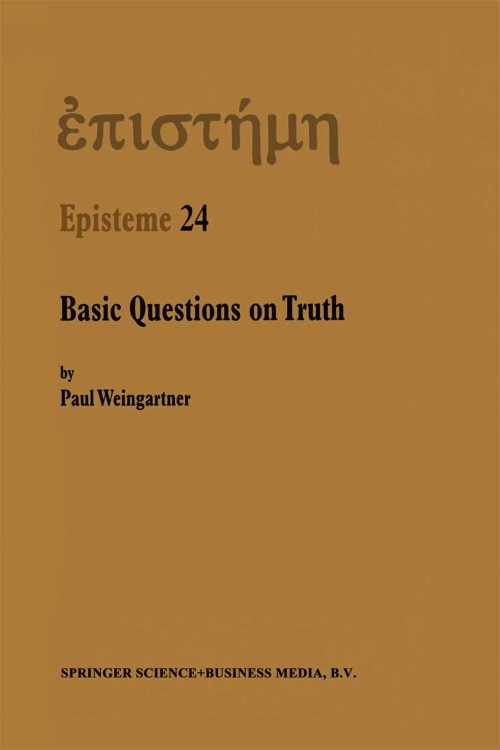
Basic Questions on Truth [electronic resource] / by P. Weingartner.
Erişim Adresi
ISBN
9789401140348
Dil Kodu
İngilizce
Yer Numarası
DK/10193
Yazar
Basım Bildirimi
1st ed. 2000.
Yayın Bilgisi
Dordrecht : Springer Netherlands : Imprint: Springer, 2000.
Fiziksel Niteleme
X, 230 p. online resource.
Dizi
Episteme, A Series in the Foundational, Methodological, Philosophical, Psychological, Sociological, and Political Aspects of the Sciences, Pure and Applied ; 24
İçindekiler Notu
One Is it appropriate to ask “What is truth”? -- Two Is it appropriate to ask for the meaning or for the definition of the expression “truth”, “the true” or “true”? -- Three Is the expression true superfluous and/or not a predicate? -- Four Can the rules of a deductive system be called true or false? -- Five Are definitions true or false? -- Six Judgements, propositions, sentences -- Seven Is a sentence true iff it corresponds to reality -- Eight Are there negative facts or properties? -- Nine Can a false theory be nearer to the truth than another false theory? -- Ten Ens et verum convertuntur? -- References -- Name index.
Özet, vb.
The task of the book is not to give a survey of the main theories on truth found in the literature. There are several books available which do this: The one of David for Deflationist (and Disquotational) Theories of Truth; that of Chapuis for Revision Theories of Truth; that of Kirkham for Correspondence Theories and several others; that ofRescher for Coherence Theories of Truth. Moreover the book is not an analy sis just of Tar ski's theory, like that of Moreno or the respective chapters in Kirkham, though Tarski's theory plays an important role in the whole work presented. The task of the book is to give a detailed answer to some basic questions on truth which have been perennial problems through the centuries and are still discussed today. The answer is given in the light of our knowledge today and with the help of modem logic. But the book explicitly aims at connecting recent problems with re lated ones in the whole history of philosophy. The method to incorporate important philosophers of the tradition into the analysis is that of disputation, i. e. of putting some of their main thesis into objections or counterobjections pro or contra a posi tive answer to the respective question. After the pros and cons are given a detailed answer to the question is proposed and finally commentaries and corrections are given to the objections and counterobjections in the light of the proposed answer.
Konu
Knowledge, Theory of.
Logic.
Language and languages __ Philosophy.
Science __ Philosophy.
Epistemology.
Logic.
Philosophy of Language.
Philosophy of Science.
Logic.
Language and languages __ Philosophy.
Science __ Philosophy.
Epistemology.
Logic.
Philosophy of Language.
Philosophy of Science.
Kurum Adı
Eseri Alıntıla
Referansları kullanmadan önce gözden geçirmeniz ve varsa gerekli düzeltmeleri yapmanız önerilir.
Dijital Kaynak
MARC Görünümü
LEADER 04916nam a22006015i 4500
001 808904
003 TR_AnAIT
005 20260131024820
007 cr nn 008mamaa
008 121227s2000 ne | s |||| 0|eng d
020 |a9789401140348|9978-94-011-4034-8
024 7 |a10.1007/978-94-011-4034-8|2doi
041 |aeng
049 |aTürk Tarih Kurumu Kütüphanesi
050 4|aBD143-237
072 7|aHPK|2bicssc
072 7|aPHI004000|2bisacsh
072 7|aQDTK|2thema
082 04|a120|223
090 |aDK/10193
100 1 |aWeingartner, P.|eauthor.|4aut|4http://id.loc.gov/vocabulary/relators/aut
245 10|aBasic Questions on Truth|h[electronic resource] /|cby P. Weingartner.
250 |a1st ed. 2000.
264 1|aDordrecht :|bSpringer Netherlands :|bImprint: Springer,|c2000.
300 |aX, 230 p.|bonline resource.
336 |atext|btxt|2rdacontent
337 |acomputer|bc|2rdamedia
338 |aonline resource|bcr|2rdacarrier
347 |atext file|bPDF|2rda
490 1 |aEpisteme, A Series in the Foundational, Methodological, Philosophical, Psychological, Sociological, and Political Aspects of the Sciences, Pure and Applied ;|v24
505 0 |aOne Is it appropriate to ask “What is truth”? -- Two Is it appropriate to ask for the meaning or for the definition of the expression “truth”, “the true” or “true”? -- Three Is the expression true superfluous and/or not a predicate? -- Four Can the rules of a deductive system be called true or false? -- Five Are definitions true or false? -- Six Judgements, propositions, sentences -- Seven Is a sentence true iff it corresponds to reality -- Eight Are there negative facts or properties? -- Nine Can a false theory be nearer to the truth than another false theory? -- Ten Ens et verum convertuntur? -- References -- Name index.
520 |aThe task of the book is not to give a survey of the main theories on truth found in the literature. There are several books available which do this: The one of David for Deflationist (and Disquotational) Theories of Truth; that of Chapuis for Revision Theories of Truth; that of Kirkham for Correspondence Theories and several others; that ofRescher for Coherence Theories of Truth. Moreover the book is not an analy sis just of Tar ski's theory, like that of Moreno or the respective chapters in Kirkham, though Tarski's theory plays an important role in the whole work presented. The task of the book is to give a detailed answer to some basic questions on truth which have been perennial problems through the centuries and are still discussed today. The answer is given in the light of our knowledge today and with the help of modem logic. But the book explicitly aims at connecting recent problems with re lated ones in the whole history of philosophy. The method to incorporate important philosophers of the tradition into the analysis is that of disputation, i. e. of putting some of their main thesis into objections or counterobjections pro or contra a posi tive answer to the respective question. After the pros and cons are given a detailed answer to the question is proposed and finally commentaries and corrections are given to the objections and counterobjections in the light of the proposed answer.
532 8 |aAccessibility summary: This PDF is not accessible. It is based on scanned pages and does not support features such as screen reader compatibility or described non-text content (images, graphs etc). However, it likely supports searchable and selectable text based on OCR (Optical Character Recognition). Users with accessibility needs may not be able to use this content effectively. Please contact us at accessibilitysupport@springernature.com if you require assistance or an alternative format.
532 8 |aInaccessible, or known limited accessibility
532 8 |aNo reading system accessibility options actively disabled
532 8 |aPublisher contact for further accessibility information: accessibilitysupport@springernature.com
650 0|aKnowledge, Theory of.
650 0|aLogic.
650 0|aLanguage and languages|xPhilosophy.
650 0|aScience|xPhilosophy.
650 14|aEpistemology.
650 24|aLogic.
650 24|aPhilosophy of Language.
650 24|aPhilosophy of Science.
710 2 |aSpringerLink (Online service)
773 0 |tSpringer Nature eBook
776 08|iPrinted edition:|z9780792362241
776 08|iPrinted edition:|z9789401140355
776 08|iPrinted edition:|z9789401057790
830 0|aEpisteme, A Series in the Foundational, Methodological, Philosophical, Psychological, Sociological, and Political Aspects of the Sciences, Pure and Applied ;|v24
856 40|uhttps://doi.org/10.1007/978-94-011-4034-8
912 |aZDB-2-SHU
912 |aZDB-2-SXPR
912 |aZDB-2-BAE
950 |aHumanities, Social Sciences and Law (SpringerNature-11648)
950 |aPhilosophy and Religion (R0) (SpringerNature-43725)
001 808904
003 TR_AnAIT
005 20260131024820
007 cr nn 008mamaa
008 121227s2000 ne | s |||| 0|eng d
020 |a9789401140348|9978-94-011-4034-8
024 7 |a10.1007/978-94-011-4034-8|2doi
041 |aeng
049 |aTürk Tarih Kurumu Kütüphanesi
050 4|aBD143-237
072 7|aHPK|2bicssc
072 7|aPHI004000|2bisacsh
072 7|aQDTK|2thema
082 04|a120|223
090 |aDK/10193
100 1 |aWeingartner, P.|eauthor.|4aut|4http://id.loc.gov/vocabulary/relators/aut
245 10|aBasic Questions on Truth|h[electronic resource] /|cby P. Weingartner.
250 |a1st ed. 2000.
264 1|aDordrecht :|bSpringer Netherlands :|bImprint: Springer,|c2000.
300 |aX, 230 p.|bonline resource.
336 |atext|btxt|2rdacontent
337 |acomputer|bc|2rdamedia
338 |aonline resource|bcr|2rdacarrier
347 |atext file|bPDF|2rda
490 1 |aEpisteme, A Series in the Foundational, Methodological, Philosophical, Psychological, Sociological, and Political Aspects of the Sciences, Pure and Applied ;|v24
505 0 |aOne Is it appropriate to ask “What is truth”? -- Two Is it appropriate to ask for the meaning or for the definition of the expression “truth”, “the true” or “true”? -- Three Is the expression true superfluous and/or not a predicate? -- Four Can the rules of a deductive system be called true or false? -- Five Are definitions true or false? -- Six Judgements, propositions, sentences -- Seven Is a sentence true iff it corresponds to reality -- Eight Are there negative facts or properties? -- Nine Can a false theory be nearer to the truth than another false theory? -- Ten Ens et verum convertuntur? -- References -- Name index.
520 |aThe task of the book is not to give a survey of the main theories on truth found in the literature. There are several books available which do this: The one of David for Deflationist (and Disquotational) Theories of Truth; that of Chapuis for Revision Theories of Truth; that of Kirkham for Correspondence Theories and several others; that ofRescher for Coherence Theories of Truth. Moreover the book is not an analy sis just of Tar ski's theory, like that of Moreno or the respective chapters in Kirkham, though Tarski's theory plays an important role in the whole work presented. The task of the book is to give a detailed answer to some basic questions on truth which have been perennial problems through the centuries and are still discussed today. The answer is given in the light of our knowledge today and with the help of modem logic. But the book explicitly aims at connecting recent problems with re lated ones in the whole history of philosophy. The method to incorporate important philosophers of the tradition into the analysis is that of disputation, i. e. of putting some of their main thesis into objections or counterobjections pro or contra a posi tive answer to the respective question. After the pros and cons are given a detailed answer to the question is proposed and finally commentaries and corrections are given to the objections and counterobjections in the light of the proposed answer.
532 8 |aAccessibility summary: This PDF is not accessible. It is based on scanned pages and does not support features such as screen reader compatibility or described non-text content (images, graphs etc). However, it likely supports searchable and selectable text based on OCR (Optical Character Recognition). Users with accessibility needs may not be able to use this content effectively. Please contact us at accessibilitysupport@springernature.com if you require assistance or an alternative format.
532 8 |aInaccessible, or known limited accessibility
532 8 |aNo reading system accessibility options actively disabled
532 8 |aPublisher contact for further accessibility information: accessibilitysupport@springernature.com
650 0|aKnowledge, Theory of.
650 0|aLogic.
650 0|aLanguage and languages|xPhilosophy.
650 0|aScience|xPhilosophy.
650 14|aEpistemology.
650 24|aLogic.
650 24|aPhilosophy of Language.
650 24|aPhilosophy of Science.
710 2 |aSpringerLink (Online service)
773 0 |tSpringer Nature eBook
776 08|iPrinted edition:|z9780792362241
776 08|iPrinted edition:|z9789401140355
776 08|iPrinted edition:|z9789401057790
830 0|aEpisteme, A Series in the Foundational, Methodological, Philosophical, Psychological, Sociological, and Political Aspects of the Sciences, Pure and Applied ;|v24
856 40|uhttps://doi.org/10.1007/978-94-011-4034-8
912 |aZDB-2-SHU
912 |aZDB-2-SXPR
912 |aZDB-2-BAE
950 |aHumanities, Social Sciences and Law (SpringerNature-11648)
950 |aPhilosophy and Religion (R0) (SpringerNature-43725)
Materyaller
Depodan talep edilen materyal sadece kütüphane içerisinde kullanılmaktadır.
Materyal dışarıya ödünç verilmemektedir.
Materyal dışarıya ödünç verilmemektedir.
