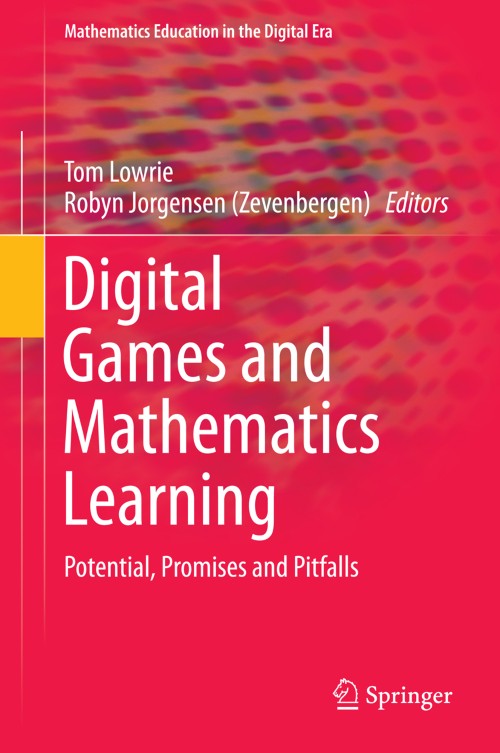
Digital Games and Mathematics Learning [electronic resource] : Potential, Promises and Pitfalls / edited by Tom Lowrie, Robyn Jorgensen (Zevenbergen).
Erişim Adresi
ISBN
9789401795173
Dil Kodu
İngilizce
Yer Numarası
DK/10207
Basım Bildirimi
1st ed. 2015.
Yayın Bilgisi
Dordrecht : Springer Netherlands : Imprint: Springer, 2015.
Fiziksel Niteleme
XIII, 309 p. online resource.
Dizi
Mathematics Education in the Digital Era, 2211-8144 ; 4
İçindekiler Notu
1. Digital Games and Learning: What’s New Is Already Old? Tom Lowrie and Robyn Jorgensen(Zevenbergen) (Australia) -- 2. Mathematics and Non-School Gameplay. Antri Avraamidou, John Monaghan and Aisha Walker (United Kingdom) -- 3. Integration of Digital Games in Learning and e-Learning Environments: Connecting Experiences and Context. Begoña Gros (Spain) -- 4. The Construction of Electronic Games as an Environment for Mathematics Education. Rodrigo Dalla Vecchia, Marcus V. Maltempi and Marcelo C. Borba (Brazil) -- 5. Digital Games, Mathematics and Visuospatial Reasoning. Tom Lowrie (Australia) -- 6. Digital Games and Equity: Implications for Issues of Social Class and Rurality. Robyn Jorgensen(Zevenbergen) (Australia) -- 7. Multimodal Literacy, Digital Games and Curriculum. Catherine Beavis (Australia) -- 8. Apples and Coconuts: Young Children ‘Kinect-ing’ with Mathematics and Sesame Street. Meagan Rothschild and Caroline C. Williams (United States) -- 9. SAPS and Digital Games: Improving Mathematics Transfer and Attitudes in Schools. Richard N. Van Eck (United States) -- 10. Mathematics and Educational Psychology: Construction of Learning Environments. Cesare Fregola (Italy) -- 11. Serious Games and Gaming. Terry Bossomaier (Australia) -- 12. Apps: Appropriate, Applicable and Appealing? Nigel Calder (New Zealand) -- 13. “An App! An App! My Kingdom for an App”: An 18 Month Quest t o Determine Whether Apps Support Mathematical Knowledge Building. Kevin Larkin (Australia) -- 14. Digital Games and Mathematics Learning: The State of Play. Tracy Logan and Kim Woodland (Australia). .
Özet, vb.
Digital games offer enormous potential for learning and engagement in mathematics ideas and processes. This volume offers multidisciplinary perspectives—of educators, cognitive scientists, psychologists and sociologists—on how digital games influence the social activities and mathematical ideas of learners/gamers. Contributing authors identify opportunities for broadening current understandings of how mathematical ideas are fostered (and embedded) within digital game environments. In particular, the volume advocates for new and different ways of thinking about mathematics in our digital age—proposing that these mathematical ideas and numeracy practices are distinct from new literacies or multiliteracies. The authors acknowledge that the promise of digital games has not always been realised/fulfilled. There is emerging, and considerable, evidence to suggest that traditional discipline boundaries restrict opportunities for mathematical learning. Throughout the book, what constitutesmathematics learnings and pedagogy is contested. Multidisciplinary viewpoints are used to describe and understand the potential of digital games for learning mathematics and identify current tensions within the field. Mathematics learning is defined as being about problem solving; engagement in mathematical ideas and processes; and social engagement. The artefact, which is the game, shapes the ways in which the gamers engage with the social activity of gaming. In parallel, the book (as a t extual artefact) will be supported by Springer’s online platform—allowing for video and digital communication (including links to relevant websites) to be used as supplementary material and establish a dynamic communication space.
Konu
Mathematics __ Study and teaching .
Education __ Data processing.
Educational technology.
Mathematics Education.
Computers and Education.
Digital Education and Educational Technology.
Education __ Data processing.
Educational technology.
Mathematics Education.
Computers and Education.
Digital Education and Educational Technology.
Kurum Adı

Eseri Alıntıla
Referansları kullanmadan önce gözden geçirmeniz ve varsa gerekli düzeltmeleri yapmanız önerilir.
Dijital Kaynak
MARC Görünümü
LEADER 05499nam a22005535i 4500
001 808918
003 TR_AnAIT
005 20260131024802
007 cr nn 008mamaa
008 151005s2015 ne | s |||| 0|eng d
020 |a9789401795173|9978-94-017-9517-3
024 7 |a10.1007/978-94-017-9517-3|2doi
041 |aeng
049 |aTürk Tarih Kurumu Kütüphanesi
050 4|aQA10.92-20
072 7|aJNU|2bicssc
072 7|aPB|2bicssc
072 7|aEDU029010|2bisacsh
072 7|aJNU|2thema
072 7|aPB|2thema
082 04|a510.71|223
090 |aDK/10207
245 10|aDigital Games and Mathematics Learning|h[electronic resource] :|bPotential, Promises and Pitfalls /|cedited by Tom Lowrie, Robyn Jorgensen (Zevenbergen).
250 |a1st ed. 2015.
264 1|aDordrecht :|bSpringer Netherlands :|bImprint: Springer,|c2015.
300 |aXIII, 309 p.|bonline resource.
336 |atext|btxt|2rdacontent
337 |acomputer|bc|2rdamedia
338 |aonline resource|bcr|2rdacarrier
347 |atext file|bPDF|2rda
490 1 |aMathematics Education in the Digital Era,|x2211-8144 ;|v4
505 0 |a1. Digital Games and Learning: What’s New Is Already Old? Tom Lowrie and Robyn Jorgensen(Zevenbergen) (Australia) -- 2. Mathematics and Non-School Gameplay. Antri Avraamidou, John Monaghan and Aisha Walker (United Kingdom) -- 3. Integration of Digital Games in Learning and e-Learning Environments: Connecting Experiences and Context. Begoña Gros (Spain) -- 4. The Construction of Electronic Games as an Environment for Mathematics Education. Rodrigo Dalla Vecchia, Marcus V. Maltempi and Marcelo C. Borba (Brazil) -- 5. Digital Games, Mathematics and Visuospatial Reasoning. Tom Lowrie (Australia) -- 6. Digital Games and Equity: Implications for Issues of Social Class and Rurality. Robyn Jorgensen(Zevenbergen) (Australia) -- 7. Multimodal Literacy, Digital Games and Curriculum. Catherine Beavis (Australia) -- 8. Apples and Coconuts: Young Children ‘Kinect-ing’ with Mathematics and Sesame Street. Meagan Rothschild and Caroline C. Williams (United States) -- 9. SAPS and Digital Games: Improving Mathematics Transfer and Attitudes in Schools. Richard N. Van Eck (United States) -- 10. Mathematics and Educational Psychology: Construction of Learning Environments. Cesare Fregola (Italy) -- 11. Serious Games and Gaming. Terry Bossomaier (Australia) -- 12. Apps: Appropriate, Applicable and Appealing? Nigel Calder (New Zealand) -- 13. “An App! An App! My Kingdom for an App”: An 18 Month Quest t o Determine Whether Apps Support Mathematical Knowledge Building. Kevin Larkin (Australia) -- 14. Digital Games and Mathematics Learning: The State of Play. Tracy Logan and Kim Woodland (Australia). .
520 |aDigital games offer enormous potential for learning and engagement in mathematics ideas and processes. This volume offers multidisciplinary perspectives—of educators, cognitive scientists, psychologists and sociologists—on how digital games influence the social activities and mathematical ideas of learners/gamers. Contributing authors identify opportunities for broadening current understandings of how mathematical ideas are fostered (and embedded) within digital game environments. In particular, the volume advocates for new and different ways of thinking about mathematics in our digital age—proposing that these mathematical ideas and numeracy practices are distinct from new literacies or multiliteracies. The authors acknowledge that the promise of digital games has not always been realised/fulfilled. There is emerging, and considerable, evidence to suggest that traditional discipline boundaries restrict opportunities for mathematical learning. Throughout the book, what constitutesmathematics learnings and pedagogy is contested. Multidisciplinary viewpoints are used to describe and understand the potential of digital games for learning mathematics and identify current tensions within the field. Mathematics learning is defined as being about problem solving; engagement in mathematical ideas and processes; and social engagement. The artefact, which is the game, shapes the ways in which the gamers engage with the social activity of gaming. In parallel, the book (as a t extual artefact) will be supported by Springer’s online platform—allowing for video and digital communication (including links to relevant websites) to be used as supplementary material and establish a dynamic communication space.
650 0|aMathematics|xStudy and teaching .
650 0|aEducation|xData processing.
650 0|aEducational technology.
650 14|aMathematics Education.
650 24|aComputers and Education.
650 24|aDigital Education and Educational Technology.
700 1 |aLowrie, Tom.|eeditor.|0(orcid)0000-0003-3042-822X|1https://orcid.org/0000-0003-3042-822X|4edt|4http://id.loc.gov/vocabulary/relators/edt
700 1 |aJorgensen (Zevenbergen), Robyn.|eeditor.|4edt|4http://id.loc.gov/vocabulary/relators/edt
710 2 |aSpringerLink (Online service)
773 0 |tSpringer Nature eBook
776 08|iPrinted edition:|z9789401795166
776 08|iPrinted edition:|z9789401795180
776 08|iPrinted edition:|z9789402400342
830 0|aMathematics Education in the Digital Era,|x2211-8144 ;|v4
856 40|uhttps://doi.org/10.1007/978-94-017-9517-3
912 |aZDB-2-SHU
912 |aZDB-2-SXED
950 |aHumanities, Social Sciences and Law (SpringerNature-11648)
950 |aEducation (R0) (SpringerNature-43721)
001 808918
003 TR_AnAIT
005 20260131024802
007 cr nn 008mamaa
008 151005s2015 ne | s |||| 0|eng d
020 |a9789401795173|9978-94-017-9517-3
024 7 |a10.1007/978-94-017-9517-3|2doi
041 |aeng
049 |aTürk Tarih Kurumu Kütüphanesi
050 4|aQA10.92-20
072 7|aJNU|2bicssc
072 7|aPB|2bicssc
072 7|aEDU029010|2bisacsh
072 7|aJNU|2thema
072 7|aPB|2thema
082 04|a510.71|223
090 |aDK/10207
245 10|aDigital Games and Mathematics Learning|h[electronic resource] :|bPotential, Promises and Pitfalls /|cedited by Tom Lowrie, Robyn Jorgensen (Zevenbergen).
250 |a1st ed. 2015.
264 1|aDordrecht :|bSpringer Netherlands :|bImprint: Springer,|c2015.
300 |aXIII, 309 p.|bonline resource.
336 |atext|btxt|2rdacontent
337 |acomputer|bc|2rdamedia
338 |aonline resource|bcr|2rdacarrier
347 |atext file|bPDF|2rda
490 1 |aMathematics Education in the Digital Era,|x2211-8144 ;|v4
505 0 |a1. Digital Games and Learning: What’s New Is Already Old? Tom Lowrie and Robyn Jorgensen(Zevenbergen) (Australia) -- 2. Mathematics and Non-School Gameplay. Antri Avraamidou, John Monaghan and Aisha Walker (United Kingdom) -- 3. Integration of Digital Games in Learning and e-Learning Environments: Connecting Experiences and Context. Begoña Gros (Spain) -- 4. The Construction of Electronic Games as an Environment for Mathematics Education. Rodrigo Dalla Vecchia, Marcus V. Maltempi and Marcelo C. Borba (Brazil) -- 5. Digital Games, Mathematics and Visuospatial Reasoning. Tom Lowrie (Australia) -- 6. Digital Games and Equity: Implications for Issues of Social Class and Rurality. Robyn Jorgensen(Zevenbergen) (Australia) -- 7. Multimodal Literacy, Digital Games and Curriculum. Catherine Beavis (Australia) -- 8. Apples and Coconuts: Young Children ‘Kinect-ing’ with Mathematics and Sesame Street. Meagan Rothschild and Caroline C. Williams (United States) -- 9. SAPS and Digital Games: Improving Mathematics Transfer and Attitudes in Schools. Richard N. Van Eck (United States) -- 10. Mathematics and Educational Psychology: Construction of Learning Environments. Cesare Fregola (Italy) -- 11. Serious Games and Gaming. Terry Bossomaier (Australia) -- 12. Apps: Appropriate, Applicable and Appealing? Nigel Calder (New Zealand) -- 13. “An App! An App! My Kingdom for an App”: An 18 Month Quest t o Determine Whether Apps Support Mathematical Knowledge Building. Kevin Larkin (Australia) -- 14. Digital Games and Mathematics Learning: The State of Play. Tracy Logan and Kim Woodland (Australia). .
520 |aDigital games offer enormous potential for learning and engagement in mathematics ideas and processes. This volume offers multidisciplinary perspectives—of educators, cognitive scientists, psychologists and sociologists—on how digital games influence the social activities and mathematical ideas of learners/gamers. Contributing authors identify opportunities for broadening current understandings of how mathematical ideas are fostered (and embedded) within digital game environments. In particular, the volume advocates for new and different ways of thinking about mathematics in our digital age—proposing that these mathematical ideas and numeracy practices are distinct from new literacies or multiliteracies. The authors acknowledge that the promise of digital games has not always been realised/fulfilled. There is emerging, and considerable, evidence to suggest that traditional discipline boundaries restrict opportunities for mathematical learning. Throughout the book, what constitutesmathematics learnings and pedagogy is contested. Multidisciplinary viewpoints are used to describe and understand the potential of digital games for learning mathematics and identify current tensions within the field. Mathematics learning is defined as being about problem solving; engagement in mathematical ideas and processes; and social engagement. The artefact, which is the game, shapes the ways in which the gamers engage with the social activity of gaming. In parallel, the book (as a t extual artefact) will be supported by Springer’s online platform—allowing for video and digital communication (including links to relevant websites) to be used as supplementary material and establish a dynamic communication space.
650 0|aMathematics|xStudy and teaching .
650 0|aEducation|xData processing.
650 0|aEducational technology.
650 14|aMathematics Education.
650 24|aComputers and Education.
650 24|aDigital Education and Educational Technology.
700 1 |aLowrie, Tom.|eeditor.|0(orcid)0000-0003-3042-822X|1https://orcid.org/0000-0003-3042-822X|4edt|4http://id.loc.gov/vocabulary/relators/edt
700 1 |aJorgensen (Zevenbergen), Robyn.|eeditor.|4edt|4http://id.loc.gov/vocabulary/relators/edt
710 2 |aSpringerLink (Online service)
773 0 |tSpringer Nature eBook
776 08|iPrinted edition:|z9789401795166
776 08|iPrinted edition:|z9789401795180
776 08|iPrinted edition:|z9789402400342
830 0|aMathematics Education in the Digital Era,|x2211-8144 ;|v4
856 40|uhttps://doi.org/10.1007/978-94-017-9517-3
912 |aZDB-2-SHU
912 |aZDB-2-SXED
950 |aHumanities, Social Sciences and Law (SpringerNature-11648)
950 |aEducation (R0) (SpringerNature-43721)
Materyaller
Depodan talep edilen materyal sadece kütüphane içerisinde kullanılmaktadır.
Materyal dışarıya ödünç verilmemektedir.
