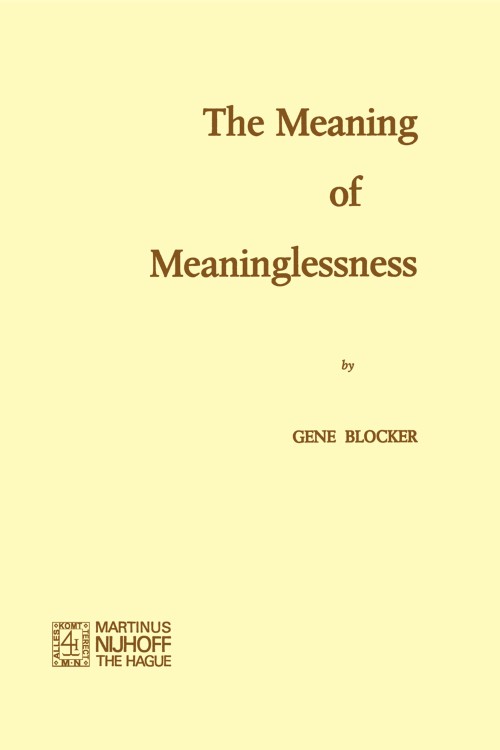
LEADER 03449nam a22004935i 4500
001 808922
003 TR_AnAIT
005 20260131024756
007 cr nn 008mamaa
008 121227s1974 ne | s |||| 0|eng d
020 |a9789401020336|9978-94-010-2033-6
024 7 |a10.1007/978-94-010-2033-6|2doi
041 |aeng
049 |aTürk Tarih Kurumu Kütüphanesi
050 4|aBD143-237
072 7|aHPK|2bicssc
072 7|aPHI004000|2bisacsh
072 7|aQDTK|2thema
082 04|a120|223
090 |aDK/10211
100 1 |aBlocker, G.|eauthor.|4aut|4http://id.loc.gov/vocabulary/relators/aut
245 14|aThe Meaning of Meaninglessness|h[electronic resource] /|cby G. Blocker.
250 |a1st ed. 1974.
264 1|aDordrecht :|bSpringer Netherlands :|bImprint: Springer,|c1974.
300 |aXV, 146 p.|bonline resource.
336 |atext|btxt|2rdacontent
337 |acomputer|bc|2rdamedia
338 |aonline resource|bcr|2rdacarrier
347 |atext file|bPDF|2rda
505 0 |a1. The Diversity of Meaning -- 2. The Unity of Meaning -- 3. Meaning and Meaninglessness -- 4. The Tragic Sense of Meaninglessness -- 5. Back to Square One.
520 |aWhat does "meaningless" mean? On the one hand, it signifies simply the absence or lack of meaning. "Zabool" is meaningless just because it doesn't happen to mean anything. "Green flees time lessly" is meaningless, despite a certain semblance of sense, because it runs afoul of certain fundamental rules of linguistic construction. On the other hand, "meaningless" characterizes that peculiar psycho logical state of dread and anxiety much discussed, if not discovered, by the French shortly after the Second World War. The first is primarily linguistic, focusing attention on emotionally neutral questions of linguistic meaning. The second is nonlinguistic, indicating a painful probing of the social psychology of an era, a clinical and literary analysis of 20th century Romanticism. On the one hand, a job for the professional philosopher; on the other hand, a task for the literary critic and the social historian. Is any useful purpose served in trying to combine these two, very different concerns? As the title of this book suggests, I think there is.
532 8 |aAccessibility summary: This PDF is not accessible. It is based on scanned pages and does not support features such as screen reader compatibility or described non-text content (images, graphs etc). However, it likely supports searchable and selectable text based on OCR (Optical Character Recognition). Users with accessibility needs may not be able to use this content effectively. Please contact us at accessibilitysupport@springernature.com if you require assistance or an alternative format.
532 8 |aInaccessible, or known limited accessibility
532 8 |aNo reading system accessibility options actively disabled
532 8 |aPublisher contact for further accessibility information: accessibilitysupport@springernature.com
650 0|aKnowledge, Theory of.
650 14|aEpistemology.
710 2 |aSpringerLink (Online service)
773 0 |tSpringer Nature eBook
776 08|iPrinted edition:|z9789024715954
776 08|iPrinted edition:|z9789401020343
856 40|uhttps://doi.org/10.1007/978-94-010-2033-6
912 |aZDB-2-SHU
912 |aZDB-2-SXPR
912 |aZDB-2-BAE
950 |aHumanities, Social Sciences and Law (SpringerNature-11648)
950 |aPhilosophy and Religion (R0) (SpringerNature-43725)