

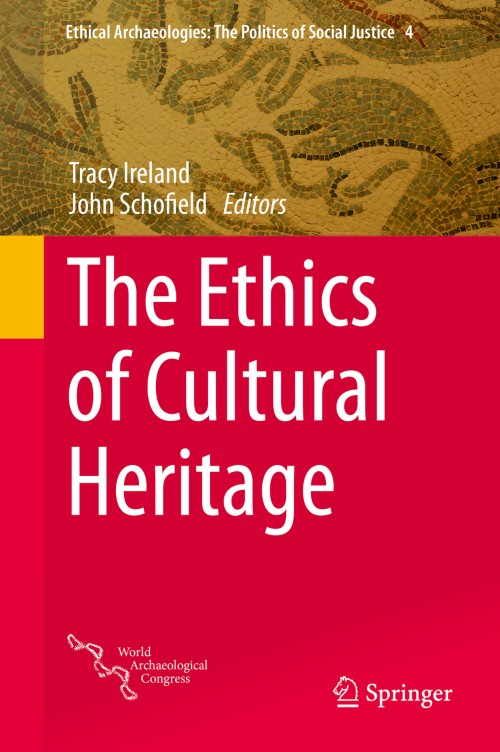
The Ethics of Cultural Heritage [electronic resource] / edited by Tracy Ireland, John Schofield.
Erişim Adresi
ISBN
9781493916498
Dil Kodu
İngilizce
Yer Numarası
DK/10278
Basım Bildirimi
1st ed. 2015.
Yayın Bilgisi
New York, NY : Springer New York : Imprint: Springer, 2015.
Fiziksel Niteleme
XVII, 219 p. 21 illus. in color. online resource.
Dizi
Ethical Archaeologies: The Politics of Social Justice, 2730-6933 ; 4
İçindekiler Notu
Chapter 1: The ethics of cultural heritage -- Section 1: Ethical domains -- Chapter 2: Ethics and digital heritage -- Chapter 3: Ethics and heritage tourism -- Chapter 4: Heritage and community engagement -- Chapter 5: Ethics, conservation and climate change -- Chapter 6: Repatriating human remains: searching for an acceptable ethics -- Chapter 7: The ethics of visibility: archaeology, conservation and memories of settler colonialism -- Chapter 8: The normative foundations of stewardship: care and respect -- Section 2: Ethics in practice -- Chapter 9: Ethics and collecting in the ‘post modern’ museum: a Papua New Guinea example -- Chapter 10: Tourism, World Heritage and local communities: an ethical framework in practice at Angkor -- Chapter 11: A matter of trust: the organisational design of the Museo de la Libertad y la Democracia, Panama -- Chapter 12: Let’s forget about ‘Heritage’: place, ethics and the Faro Convention.
Özet, vb.
It is widely acknowledged that all archaeological research is embedded within cultural, political and economic contexts, and that all archaeological research falls under the heading ‘heritage’. Most archaeologists now work in museums and other cultural institutions, government agencies, non-government organisations and private sector companies, and this diversity ensures that debates continue to proliferate about what constitutes appropriate professional ethics within these related and relevant contexts. Discussions about the ethics of cultural heritage in the 20th century focused on standards of professionalism, stewardship, responsibilities to stakeholders and on establishing public trust in the authenticity of the outcomes of the heritage process. This volume builds on recent approaches that move away from treating ethics as responsibilities to external domains and to the discipline, and which seek to ensure ethics are integral to all heritage theory, practice and methods. The chapters in this collection chart a departure from the tradition of external heritage ethics towards a broader approach underpinned by the turn to human rights, issues of social justice and the political economy of heritage, conceptualising ethical responsibilities not as pertaining to the past, but to a future-focused domain of social action.
Konu
Archaeology.
Ethics.
Cultural property.
Archaeology.
Moral Philosophy and Applied Ethics.
Cultural Heritage.
Ethics.
Cultural property.
Archaeology.
Moral Philosophy and Applied Ethics.
Cultural Heritage.
Diğer Yazarlar
Kurum Adı
Eseri Alıntıla
Referansları kullanmadan önce gözden geçirmeniz ve varsa gerekli düzeltmeleri yapmanız önerilir.
Dijital Kaynak
MARC Görünümü
LEADER 04275nam a22005415i 4500
001 808989
003 TR_AnAIT
005 20260131024530
007 cr nn 008mamaa
008 141101s2015 xxu| s |||| 0|eng d
020 |a9781493916498|9978-1-4939-1649-8
024 7 |a10.1007/978-1-4939-1649-8|2doi
041 |aeng
049 |aTürk Tarih Kurumu Kütüphanesi
050 4|aCC1-960
072 7|aHD|2bicssc
072 7|aSOC003000|2bisacsh
072 7|aNK|2thema
082 04|a930.1|223
090 |aDK/10278
245 14|aThe Ethics of Cultural Heritage|h[electronic resource] /|cedited by Tracy Ireland, John Schofield.
250 |a1st ed. 2015.
264 1|aNew York, NY :|bSpringer New York :|bImprint: Springer,|c2015.
300 |aXVII, 219 p. 21 illus. in color.|bonline resource.
336 |atext|btxt|2rdacontent
337 |acomputer|bc|2rdamedia
338 |aonline resource|bcr|2rdacarrier
347 |atext file|bPDF|2rda
490 1 |aEthical Archaeologies: The Politics of Social Justice,|x2730-6933 ;|v4
505 0 |aChapter 1: The ethics of cultural heritage -- Section 1: Ethical domains -- Chapter 2: Ethics and digital heritage -- Chapter 3: Ethics and heritage tourism -- Chapter 4: Heritage and community engagement -- Chapter 5: Ethics, conservation and climate change -- Chapter 6: Repatriating human remains: searching for an acceptable ethics -- Chapter 7: The ethics of visibility: archaeology, conservation and memories of settler colonialism -- Chapter 8: The normative foundations of stewardship: care and respect -- Section 2: Ethics in practice -- Chapter 9: Ethics and collecting in the ‘post modern’ museum: a Papua New Guinea example -- Chapter 10: Tourism, World Heritage and local communities: an ethical framework in practice at Angkor -- Chapter 11: A matter of trust: the organisational design of the Museo de la Libertad y la Democracia, Panama -- Chapter 12: Let’s forget about ‘Heritage’: place, ethics and the Faro Convention.
520 |aIt is widely acknowledged that all archaeological research is embedded within cultural, political and economic contexts, and that all archaeological research falls under the heading ‘heritage’. Most archaeologists now work in museums and other cultural institutions, government agencies, non-government organisations and private sector companies, and this diversity ensures that debates continue to proliferate about what constitutes appropriate professional ethics within these related and relevant contexts. Discussions about the ethics of cultural heritage in the 20th century focused on standards of professionalism, stewardship, responsibilities to stakeholders and on establishing public trust in the authenticity of the outcomes of the heritage process. This volume builds on recent approaches that move away from treating ethics as responsibilities to external domains and to the discipline, and which seek to ensure ethics are integral to all heritage theory, practice and methods. The chapters in this collection chart a departure from the tradition of external heritage ethics towards a broader approach underpinned by the turn to human rights, issues of social justice and the political economy of heritage, conceptualising ethical responsibilities not as pertaining to the past, but to a future-focused domain of social action.
650 0|aArchaeology.
650 0|aEthics.
650 0|aCultural property.
650 14|aArchaeology.
650 24|aMoral Philosophy and Applied Ethics.
650 24|aCultural Heritage.
700 1 |aIreland, Tracy.|eeditor.|4edt|4http://id.loc.gov/vocabulary/relators/edt
700 1 |aSchofield, John.|eeditor.|4edt|4http://id.loc.gov/vocabulary/relators/edt
710 2 |aSpringerLink (Online service)
773 0 |tSpringer Nature eBook
776 08|iPrinted edition:|z9781493916481
776 08|iPrinted edition:|z9781493916504
776 08|iPrinted edition:|z9781493937622
776 08|iPrinted edition:|z9781493943159
830 0|aEthical Archaeologies: The Politics of Social Justice,|x2730-6933 ;|v4
856 40|uhttps://doi.org/10.1007/978-1-4939-1649-8
912 |aZDB-2-SHU
912 |aZDB-2-SXS
950 |aHumanities, Social Sciences and Law (SpringerNature-11648)
950 |aSocial Sciences (R0) (SpringerNature-43726)
001 808989
003 TR_AnAIT
005 20260131024530
007 cr nn 008mamaa
008 141101s2015 xxu| s |||| 0|eng d
020 |a9781493916498|9978-1-4939-1649-8
024 7 |a10.1007/978-1-4939-1649-8|2doi
041 |aeng
049 |aTürk Tarih Kurumu Kütüphanesi
050 4|aCC1-960
072 7|aHD|2bicssc
072 7|aSOC003000|2bisacsh
072 7|aNK|2thema
082 04|a930.1|223
090 |aDK/10278
245 14|aThe Ethics of Cultural Heritage|h[electronic resource] /|cedited by Tracy Ireland, John Schofield.
250 |a1st ed. 2015.
264 1|aNew York, NY :|bSpringer New York :|bImprint: Springer,|c2015.
300 |aXVII, 219 p. 21 illus. in color.|bonline resource.
336 |atext|btxt|2rdacontent
337 |acomputer|bc|2rdamedia
338 |aonline resource|bcr|2rdacarrier
347 |atext file|bPDF|2rda
490 1 |aEthical Archaeologies: The Politics of Social Justice,|x2730-6933 ;|v4
505 0 |aChapter 1: The ethics of cultural heritage -- Section 1: Ethical domains -- Chapter 2: Ethics and digital heritage -- Chapter 3: Ethics and heritage tourism -- Chapter 4: Heritage and community engagement -- Chapter 5: Ethics, conservation and climate change -- Chapter 6: Repatriating human remains: searching for an acceptable ethics -- Chapter 7: The ethics of visibility: archaeology, conservation and memories of settler colonialism -- Chapter 8: The normative foundations of stewardship: care and respect -- Section 2: Ethics in practice -- Chapter 9: Ethics and collecting in the ‘post modern’ museum: a Papua New Guinea example -- Chapter 10: Tourism, World Heritage and local communities: an ethical framework in practice at Angkor -- Chapter 11: A matter of trust: the organisational design of the Museo de la Libertad y la Democracia, Panama -- Chapter 12: Let’s forget about ‘Heritage’: place, ethics and the Faro Convention.
520 |aIt is widely acknowledged that all archaeological research is embedded within cultural, political and economic contexts, and that all archaeological research falls under the heading ‘heritage’. Most archaeologists now work in museums and other cultural institutions, government agencies, non-government organisations and private sector companies, and this diversity ensures that debates continue to proliferate about what constitutes appropriate professional ethics within these related and relevant contexts. Discussions about the ethics of cultural heritage in the 20th century focused on standards of professionalism, stewardship, responsibilities to stakeholders and on establishing public trust in the authenticity of the outcomes of the heritage process. This volume builds on recent approaches that move away from treating ethics as responsibilities to external domains and to the discipline, and which seek to ensure ethics are integral to all heritage theory, practice and methods. The chapters in this collection chart a departure from the tradition of external heritage ethics towards a broader approach underpinned by the turn to human rights, issues of social justice and the political economy of heritage, conceptualising ethical responsibilities not as pertaining to the past, but to a future-focused domain of social action.
650 0|aArchaeology.
650 0|aEthics.
650 0|aCultural property.
650 14|aArchaeology.
650 24|aMoral Philosophy and Applied Ethics.
650 24|aCultural Heritage.
700 1 |aIreland, Tracy.|eeditor.|4edt|4http://id.loc.gov/vocabulary/relators/edt
700 1 |aSchofield, John.|eeditor.|4edt|4http://id.loc.gov/vocabulary/relators/edt
710 2 |aSpringerLink (Online service)
773 0 |tSpringer Nature eBook
776 08|iPrinted edition:|z9781493916481
776 08|iPrinted edition:|z9781493916504
776 08|iPrinted edition:|z9781493937622
776 08|iPrinted edition:|z9781493943159
830 0|aEthical Archaeologies: The Politics of Social Justice,|x2730-6933 ;|v4
856 40|uhttps://doi.org/10.1007/978-1-4939-1649-8
912 |aZDB-2-SHU
912 |aZDB-2-SXS
950 |aHumanities, Social Sciences and Law (SpringerNature-11648)
950 |aSocial Sciences (R0) (SpringerNature-43726)
Materyaller
Depodan talep edilen materyal sadece kütüphane içerisinde kullanılmaktadır.
Materyal dışarıya ödünç verilmemektedir.
Materyal dışarıya ödünç verilmemektedir.
