

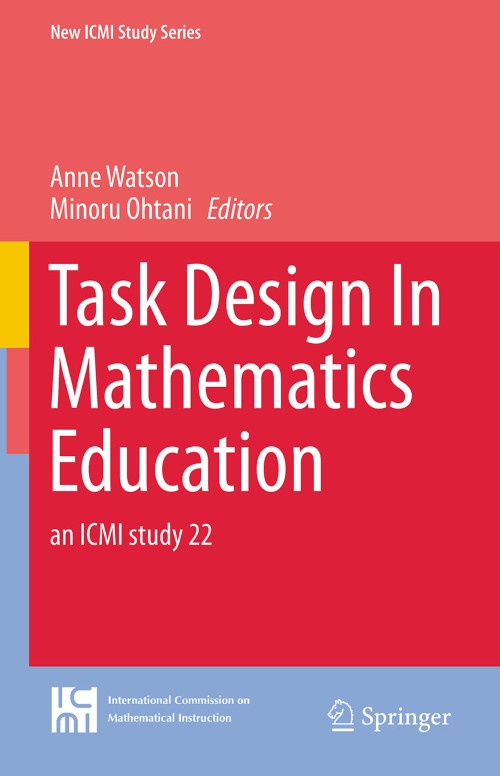
Task Design In Mathematics Education [electronic resource] : an ICMI study 22 / edited by Anne Watson, Minoru Ohtani.
Erişim Adresi
ISBN
9783319096292
Dil Kodu
İngilizce
Yer Numarası
DK/10292
Basım Bildirimi
1st ed. 2015.
Yayın Bilgisi
Cham : Springer International Publishing : Imprint: Springer, 2015.
Fiziksel Niteleme
XVIII, 339 p. 123 illus., 39 illus. in color. online resource.
Dizi
New ICMI Study Series, 2215-1745
İçindekiler Notu
Part 1 Chapter 1: Frameworks and principles for task design -- Chapter 2: Features of task design informing teachers’ decisions about goals and pedagogies -- Chapter 3: Accounting for student perspectives in task design -- Chapter 4: Design and use of textbased tasks. Chapter 5: The Role of Tools and Representations in Designing Mathematics -- Chapter 5: The Role of Tools and Representations in Designing Mathematics -- Part 2 Chapter 6: E-Textbooks for Mathematical Guided Inquiry: Design of Tasks and Task Sequences -- Chapter 7: Didactic engineering as a research methodology: from fundamental situations to study and research paths -- Chapter 8: The Critical Role of Task Design in Lesson Study -- Chapter 9: Possible presentation by Jan de Lange, Freudenthal Institute -- Part 3 Commentaries : Chapter 10: Commentary on chapters 1, 2 and 3 -- Chapter 11: Commentary on chapters 1, 4, and 5.
Özet, vb.
This book is the product of ICMI Study 22 Task Design in Mathematics Education. The study offers a state-of-the-art summary of relevant research and goes beyond that to develop new insights and new areas of knowledge and study about task design. The authors represent a wide range of countries and cultures and are leading researchers, teachers and designers. In particular, the authors develop explicit understandings of the opportunities and difficulties involved in designing and implementing tasks and of the interfaces between the teaching, researching and designing roles – recognising that these might be undertaken by the same person or by completely separate teams. Tasks generate the activity through which learners meet mathematical concepts, ideas, strategies and learn to use and develop mathematical thinking and modes of enquiry. Teaching includes the selection, modification, design, sequencing, installation, observation and evaluation of tasks. The book illustrates how task designis core to effective teaching, whether the task is a complex, extended, investigation or a small part of a lesson; whether it is part of a curriculum system, such as a textbook, or promotes free standing activity; whether the task comes from published source or is devised by the teacher or the student.
Konu
Mathematics __ Study and teaching .
Learning, Psychology of.
Mathematics Education.
Instructional Psychology.
Learning, Psychology of.
Mathematics Education.
Instructional Psychology.
Diğer Yazarlar
Kurum Adı
Eseri Alıntıla
Referansları kullanmadan önce gözden geçirmeniz ve varsa gerekli düzeltmeleri yapmanız önerilir.
Dijital Kaynak
MARC Görünümü
LEADER 04182nam a22005535i 4500
001 809003
003 TR_AnAIT
005 20260131024501
007 cr nn 008mamaa
008 151026s2015 sz | s |||| 0|eng d
020 |a9783319096292|9978-3-319-09629-2
024 7 |a10.1007/978-3-319-09629-2|2doi
041 |aeng
049 |aTürk Tarih Kurumu Kütüphanesi
050 4|aQA10.92-20
072 7|aJNU|2bicssc
072 7|aPB|2bicssc
072 7|aEDU029010|2bisacsh
072 7|aJNU|2thema
072 7|aPB|2thema
082 04|a510.71|223
090 |aDK/10292
245 10|aTask Design In Mathematics Education|h[electronic resource] :|ban ICMI study 22 /|cedited by Anne Watson, Minoru Ohtani.
250 |a1st ed. 2015.
264 1|aCham :|bSpringer International Publishing :|bImprint: Springer,|c2015.
300 |aXVIII, 339 p. 123 illus., 39 illus. in color.|bonline resource.
336 |atext|btxt|2rdacontent
337 |acomputer|bc|2rdamedia
338 |aonline resource|bcr|2rdacarrier
347 |atext file|bPDF|2rda
490 1 |aNew ICMI Study Series,|x2215-1745
505 0 |aPart 1 Chapter 1: Frameworks and principles for task design -- Chapter 2: Features of task design informing teachers’ decisions about goals and pedagogies -- Chapter 3: Accounting for student perspectives in task design -- Chapter 4: Design and use of textbased tasks. Chapter 5: The Role of Tools and Representations in Designing Mathematics -- Chapter 5: The Role of Tools and Representations in Designing Mathematics -- Part 2 Chapter 6: E-Textbooks for Mathematical Guided Inquiry: Design of Tasks and Task Sequences -- Chapter 7: Didactic engineering as a research methodology: from fundamental situations to study and research paths -- Chapter 8: The Critical Role of Task Design in Lesson Study -- Chapter 9: Possible presentation by Jan de Lange, Freudenthal Institute -- Part 3 Commentaries : Chapter 10: Commentary on chapters 1, 2 and 3 -- Chapter 11: Commentary on chapters 1, 4, and 5.
506 0 |aOpen Access
520 |aThis book is the product of ICMI Study 22 Task Design in Mathematics Education. The study offers a state-of-the-art summary of relevant research and goes beyond that to develop new insights and new areas of knowledge and study about task design. The authors represent a wide range of countries and cultures and are leading researchers, teachers and designers. In particular, the authors develop explicit understandings of the opportunities and difficulties involved in designing and implementing tasks and of the interfaces between the teaching, researching and designing roles – recognising that these might be undertaken by the same person or by completely separate teams. Tasks generate the activity through which learners meet mathematical concepts, ideas, strategies and learn to use and develop mathematical thinking and modes of enquiry. Teaching includes the selection, modification, design, sequencing, installation, observation and evaluation of tasks. The book illustrates how task designis core to effective teaching, whether the task is a complex, extended, investigation or a small part of a lesson; whether it is part of a curriculum system, such as a textbook, or promotes free standing activity; whether the task comes from published source or is devised by the teacher or the student.
650 0|aMathematics|xStudy and teaching .
650 0|aLearning, Psychology of.
650 14|aMathematics Education.
650 24|aInstructional Psychology.
700 1 |aWatson, Anne.|eeditor.|4edt|4http://id.loc.gov/vocabulary/relators/edt
700 1 |aOhtani, Minoru.|eeditor.|4edt|4http://id.loc.gov/vocabulary/relators/edt
710 2 |aSpringerLink (Online service)
773 0 |tSpringer Nature eBook
776 08|iPrinted edition:|z9783319096285
776 08|iPrinted edition:|z9783319096308
776 08|iPrinted edition:|z9783319363905
830 0|aNew ICMI Study Series,|x2215-1745
856 40|uhttps://doi.org/10.1007/978-3-319-09629-2
912 |aZDB-2-SHU
912 |aZDB-2-SXED
912 |aZDB-2-SOB
950 |aHumanities, Social Sciences and Law (SpringerNature-11648)
950 |aEducation (R0) (SpringerNature-43721)
Materyaller
Depodan talep edilen materyal sadece kütüphane içerisinde kullanılmaktadır.
Materyal dışarıya ödünç verilmemektedir.
Materyal dışarıya ödünç verilmemektedir.
