

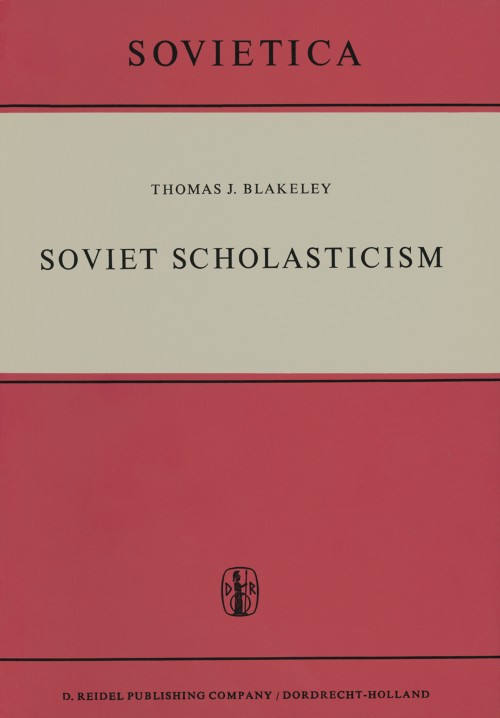
Soviet Scholasticism [electronic resource] / by J.E. Blakeley.
Erişim Adresi
ISBN
9789401036702
Dil Kodu
İngilizce
Yer Numarası
DK/10297
Yazar
Basım Bildirimi
1st ed. 1961.
Yayın Bilgisi
Dordrecht : Springer Netherlands : Imprint: Springer, 1961.
Fiziksel Niteleme
189 p. online resource.
Dizi
Sovietica ; 6
İçindekiler Notu
I Doctrine -- 1 The “Method” -- 2 The “Dialectical” -- 3 The “Marxist” -- 4 Survey -- II: Procedures: Dogmatism and Verification -- 5 The “Classics”: Theory -- 6 The “Classics”: Practice -- 7 “Verification” -- III: Assumptions -- 8 Structure and Elements of Soviet Philosophic Procedure -- 9 The Work of the “Classics” -- 10 Meta-Dogmata: Generalities -- 11 Meta-Dogmata: The “Proletarian Redemption” -- 12 Meta-Dogmata: The “Communist Destiny” -- 13 The Party as Philosophic Authority -- 14 The Exclusion of Negative Cases -- IV: Soviet Scholasticism -- Appendix of Quotations -- General Bibliography -- Classified Bibliography -- Index of Names -- Index of Subjects.
Özet, vb.
The present work is a study of the method of contemporary Soviet philosophy. By "Soviet philosophy" we mean philosophy as published in the Soviet Union. For practical purposes we have limited our attention to Soviet sources in Russian in spite of the fact that Soviet philosophical works are also published in other languages (see B 2029(21)(38». The term "method" is taken in the sense usual in Western books on methodology .1 In view of the content of the first chapter it will be useful to explain the last term a little more fully. By method we mean a procedure and it is obvious that the principles according to which a procedure is carried out are rules, i.e. imperatives, which tell us not what is but what should be done. Such imperatives mayor may not be connected with and founded on certain descriptive statements (the fact that every rule of formal logic is based on a corresponding law has been well-known since Husserl's "Logische Unter suchungen" and is generally accepted in contemporary logic), but such a foundation is irrelevant to a methodological study. The object of such a study is to find out what these rules are, why they are accepted and how they are inter-connected and applied. This is how methodology - the science of method - is conceived in Western treatises on the subject and this is also the standpoint assumed here.
Konu
Ethnology.
Culture.
Regional Cultural Studies.
Culture.
Regional Cultural Studies.
Kurum Adı
Eseri Alıntıla
Referansları kullanmadan önce gözden geçirmeniz ve varsa gerekli düzeltmeleri yapmanız önerilir.
Dijital Kaynak
MARC Görünümü
LEADER 04437nam a22005415i 4500
001 809008
003 TR_AnAIT
005 20260131024432
007 cr nn 008mamaa
008 121227s1961 ne | s |||| 0|eng d
020 |a9789401036702|9978-94-010-3670-2
024 7 |a10.1007/978-94-010-3670-2|2doi
041 |aeng
049 |aTürk Tarih Kurumu Kütüphanesi
050 4|aGN550-674
072 7|aJFC|2bicssc
072 7|aSOC053000|2bisacsh
072 7|aJBCC|2thema
082 04|a306.091|223
090 |aDK/10297
100 1 |aBlakeley, J.E.|eauthor.|4aut|4http://id.loc.gov/vocabulary/relators/aut
245 10|aSoviet Scholasticism|h[electronic resource] /|cby J.E. Blakeley.
250 |a1st ed. 1961.
264 1|aDordrecht :|bSpringer Netherlands :|bImprint: Springer,|c1961.
300 |a189 p.|bonline resource.
336 |atext|btxt|2rdacontent
337 |acomputer|bc|2rdamedia
338 |aonline resource|bcr|2rdacarrier
347 |atext file|bPDF|2rda
490 1 |aSovietica ;|v6
505 0 |aI Doctrine -- 1 The “Method” -- 2 The “Dialectical” -- 3 The “Marxist” -- 4 Survey -- II: Procedures: Dogmatism and Verification -- 5 The “Classics”: Theory -- 6 The “Classics”: Practice -- 7 “Verification” -- III: Assumptions -- 8 Structure and Elements of Soviet Philosophic Procedure -- 9 The Work of the “Classics” -- 10 Meta-Dogmata: Generalities -- 11 Meta-Dogmata: The “Proletarian Redemption” -- 12 Meta-Dogmata: The “Communist Destiny” -- 13 The Party as Philosophic Authority -- 14 The Exclusion of Negative Cases -- IV: Soviet Scholasticism -- Appendix of Quotations -- General Bibliography -- Classified Bibliography -- Index of Names -- Index of Subjects.
520 |aThe present work is a study of the method of contemporary Soviet philosophy. By "Soviet philosophy" we mean philosophy as published in the Soviet Union. For practical purposes we have limited our attention to Soviet sources in Russian in spite of the fact that Soviet philosophical works are also published in other languages (see B 2029(21)(38». The term "method" is taken in the sense usual in Western books on methodology .1 In view of the content of the first chapter it will be useful to explain the last term a little more fully. By method we mean a procedure and it is obvious that the principles according to which a procedure is carried out are rules, i.e. imperatives, which tell us not what is but what should be done. Such imperatives mayor may not be connected with and founded on certain descriptive statements (the fact that every rule of formal logic is based on a corresponding law has been well-known since Husserl's "Logische Unter suchungen" and is generally accepted in contemporary logic), but such a foundation is irrelevant to a methodological study. The object of such a study is to find out what these rules are, why they are accepted and how they are inter-connected and applied. This is how methodology - the science of method - is conceived in Western treatises on the subject and this is also the standpoint assumed here.
532 8 |aAccessibility summary: This PDF is not accessible. It is based on scanned pages and does not support features such as screen reader compatibility or described non-text content (images, graphs etc). However, it likely supports searchable and selectable text based on OCR (Optical Character Recognition). Users with accessibility needs may not be able to use this content effectively. Please contact us at accessibilitysupport@springernature.com if you require assistance or an alternative format.
532 8 |aInaccessible, or known limited accessibility
532 8 |aNo reading system accessibility options actively disabled
532 8 |aPublisher contact for further accessibility information: accessibilitysupport@springernature.com
650 0|aEthnology.
650 0|aCulture.
650 14|aRegional Cultural Studies.
710 2 |aSpringerLink (Online service)
773 0 |tSpringer Nature eBook
776 08|iPrinted edition:|z9789027700391
776 08|iPrinted edition:|z9789401036719
776 08|iPrinted edition:|z9789401036726
830 0|aSovietica ;|v6
856 40|uhttps://doi.org/10.1007/978-94-010-3670-2
912 |aZDB-2-SHU
912 |aZDB-2-SXL
912 |aZDB-2-BAE
950 |aHumanities, Social Sciences and Law (SpringerNature-11648)
950 |aLiterature, Cultural and Media Studies (R0) (SpringerNature-43723)
001 809008
003 TR_AnAIT
005 20260131024432
007 cr nn 008mamaa
008 121227s1961 ne | s |||| 0|eng d
020 |a9789401036702|9978-94-010-3670-2
024 7 |a10.1007/978-94-010-3670-2|2doi
041 |aeng
049 |aTürk Tarih Kurumu Kütüphanesi
050 4|aGN550-674
072 7|aJFC|2bicssc
072 7|aSOC053000|2bisacsh
072 7|aJBCC|2thema
082 04|a306.091|223
090 |aDK/10297
100 1 |aBlakeley, J.E.|eauthor.|4aut|4http://id.loc.gov/vocabulary/relators/aut
245 10|aSoviet Scholasticism|h[electronic resource] /|cby J.E. Blakeley.
250 |a1st ed. 1961.
264 1|aDordrecht :|bSpringer Netherlands :|bImprint: Springer,|c1961.
300 |a189 p.|bonline resource.
336 |atext|btxt|2rdacontent
337 |acomputer|bc|2rdamedia
338 |aonline resource|bcr|2rdacarrier
347 |atext file|bPDF|2rda
490 1 |aSovietica ;|v6
505 0 |aI Doctrine -- 1 The “Method” -- 2 The “Dialectical” -- 3 The “Marxist” -- 4 Survey -- II: Procedures: Dogmatism and Verification -- 5 The “Classics”: Theory -- 6 The “Classics”: Practice -- 7 “Verification” -- III: Assumptions -- 8 Structure and Elements of Soviet Philosophic Procedure -- 9 The Work of the “Classics” -- 10 Meta-Dogmata: Generalities -- 11 Meta-Dogmata: The “Proletarian Redemption” -- 12 Meta-Dogmata: The “Communist Destiny” -- 13 The Party as Philosophic Authority -- 14 The Exclusion of Negative Cases -- IV: Soviet Scholasticism -- Appendix of Quotations -- General Bibliography -- Classified Bibliography -- Index of Names -- Index of Subjects.
520 |aThe present work is a study of the method of contemporary Soviet philosophy. By "Soviet philosophy" we mean philosophy as published in the Soviet Union. For practical purposes we have limited our attention to Soviet sources in Russian in spite of the fact that Soviet philosophical works are also published in other languages (see B 2029(21)(38». The term "method" is taken in the sense usual in Western books on methodology .1 In view of the content of the first chapter it will be useful to explain the last term a little more fully. By method we mean a procedure and it is obvious that the principles according to which a procedure is carried out are rules, i.e. imperatives, which tell us not what is but what should be done. Such imperatives mayor may not be connected with and founded on certain descriptive statements (the fact that every rule of formal logic is based on a corresponding law has been well-known since Husserl's "Logische Unter suchungen" and is generally accepted in contemporary logic), but such a foundation is irrelevant to a methodological study. The object of such a study is to find out what these rules are, why they are accepted and how they are inter-connected and applied. This is how methodology - the science of method - is conceived in Western treatises on the subject and this is also the standpoint assumed here.
532 8 |aAccessibility summary: This PDF is not accessible. It is based on scanned pages and does not support features such as screen reader compatibility or described non-text content (images, graphs etc). However, it likely supports searchable and selectable text based on OCR (Optical Character Recognition). Users with accessibility needs may not be able to use this content effectively. Please contact us at accessibilitysupport@springernature.com if you require assistance or an alternative format.
532 8 |aInaccessible, or known limited accessibility
532 8 |aNo reading system accessibility options actively disabled
532 8 |aPublisher contact for further accessibility information: accessibilitysupport@springernature.com
650 0|aEthnology.
650 0|aCulture.
650 14|aRegional Cultural Studies.
710 2 |aSpringerLink (Online service)
773 0 |tSpringer Nature eBook
776 08|iPrinted edition:|z9789027700391
776 08|iPrinted edition:|z9789401036719
776 08|iPrinted edition:|z9789401036726
830 0|aSovietica ;|v6
856 40|uhttps://doi.org/10.1007/978-94-010-3670-2
912 |aZDB-2-SHU
912 |aZDB-2-SXL
912 |aZDB-2-BAE
950 |aHumanities, Social Sciences and Law (SpringerNature-11648)
950 |aLiterature, Cultural and Media Studies (R0) (SpringerNature-43723)
Materyaller
Depodan talep edilen materyal sadece kütüphane içerisinde kullanılmaktadır.
Materyal dışarıya ödünç verilmemektedir.
Materyal dışarıya ödünç verilmemektedir.
