

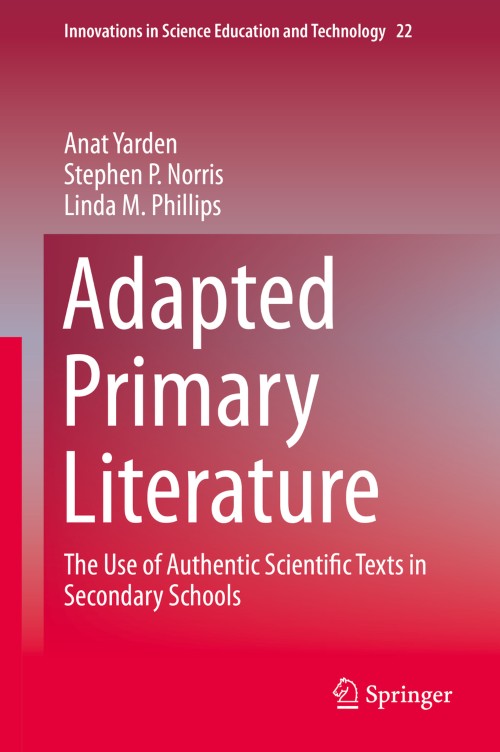
Adapted Primary Literature [electronic resource] : The Use of Authentic Scientific Texts in Secondary Schools / by Anat Yarden, Stephen P. Norris, Linda M. Phillips.
Erişim Adresi
ISBN
9789401797597
Dil Kodu
İngilizce
Yer Numarası
DK/10328
Yazar
Basım Bildirimi
1st ed. 2015.
Yayın Bilgisi
Dordrecht : Springer Netherlands : Imprint: Springer, 2015.
Fiziksel Niteleme
XIV, 242 p. 32 illus. online resource.
Dizi
Innovations in Science Education and Technology, 2213-2236 ; 22
İçindekiler Notu
Prologue: The Origins of the First Adapted Primary Literature (APL) -- PART I: The Theory of Adapted Primary Literature -- Chapter 1: Adapting Primary Literature for Promoting Scientific Literacy -- Chapter 2: Foundations for Conceptualizing APL.- Chapter 3: APL and Reading in Science Classrooms -- PART II: The Practice of Adapted Primary Literature.- Chapter 4: Creating and Using APL -- Chapter 5: Teaching Scientific Reading -- Chapter 6: Applications of Adapted Primary Literature -- PART III: A Compendium of Adapted Primary Literature Annotated for Critical Reading.- Chapter 7: Developing an Inhibitor of Anthrax Toxin (Annotated for Epistemology) -- Chapter 8: An Epidemiological Model for West Nile Virus: Invasion Analysis and Control Applications (Annotated for Structure) -- Chapter 9: The Coronal Heating Problem (Annotated for Epistemology and Meta-scientific Language) -- Chapter 10: Did Early Maritime Archaic Indians Ever Live in Newfoundland? (Annotated for Epistemology) -- Epilogue: The Basis of and Possibilities for Adapted Primary Literature.
Özet, vb.
This book specifies the foundation for Adapted Primary Literature (APL), a novel text genre that enables the learning and teaching of science using research articles that were adapted to the knowledge level of high-school students. More than 50 years ago, J.J. Schwab suggested that Primary Scientific Articles “afford the most authentic, unretouched specimens of enquiry that we can obtain” and raised for the first time the idea that such articles can be used for “enquiry into enquiry”. This book, the first to be published on this topic, presents the realization of this vision and shows how the reading and writing of scientific articles can be used for inquiry learning and teaching. It provides the origins and theory of APL and examines the concept and its importance. It outlines a detailed description of creating and using APL, and provides examples for the use of the enactment of APL in classes, as well as descriptions of possible future prospects for the implementation of APL. Altogether, the book lays the foundations for the use of this authentic text genre for the learning and teaching of science in secondary schools.
Konu
Science __ Study and teaching.
Literacy.
Learning, Psychology of.
Science Education.
Literacy.
Instructional Psychology.
Literacy.
Learning, Psychology of.
Science Education.
Literacy.
Instructional Psychology.
Diğer Yazarlar
Kurum Adı
Eseri Alıntıla
Referansları kullanmadan önce gözden geçirmeniz ve varsa gerekli düzeltmeleri yapmanız önerilir.
Dijital Kaynak
MARC Görünümü
LEADER 04357nam a22005655i 4500
001 809039
003 TR_AnAIT
005 20260131024322
007 cr nn 008mamaa
008 150316s2015 ne | s |||| 0|eng d
020 |a9789401797597|9978-94-017-9759-7
024 7 |a10.1007/978-94-017-9759-7|2doi
041 |aeng
049 |aTürk Tarih Kurumu Kütüphanesi
050 4|aQ181-183.4
072 7|aJNU|2bicssc
072 7|aPD|2bicssc
072 7|aSCI063000|2bisacsh
072 7|aJNU|2thema
072 7|aPD|2thema
082 04|a507.1|223
090 |aDK/10328
100 1 |aYarden, Anat.|eauthor.|4aut|4http://id.loc.gov/vocabulary/relators/aut
245 10|aAdapted Primary Literature|h[electronic resource] :|bThe Use of Authentic Scientific Texts in Secondary Schools /|cby Anat Yarden, Stephen P. Norris, Linda M. Phillips.
250 |a1st ed. 2015.
264 1|aDordrecht :|bSpringer Netherlands :|bImprint: Springer,|c2015.
300 |aXIV, 242 p. 32 illus.|bonline resource.
336 |atext|btxt|2rdacontent
337 |acomputer|bc|2rdamedia
338 |aonline resource|bcr|2rdacarrier
347 |atext file|bPDF|2rda
490 1 |aInnovations in Science Education and Technology,|x2213-2236 ;|v22
505 0 |aPrologue: The Origins of the First Adapted Primary Literature (APL) -- PART I: The Theory of Adapted Primary Literature -- Chapter 1: Adapting Primary Literature for Promoting Scientific Literacy -- Chapter 2: Foundations for Conceptualizing APL.- Chapter 3: APL and Reading in Science Classrooms -- PART II: The Practice of Adapted Primary Literature.- Chapter 4: Creating and Using APL -- Chapter 5: Teaching Scientific Reading -- Chapter 6: Applications of Adapted Primary Literature -- PART III: A Compendium of Adapted Primary Literature Annotated for Critical Reading.- Chapter 7: Developing an Inhibitor of Anthrax Toxin (Annotated for Epistemology) -- Chapter 8: An Epidemiological Model for West Nile Virus: Invasion Analysis and Control Applications (Annotated for Structure) -- Chapter 9: The Coronal Heating Problem (Annotated for Epistemology and Meta-scientific Language) -- Chapter 10: Did Early Maritime Archaic Indians Ever Live in Newfoundland? (Annotated for Epistemology) -- Epilogue: The Basis of and Possibilities for Adapted Primary Literature.
520 |aThis book specifies the foundation for Adapted Primary Literature (APL), a novel text genre that enables the learning and teaching of science using research articles that were adapted to the knowledge level of high-school students. More than 50 years ago, J.J. Schwab suggested that Primary Scientific Articles “afford the most authentic, unretouched specimens of enquiry that we can obtain” and raised for the first time the idea that such articles can be used for “enquiry into enquiry”. This book, the first to be published on this topic, presents the realization of this vision and shows how the reading and writing of scientific articles can be used for inquiry learning and teaching. It provides the origins and theory of APL and examines the concept and its importance. It outlines a detailed description of creating and using APL, and provides examples for the use of the enactment of APL in classes, as well as descriptions of possible future prospects for the implementation of APL. Altogether, the book lays the foundations for the use of this authentic text genre for the learning and teaching of science in secondary schools.
650 0|aScience|xStudy and teaching.
650 0|aLiteracy.
650 0|aLearning, Psychology of.
650 14|aScience Education.
650 24|aLiteracy.
650 24|aInstructional Psychology.
700 1 |aNorris, Stephen P.|eauthor.|4aut|4http://id.loc.gov/vocabulary/relators/aut
700 1 |aPhillips, Linda M.|eauthor.|4aut|4http://id.loc.gov/vocabulary/relators/aut
710 2 |aSpringerLink (Online service)
773 0 |tSpringer Nature eBook
776 08|iPrinted edition:|z9789401797580
776 08|iPrinted edition:|z9789401797603
776 08|iPrinted edition:|z9789401778268
830 0|aInnovations in Science Education and Technology,|x2213-2236 ;|v22
856 40|uhttps://doi.org/10.1007/978-94-017-9759-7
912 |aZDB-2-SHU
912 |aZDB-2-SXED
950 |aHumanities, Social Sciences and Law (SpringerNature-11648)
950 |aEducation (R0) (SpringerNature-43721)
001 809039
003 TR_AnAIT
005 20260131024322
007 cr nn 008mamaa
008 150316s2015 ne | s |||| 0|eng d
020 |a9789401797597|9978-94-017-9759-7
024 7 |a10.1007/978-94-017-9759-7|2doi
041 |aeng
049 |aTürk Tarih Kurumu Kütüphanesi
050 4|aQ181-183.4
072 7|aJNU|2bicssc
072 7|aPD|2bicssc
072 7|aSCI063000|2bisacsh
072 7|aJNU|2thema
072 7|aPD|2thema
082 04|a507.1|223
090 |aDK/10328
100 1 |aYarden, Anat.|eauthor.|4aut|4http://id.loc.gov/vocabulary/relators/aut
245 10|aAdapted Primary Literature|h[electronic resource] :|bThe Use of Authentic Scientific Texts in Secondary Schools /|cby Anat Yarden, Stephen P. Norris, Linda M. Phillips.
250 |a1st ed. 2015.
264 1|aDordrecht :|bSpringer Netherlands :|bImprint: Springer,|c2015.
300 |aXIV, 242 p. 32 illus.|bonline resource.
336 |atext|btxt|2rdacontent
337 |acomputer|bc|2rdamedia
338 |aonline resource|bcr|2rdacarrier
347 |atext file|bPDF|2rda
490 1 |aInnovations in Science Education and Technology,|x2213-2236 ;|v22
505 0 |aPrologue: The Origins of the First Adapted Primary Literature (APL) -- PART I: The Theory of Adapted Primary Literature -- Chapter 1: Adapting Primary Literature for Promoting Scientific Literacy -- Chapter 2: Foundations for Conceptualizing APL.- Chapter 3: APL and Reading in Science Classrooms -- PART II: The Practice of Adapted Primary Literature.- Chapter 4: Creating and Using APL -- Chapter 5: Teaching Scientific Reading -- Chapter 6: Applications of Adapted Primary Literature -- PART III: A Compendium of Adapted Primary Literature Annotated for Critical Reading.- Chapter 7: Developing an Inhibitor of Anthrax Toxin (Annotated for Epistemology) -- Chapter 8: An Epidemiological Model for West Nile Virus: Invasion Analysis and Control Applications (Annotated for Structure) -- Chapter 9: The Coronal Heating Problem (Annotated for Epistemology and Meta-scientific Language) -- Chapter 10: Did Early Maritime Archaic Indians Ever Live in Newfoundland? (Annotated for Epistemology) -- Epilogue: The Basis of and Possibilities for Adapted Primary Literature.
520 |aThis book specifies the foundation for Adapted Primary Literature (APL), a novel text genre that enables the learning and teaching of science using research articles that were adapted to the knowledge level of high-school students. More than 50 years ago, J.J. Schwab suggested that Primary Scientific Articles “afford the most authentic, unretouched specimens of enquiry that we can obtain” and raised for the first time the idea that such articles can be used for “enquiry into enquiry”. This book, the first to be published on this topic, presents the realization of this vision and shows how the reading and writing of scientific articles can be used for inquiry learning and teaching. It provides the origins and theory of APL and examines the concept and its importance. It outlines a detailed description of creating and using APL, and provides examples for the use of the enactment of APL in classes, as well as descriptions of possible future prospects for the implementation of APL. Altogether, the book lays the foundations for the use of this authentic text genre for the learning and teaching of science in secondary schools.
650 0|aScience|xStudy and teaching.
650 0|aLiteracy.
650 0|aLearning, Psychology of.
650 14|aScience Education.
650 24|aLiteracy.
650 24|aInstructional Psychology.
700 1 |aNorris, Stephen P.|eauthor.|4aut|4http://id.loc.gov/vocabulary/relators/aut
700 1 |aPhillips, Linda M.|eauthor.|4aut|4http://id.loc.gov/vocabulary/relators/aut
710 2 |aSpringerLink (Online service)
773 0 |tSpringer Nature eBook
776 08|iPrinted edition:|z9789401797580
776 08|iPrinted edition:|z9789401797603
776 08|iPrinted edition:|z9789401778268
830 0|aInnovations in Science Education and Technology,|x2213-2236 ;|v22
856 40|uhttps://doi.org/10.1007/978-94-017-9759-7
912 |aZDB-2-SHU
912 |aZDB-2-SXED
950 |aHumanities, Social Sciences and Law (SpringerNature-11648)
950 |aEducation (R0) (SpringerNature-43721)
Materyaller
Depodan talep edilen materyal sadece kütüphane içerisinde kullanılmaktadır.
Materyal dışarıya ödünç verilmemektedir.
Materyal dışarıya ödünç verilmemektedir.
