

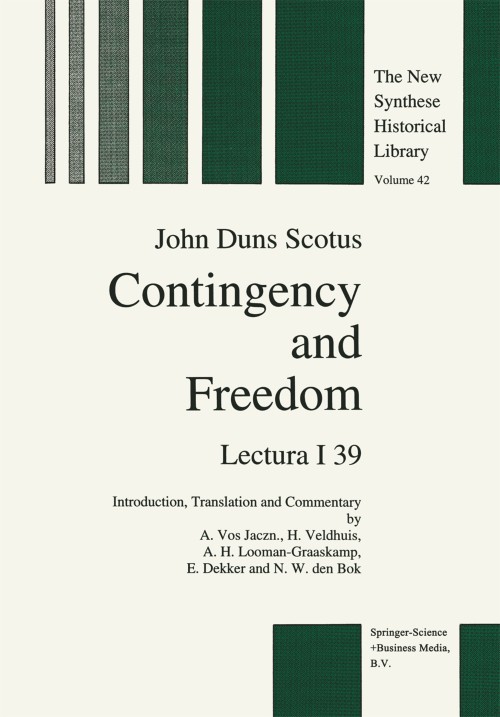
Contingency and Freedom [electronic resource] : Lectura I 39 / edited by Anthonie Vos Jaczn., Henri Veldhuis, Aline H. Looman-Graaskamp, E. Dekker, Nico W. den Bok.
Erişim Adresi
ISBN
9789401582759
Dil Kodu
İngilizce
Yer Numarası
DK/10332
Basım Bildirimi
1st ed. 1994.
Yayın Bilgisi
Dordrecht : Springer Netherlands : Imprint: Springer, 1994.
Fiziksel Niteleme
VII, 208 p. 1 illus. online resource.
Dizi
The New Synthese Historical Library, Texts and Studies in the History of Philosophy, 2352-2585 ; 42
İçindekiler Notu
1 Lectura I 39 of John Duns Scotus: a key-text -- 2 John Duns Scotus’ development -- 3 The Lectura, a course on the Sentences in Oxford -- 4 The structure of Lectura I 39 -- 5 The target of Lectura I 39 -- 6 Scotus’ theory of contingency -- 7 The theory of synchronic contingency as a key to the Lectura -- 8 The logical tools used -- 9 On the translation -- Index of names -- Index of subjects.
Özet, vb.
During the seventies, there was a revival of systematic philosophy in general and of ontology in particular. At the same time, especially in Anglo-Saxon thinking, systematic philosophy interacted very creatively with the history of medieval philosophy. It seems to us that the work of John Duns Scotus (1266-1308) could substantially benefit these develop ments. Not only this, but his works cries out to be developed across the whole spectrum of theology -that science which, in the Middle Ages, ruled all others ('regina scientiarum'). This book is the outcome of several years of scholarship and friend ship during which, guided by Dr. A. Vos, we have studied the work of Scotus. Our research group is connected to the Theological Faculty of Utrecht and to the Dutch Franciscan Study Centre (Stichting Francis caans Studiecentrum). This study presents a translation and commentary of Lectura I 39, which, in our view, is noteable as one of the key texts in the history of systematic theology and philosophy. In this book we have used specialist language and argumentation, but at the same time have taken pains to make it useful to a circle of in terested readers wider than simply that of those well-versed in medieval scholasticism. In this way, we hope to present the difficult but instruc tive work of the 'subtle master' ('doctor subtilis') in such a way as to make it attractive to other scholars and students in theology and philoso phy.
Konu
Metaphysics.
Ontology.
Philosophy, Medieval.
Religion __ Philosophy.
Religion.
Metaphysics.
Ontology.
Medieval Philosophy.
Philosophy of Religion.
Religion.
Ontology.
Philosophy, Medieval.
Religion __ Philosophy.
Religion.
Metaphysics.
Ontology.
Medieval Philosophy.
Philosophy of Religion.
Religion.
Diğer Yazarlar
Kurum Adı
Eseri Alıntıla
Referansları kullanmadan önce gözden geçirmeniz ve varsa gerekli düzeltmeleri yapmanız önerilir.
Dijital Kaynak
MARC Görünümü
LEADER 05100nam a22006735i 4500
001 809043
003 TR_AnAIT
005 20260131024316
007 cr nn 008mamaa
008 130321s1994 ne | s |||| 0|eng d
020 |a9789401582759|9978-94-015-8275-9
024 7 |a10.1007/978-94-015-8275-9|2doi
041 |aeng
049 |aTürk Tarih Kurumu Kütüphanesi
050 4|aBD95-131
072 7|aHPJ|2bicssc
072 7|aPHI013000|2bisacsh
072 7|aQDTJ|2thema
082 04|a110|223
090 |aDK/10332
245 10|aContingency and Freedom|h[electronic resource] :|bLectura I 39 /|cedited by Anthonie Vos Jaczn., Henri Veldhuis, Aline H. Looman-Graaskamp, E. Dekker, Nico W. den Bok.
250 |a1st ed. 1994.
264 1|aDordrecht :|bSpringer Netherlands :|bImprint: Springer,|c1994.
300 |aVII, 208 p. 1 illus.|bonline resource.
336 |atext|btxt|2rdacontent
337 |acomputer|bc|2rdamedia
338 |aonline resource|bcr|2rdacarrier
347 |atext file|bPDF|2rda
490 1 |aThe New Synthese Historical Library, Texts and Studies in the History of Philosophy,|x2352-2585 ;|v42
505 0 |a1 Lectura I 39 of John Duns Scotus: a key-text -- 2 John Duns Scotus’ development -- 3 The Lectura, a course on the Sentences in Oxford -- 4 The structure of Lectura I 39 -- 5 The target of Lectura I 39 -- 6 Scotus’ theory of contingency -- 7 The theory of synchronic contingency as a key to the Lectura -- 8 The logical tools used -- 9 On the translation -- Index of names -- Index of subjects.
520 |aDuring the seventies, there was a revival of systematic philosophy in general and of ontology in particular. At the same time, especially in Anglo-Saxon thinking, systematic philosophy interacted very creatively with the history of medieval philosophy. It seems to us that the work of John Duns Scotus (1266-1308) could substantially benefit these develop ments. Not only this, but his works cries out to be developed across the whole spectrum of theology -that science which, in the Middle Ages, ruled all others ('regina scientiarum'). This book is the outcome of several years of scholarship and friend ship during which, guided by Dr. A. Vos, we have studied the work of Scotus. Our research group is connected to the Theological Faculty of Utrecht and to the Dutch Franciscan Study Centre (Stichting Francis caans Studiecentrum). This study presents a translation and commentary of Lectura I 39, which, in our view, is noteable as one of the key texts in the history of systematic theology and philosophy. In this book we have used specialist language and argumentation, but at the same time have taken pains to make it useful to a circle of in terested readers wider than simply that of those well-versed in medieval scholasticism. In this way, we hope to present the difficult but instruc tive work of the 'subtle master' ('doctor subtilis') in such a way as to make it attractive to other scholars and students in theology and philoso phy.
532 8 |aAccessibility summary: This PDF is not accessible. It is based on scanned pages and does not support features such as screen reader compatibility or described non-text content (images, graphs etc). However, it likely supports searchable and selectable text based on OCR (Optical Character Recognition). Users with accessibility needs may not be able to use this content effectively. Please contact us at accessibilitysupport@springernature.com if you require assistance or an alternative format.
532 8 |aInaccessible, or known limited accessibility
532 8 |aNo reading system accessibility options actively disabled
532 8 |aPublisher contact for further accessibility information: accessibilitysupport@springernature.com
650 0|aMetaphysics.
650 0|aOntology.
650 0|aPhilosophy, Medieval.
650 0|aReligion|xPhilosophy.
650 0|aReligion.
650 14|aMetaphysics.
650 24|aOntology.
650 24|aMedieval Philosophy.
650 24|aPhilosophy of Religion.
650 24|aReligion.
700 1 |aVos Jaczn., Anthonie.|eeditor.|4edt|4http://id.loc.gov/vocabulary/relators/edt
700 1 |aVeldhuis, Henri.|eeditor.|4edt|4http://id.loc.gov/vocabulary/relators/edt
700 1 |aLooman-Graaskamp, Aline H.|eeditor.|4edt|4http://id.loc.gov/vocabulary/relators/edt
700 1 |aDekker, E.|eeditor.|4edt|4http://id.loc.gov/vocabulary/relators/edt
700 1 |aden Bok, Nico W.|eeditor.|4edt|4http://id.loc.gov/vocabulary/relators/edt
710 2 |aSpringerLink (Online service)
773 0 |tSpringer Nature eBook
776 08|iPrinted edition:|z9780792327073
776 08|iPrinted edition:|z9789048143672
776 08|iPrinted edition:|z9789401582766
830 0|aThe New Synthese Historical Library, Texts and Studies in the History of Philosophy,|x2352-2585 ;|v42
856 40|uhttps://doi.org/10.1007/978-94-015-8275-9
912 |aZDB-2-SHU
912 |aZDB-2-SXPR
912 |aZDB-2-BAE
950 |aHumanities, Social Sciences and Law (SpringerNature-11648)
950 |aPhilosophy and Religion (R0) (SpringerNature-43725)
001 809043
003 TR_AnAIT
005 20260131024316
007 cr nn 008mamaa
008 130321s1994 ne | s |||| 0|eng d
020 |a9789401582759|9978-94-015-8275-9
024 7 |a10.1007/978-94-015-8275-9|2doi
041 |aeng
049 |aTürk Tarih Kurumu Kütüphanesi
050 4|aBD95-131
072 7|aHPJ|2bicssc
072 7|aPHI013000|2bisacsh
072 7|aQDTJ|2thema
082 04|a110|223
090 |aDK/10332
245 10|aContingency and Freedom|h[electronic resource] :|bLectura I 39 /|cedited by Anthonie Vos Jaczn., Henri Veldhuis, Aline H. Looman-Graaskamp, E. Dekker, Nico W. den Bok.
250 |a1st ed. 1994.
264 1|aDordrecht :|bSpringer Netherlands :|bImprint: Springer,|c1994.
300 |aVII, 208 p. 1 illus.|bonline resource.
336 |atext|btxt|2rdacontent
337 |acomputer|bc|2rdamedia
338 |aonline resource|bcr|2rdacarrier
347 |atext file|bPDF|2rda
490 1 |aThe New Synthese Historical Library, Texts and Studies in the History of Philosophy,|x2352-2585 ;|v42
505 0 |a1 Lectura I 39 of John Duns Scotus: a key-text -- 2 John Duns Scotus’ development -- 3 The Lectura, a course on the Sentences in Oxford -- 4 The structure of Lectura I 39 -- 5 The target of Lectura I 39 -- 6 Scotus’ theory of contingency -- 7 The theory of synchronic contingency as a key to the Lectura -- 8 The logical tools used -- 9 On the translation -- Index of names -- Index of subjects.
520 |aDuring the seventies, there was a revival of systematic philosophy in general and of ontology in particular. At the same time, especially in Anglo-Saxon thinking, systematic philosophy interacted very creatively with the history of medieval philosophy. It seems to us that the work of John Duns Scotus (1266-1308) could substantially benefit these develop ments. Not only this, but his works cries out to be developed across the whole spectrum of theology -that science which, in the Middle Ages, ruled all others ('regina scientiarum'). This book is the outcome of several years of scholarship and friend ship during which, guided by Dr. A. Vos, we have studied the work of Scotus. Our research group is connected to the Theological Faculty of Utrecht and to the Dutch Franciscan Study Centre (Stichting Francis caans Studiecentrum). This study presents a translation and commentary of Lectura I 39, which, in our view, is noteable as one of the key texts in the history of systematic theology and philosophy. In this book we have used specialist language and argumentation, but at the same time have taken pains to make it useful to a circle of in terested readers wider than simply that of those well-versed in medieval scholasticism. In this way, we hope to present the difficult but instruc tive work of the 'subtle master' ('doctor subtilis') in such a way as to make it attractive to other scholars and students in theology and philoso phy.
532 8 |aAccessibility summary: This PDF is not accessible. It is based on scanned pages and does not support features such as screen reader compatibility or described non-text content (images, graphs etc). However, it likely supports searchable and selectable text based on OCR (Optical Character Recognition). Users with accessibility needs may not be able to use this content effectively. Please contact us at accessibilitysupport@springernature.com if you require assistance or an alternative format.
532 8 |aInaccessible, or known limited accessibility
532 8 |aNo reading system accessibility options actively disabled
532 8 |aPublisher contact for further accessibility information: accessibilitysupport@springernature.com
650 0|aMetaphysics.
650 0|aOntology.
650 0|aPhilosophy, Medieval.
650 0|aReligion|xPhilosophy.
650 0|aReligion.
650 14|aMetaphysics.
650 24|aOntology.
650 24|aMedieval Philosophy.
650 24|aPhilosophy of Religion.
650 24|aReligion.
700 1 |aVos Jaczn., Anthonie.|eeditor.|4edt|4http://id.loc.gov/vocabulary/relators/edt
700 1 |aVeldhuis, Henri.|eeditor.|4edt|4http://id.loc.gov/vocabulary/relators/edt
700 1 |aLooman-Graaskamp, Aline H.|eeditor.|4edt|4http://id.loc.gov/vocabulary/relators/edt
700 1 |aDekker, E.|eeditor.|4edt|4http://id.loc.gov/vocabulary/relators/edt
700 1 |aden Bok, Nico W.|eeditor.|4edt|4http://id.loc.gov/vocabulary/relators/edt
710 2 |aSpringerLink (Online service)
773 0 |tSpringer Nature eBook
776 08|iPrinted edition:|z9780792327073
776 08|iPrinted edition:|z9789048143672
776 08|iPrinted edition:|z9789401582766
830 0|aThe New Synthese Historical Library, Texts and Studies in the History of Philosophy,|x2352-2585 ;|v42
856 40|uhttps://doi.org/10.1007/978-94-015-8275-9
912 |aZDB-2-SHU
912 |aZDB-2-SXPR
912 |aZDB-2-BAE
950 |aHumanities, Social Sciences and Law (SpringerNature-11648)
950 |aPhilosophy and Religion (R0) (SpringerNature-43725)
Materyaller
Depodan talep edilen materyal sadece kütüphane içerisinde kullanılmaktadır.
Materyal dışarıya ödünç verilmemektedir.
Materyal dışarıya ödünç verilmemektedir.
