

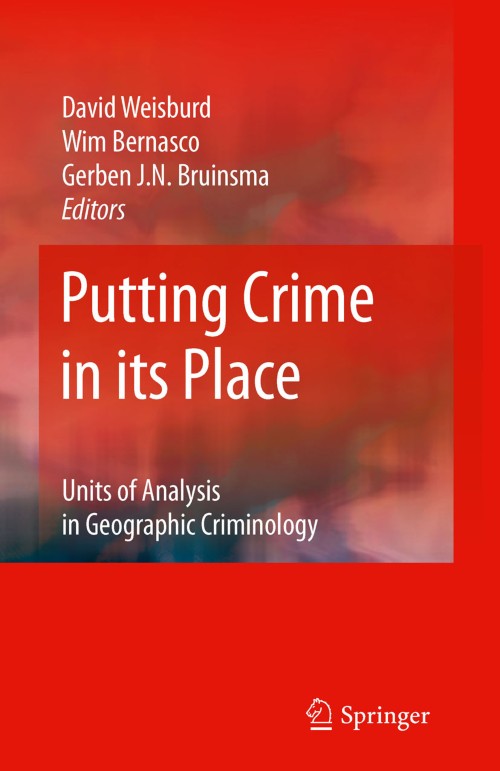
Putting Crime in its Place [electronic resource] : Units of Analysis in Geographic Criminology / edited by David Weisburd, Wim Bernasco, Gerben Bruinsma.
Erişim Adresi
ISBN
9780387096889
Dil Kodu
İngilizce
Yer Numarası
DK/10360
Basım Bildirimi
1st ed. 2009.
Yayın Bilgisi
New York, NY : Springer New York : Imprint: Springer, 2009.
Fiziksel Niteleme
XII, 254 p. online resource.
İçindekiler Notu
Units of Analysis in Geographic Criminology: Historical Development, Critical Issues, and Open Questions -- What Is the Appropriate Level of Investigation of Crime at Place? Theoretical and Methodological Issues -- Why Small Is Better: Advancing the Study of the Role of Behavioral Contexts in Crime Causation -- Where the Action Is at Places: Examining Spatio-Temporal Patterns of Juvenile Crime at Places Using Trajectory Analysis and GIS -- Crime Analysis at Multiple Scales of Aggregation: A Topological Approach -- Geographical Units of Analysis and the Analysis of Crime -- Waves, Particles, and Crime -- Empirical Examples of Crime Place Studies: What Can We Learn? -- Crime, Neighborhoods, and Units of Analysis: Putting Space in Its Place -- Predictive Mapping of Crime by ProMap: Accuracy, Units of Analysis, and the Environmental Backcloth -- Urban Streets as Micro Contexts to Commit Violence -- Determining How Journeys-to-Crime Vary: Measuring Inter- and Intra-Offender Crime Trip Distributions.
Özet, vb.
Putting Crime in its Place: Units of Analysis in Geographic Criminology focuses on the units of analysis used in geographic criminology. While crime and place studies have been a part of criminology from the early 19th century, growing interest in crime places over the last two decades demands critical reflection on the units of analysis that should form the focus of geographic analysis of crime. Should the focus be on very small units such as street addresses or street segments, or on larger aggregates such as census tracts or communities? Academic researchers, as well as practical crime analysts, are confronted routinely with the dilemma of deciding what the unit of analysis should be when reporting on trends in crime, when identifying crime hot spots or when mapping crime in cities. In place-based crime prevention, the choice of the level of aggregation plays a particularly critical role. This peer reviewed collection of essays aims to contribute to crime and place studies by making explicit the problems involved in choosing units of analysis in geographic criminology. Written by renowned experts in the field, the chapters in this book address basic academic questions, and also provide real-life examples and applications of how they are resolved in cutting-edge research. Crime analysts in police and law enforcement agencies as well as academic researchers studying the spatial distributions of crime and victimization will learn from the discussions and tools presented.
Konu
Criminology.
Demography.
Population.
Sociology.
Criminology.
Population and Demography.
Sociology.
Demography.
Population.
Sociology.
Criminology.
Population and Demography.
Sociology.
Diğer Yazarlar
Kurum Adı
Eseri Alıntıla
Referansları kullanmadan önce gözden geçirmeniz ve varsa gerekli düzeltmeleri yapmanız önerilir.
Dijital Kaynak
MARC Görünümü
LEADER 04405nam a22005295i 4500
001 809071
003 TR_AnAIT
005 20260131024214
007 cr nn 008mamaa
008 100301s2009 xxu| s |||| 0|eng d
020 |a9780387096889|9978-0-387-09688-9
024 7 |a10.1007/978-0-387-09688-9|2doi
041 |aeng
049 |aTürk Tarih Kurumu Kütüphanesi
050 4|aHV6001-7220.5
072 7|aJKV|2bicssc
072 7|aSOC004000|2bisacsh
072 7|aJKV|2thema
082 04|a364|223
090 |aDK/10360
245 10|aPutting Crime in its Place|h[electronic resource] :|bUnits of Analysis in Geographic Criminology /|cedited by David Weisburd, Wim Bernasco, Gerben Bruinsma.
250 |a1st ed. 2009.
264 1|aNew York, NY :|bSpringer New York :|bImprint: Springer,|c2009.
300 |aXII, 254 p.|bonline resource.
336 |atext|btxt|2rdacontent
337 |acomputer|bc|2rdamedia
338 |aonline resource|bcr|2rdacarrier
347 |atext file|bPDF|2rda
505 0 |aUnits of Analysis in Geographic Criminology: Historical Development, Critical Issues, and Open Questions -- What Is the Appropriate Level of Investigation of Crime at Place? Theoretical and Methodological Issues -- Why Small Is Better: Advancing the Study of the Role of Behavioral Contexts in Crime Causation -- Where the Action Is at Places: Examining Spatio-Temporal Patterns of Juvenile Crime at Places Using Trajectory Analysis and GIS -- Crime Analysis at Multiple Scales of Aggregation: A Topological Approach -- Geographical Units of Analysis and the Analysis of Crime -- Waves, Particles, and Crime -- Empirical Examples of Crime Place Studies: What Can We Learn? -- Crime, Neighborhoods, and Units of Analysis: Putting Space in Its Place -- Predictive Mapping of Crime by ProMap: Accuracy, Units of Analysis, and the Environmental Backcloth -- Urban Streets as Micro Contexts to Commit Violence -- Determining How Journeys-to-Crime Vary: Measuring Inter- and Intra-Offender Crime Trip Distributions.
520 |aPutting Crime in its Place: Units of Analysis in Geographic Criminology focuses on the units of analysis used in geographic criminology. While crime and place studies have been a part of criminology from the early 19th century, growing interest in crime places over the last two decades demands critical reflection on the units of analysis that should form the focus of geographic analysis of crime. Should the focus be on very small units such as street addresses or street segments, or on larger aggregates such as census tracts or communities? Academic researchers, as well as practical crime analysts, are confronted routinely with the dilemma of deciding what the unit of analysis should be when reporting on trends in crime, when identifying crime hot spots or when mapping crime in cities. In place-based crime prevention, the choice of the level of aggregation plays a particularly critical role. This peer reviewed collection of essays aims to contribute to crime and place studies by making explicit the problems involved in choosing units of analysis in geographic criminology. Written by renowned experts in the field, the chapters in this book address basic academic questions, and also provide real-life examples and applications of how they are resolved in cutting-edge research. Crime analysts in police and law enforcement agencies as well as academic researchers studying the spatial distributions of crime and victimization will learn from the discussions and tools presented.
650 0|aCriminology.
650 0|aDemography.
650 0|aPopulation.
650 0|aSociology.
650 14|aCriminology.
650 24|aPopulation and Demography.
650 24|aSociology.
700 1 |aWeisburd, David.|eeditor.|4edt|4http://id.loc.gov/vocabulary/relators/edt
700 1 |aBernasco, Wim.|eeditor.|4edt|4http://id.loc.gov/vocabulary/relators/edt
700 1 |aBruinsma, Gerben.|eeditor.|4edt|4http://id.loc.gov/vocabulary/relators/edt
710 2 |aSpringerLink (Online service)
773 0 |tSpringer Nature eBook
776 08|iPrinted edition:|z9780387096872
776 08|iPrinted edition:|z9780387561417
776 08|iPrinted edition:|z9781441909732
856 40|uhttps://doi.org/10.1007/978-0-387-09688-9
912 |aZDB-2-SHU
912 |aZDB-2-SXS
950 |aHumanities, Social Sciences and Law (SpringerNature-11648)
950 |aSocial Sciences (R0) (SpringerNature-43726)
001 809071
003 TR_AnAIT
005 20260131024214
007 cr nn 008mamaa
008 100301s2009 xxu| s |||| 0|eng d
020 |a9780387096889|9978-0-387-09688-9
024 7 |a10.1007/978-0-387-09688-9|2doi
041 |aeng
049 |aTürk Tarih Kurumu Kütüphanesi
050 4|aHV6001-7220.5
072 7|aJKV|2bicssc
072 7|aSOC004000|2bisacsh
072 7|aJKV|2thema
082 04|a364|223
090 |aDK/10360
245 10|aPutting Crime in its Place|h[electronic resource] :|bUnits of Analysis in Geographic Criminology /|cedited by David Weisburd, Wim Bernasco, Gerben Bruinsma.
250 |a1st ed. 2009.
264 1|aNew York, NY :|bSpringer New York :|bImprint: Springer,|c2009.
300 |aXII, 254 p.|bonline resource.
336 |atext|btxt|2rdacontent
337 |acomputer|bc|2rdamedia
338 |aonline resource|bcr|2rdacarrier
347 |atext file|bPDF|2rda
505 0 |aUnits of Analysis in Geographic Criminology: Historical Development, Critical Issues, and Open Questions -- What Is the Appropriate Level of Investigation of Crime at Place? Theoretical and Methodological Issues -- Why Small Is Better: Advancing the Study of the Role of Behavioral Contexts in Crime Causation -- Where the Action Is at Places: Examining Spatio-Temporal Patterns of Juvenile Crime at Places Using Trajectory Analysis and GIS -- Crime Analysis at Multiple Scales of Aggregation: A Topological Approach -- Geographical Units of Analysis and the Analysis of Crime -- Waves, Particles, and Crime -- Empirical Examples of Crime Place Studies: What Can We Learn? -- Crime, Neighborhoods, and Units of Analysis: Putting Space in Its Place -- Predictive Mapping of Crime by ProMap: Accuracy, Units of Analysis, and the Environmental Backcloth -- Urban Streets as Micro Contexts to Commit Violence -- Determining How Journeys-to-Crime Vary: Measuring Inter- and Intra-Offender Crime Trip Distributions.
520 |aPutting Crime in its Place: Units of Analysis in Geographic Criminology focuses on the units of analysis used in geographic criminology. While crime and place studies have been a part of criminology from the early 19th century, growing interest in crime places over the last two decades demands critical reflection on the units of analysis that should form the focus of geographic analysis of crime. Should the focus be on very small units such as street addresses or street segments, or on larger aggregates such as census tracts or communities? Academic researchers, as well as practical crime analysts, are confronted routinely with the dilemma of deciding what the unit of analysis should be when reporting on trends in crime, when identifying crime hot spots or when mapping crime in cities. In place-based crime prevention, the choice of the level of aggregation plays a particularly critical role. This peer reviewed collection of essays aims to contribute to crime and place studies by making explicit the problems involved in choosing units of analysis in geographic criminology. Written by renowned experts in the field, the chapters in this book address basic academic questions, and also provide real-life examples and applications of how they are resolved in cutting-edge research. Crime analysts in police and law enforcement agencies as well as academic researchers studying the spatial distributions of crime and victimization will learn from the discussions and tools presented.
650 0|aCriminology.
650 0|aDemography.
650 0|aPopulation.
650 0|aSociology.
650 14|aCriminology.
650 24|aPopulation and Demography.
650 24|aSociology.
700 1 |aWeisburd, David.|eeditor.|4edt|4http://id.loc.gov/vocabulary/relators/edt
700 1 |aBernasco, Wim.|eeditor.|4edt|4http://id.loc.gov/vocabulary/relators/edt
700 1 |aBruinsma, Gerben.|eeditor.|4edt|4http://id.loc.gov/vocabulary/relators/edt
710 2 |aSpringerLink (Online service)
773 0 |tSpringer Nature eBook
776 08|iPrinted edition:|z9780387096872
776 08|iPrinted edition:|z9780387561417
776 08|iPrinted edition:|z9781441909732
856 40|uhttps://doi.org/10.1007/978-0-387-09688-9
912 |aZDB-2-SHU
912 |aZDB-2-SXS
950 |aHumanities, Social Sciences and Law (SpringerNature-11648)
950 |aSocial Sciences (R0) (SpringerNature-43726)
Materyaller
Depodan talep edilen materyal sadece kütüphane içerisinde kullanılmaktadır.
Materyal dışarıya ödünç verilmemektedir.
Materyal dışarıya ödünç verilmemektedir.
