LEADER 04192nam a22005535i 4500
001 809079
003 TR_AnAIT
005 20260131024149
007 cr nn 008mamaa
008 100301s2005 xxu| s |||| 0|eng d
020 |a9780387277493|9978-0-387-27749-3
024 7 |a10.1007/0-387-27749-8|2doi
041 |aeng
049 |aTürk Tarih Kurumu Kütüphanesi
050 4|aL1-991
072 7|aJN|2bicssc
072 7|aEDU000000|2bisacsh
072 7|aJN|2thema
082 04|a370|223
090 |aDK/10368
100 1 |aYang, Otto O.|eauthor.|4aut|4http://id.loc.gov/vocabulary/relators/aut
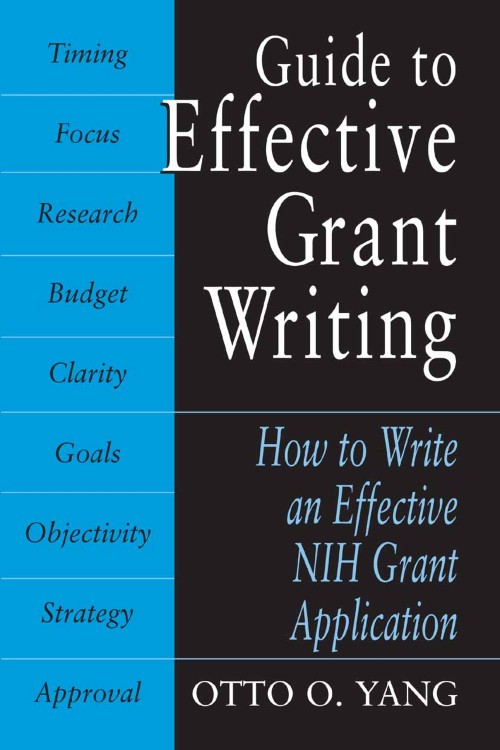
245 10|aGuide to Effective Grant Writing|h[electronic resource] :|bHow to Write a Successful NIH Grant Application /|cby Otto O. Yang.
250 |a1st ed. 2005.
264 1|aNew York, NY :|bSpringer US :|bImprint: Springer,|c2005.
300 |aVI, 94 p.|bonline resource.
336 |atext|btxt|2rdacontent
337 |acomputer|bc|2rdamedia
338 |aonline resource|bcr|2rdacarrier
347 |atext file|bPDF|2rda
505 0 |aOverview: Overall Goals When Writing Grant Applications -- Organization and Use of This Guide -- Preparing to Write -- Types of NIH Grants -- Anatomy of the NIH Grant Application -- Organization and Aesthetics -- Specific Aims -- Background and Significance -- Preliminary Results -- Research Design and Methods -- Use of Literature Citations -- Use of Appendices -- Administrative Sections -- Collaborators and Consultants -- Scoring Process -- Resubmitting an Application -- Submitting a Competing Renewal -- Non-NIH Grants -- Conclusions.
520 |aGuide to Effective Grant Writing: How to Write a Successful NIH Grant is written to help the 100,000+ post-graduate students and professionals who need to write effective proposals for grants. There is little or no formal teaching about the process of writing grants for NIH, and many grant applications are rejected due to poor writing and weak formulation of ideas. Procuring grant funding is the central key to survival for any academic researcher in the biological sciences; thus, being able to write a proposal that effectively illustrates one's ideas is essential. Covering all aspects of the proposal process, from the most basic questions about form and style to the task of seeking funding, this volume offers clear advice backed up with excellent examples. Included are a number of specimen proposals to help shed light on the important issues surrounding the writing of proposals. The Guide is a clear, straight-forward, and reader-friendly tool. Guide to Effective Grant Writing: How to Write a Successful NIH Grant Writing is based on Dr. Yang's extensive experience serving on NIH grant review panels; it covers the common mistakes and problems he routinely witnesses while reviewing grants.
532 8 |aAccessibility summary: This PDF is not accessible. It is based on scanned pages and does not support features such as screen reader compatibility or described non-text content (images, graphs etc). However, it likely supports searchable and selectable text based on OCR (Optical Character Recognition). Users with accessibility needs may not be able to use this content effectively. Please contact us at accessibilitysupport@springernature.com if you require assistance or an alternative format.
532 8 |aInaccessible, or known limited accessibility
532 8 |aNo reading system accessibility options actively disabled
532 8 |aPublisher contact for further accessibility information: accessibilitysupport@springernature.com
650 0|aEducation.
650 0|aTeachers|xTraining of.
650 0|aLearning, Psychology of.
650 0|aLife sciences.
650 14|aEducation.
650 24|aTeaching and Teacher Education.
650 24|aInstructional Psychology.
650 24|aLife Sciences.
710 2 |aSpringerLink (Online service)
773 0 |tSpringer Nature eBook
776 08|iPrinted edition:|z9780306486647
776 08|iPrinted edition:|z9780387500584
856 40|uhttps://doi.org/10.1007/0-387-27749-8
912 |aZDB-2-SHU
912 |aZDB-2-SXED
950 |aHumanities, Social Sciences and Law (SpringerNature-11648)
950 |aEducation (R0) (SpringerNature-43721)