

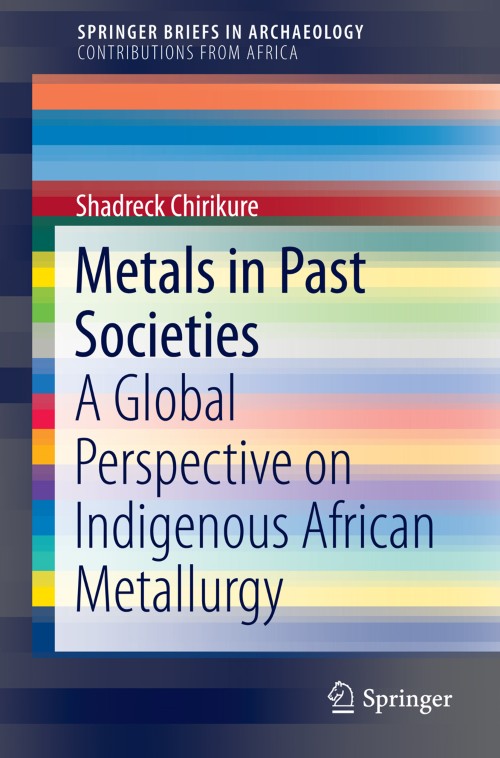
Metals in Past Societies [electronic resource] : A Global Perspective on Indigenous African Metallurgy / by Shadreck Chirikure.
Erişim Adresi
ISBN
9783319116419
Dil Kodu
İngilizce
Yer Numarası
DK/10389
Yazar
Basım Bildirimi
1st ed. 2015.
Yayın Bilgisi
Cham : Springer International Publishing : Imprint: Springer, 2015.
Fiziksel Niteleme
XXI, 166 p. 65 illus., 44 illus. in color. online resource.
Dizi
Contributions from Africa, 2196-5463
İçindekiler Notu
Chapter 1: Metals and the production and reproduction of society -- Chapter 2: Origins and development of Africa’s pre-industrial mining and metallurgy -- Chapter 3: Mother earth provides: mining and crossing the boundary between nature and culture -- Chapter 4: Domesticating nature -- Chapter 5: Socializing metals -- Chapter 6: The social role of metals -- Chapter 7: Bridging conceptual boundaries, a global perspective.
Özet, vb.
This book seeks to communicate to both a global and local audience, the key attributes of pre-industrial African metallurgy such as technological variation across space and time, methods of mining and extractive metallurgy and the fabrication of metal objects. These processes were transformative in a physical and metaphoric sense, which made them total social facts. Because the production and use of metals was an accretion of various categories of practice, a chaine operatoire conceptual and theoretical framework that simultaneously considers the embedded technological and anthropological factors was used. The book focuses on Africa’s different regions as roughly defined by cultural geography. On the one hand there is North Africa, Egypt, the Egyptian Sudan, and the Horn of Africa which share cultural inheritances with the Middle East and on the other is Africa south of the Sahara and the Sudan which despite interacting with the former is remarkably different in terms of technological practice. For example, not only is the timing of metallurgy different but so is the infrastructure for working metals and the associated symbolic and sociological factors. The cultural valuation of metals and the social positions of metal workers were different too although there is evidence of some values transfer and multi-directional technological cross borrowing. The multitude of permutations associated with metals production and use amply demonstrates that metals participated in the production and reproduction of society. Despite huge temporal and spatial differences there are so many common factors between African metallurgy and that of other regions of the world. For example, the role of magic and ritual in metal working is almost universal be it in Bolivia, Nepal, Malawi, Timna, Togo or Zimbabwe. Similarly, techniques of mining were constrained by the underlying geology but this should not in any way suggest that Africa’s metallurgy was derivative or that thecontinent had no initiative. Rather it demonstrates that when confronted with similar challenges, humanity in different regions of the world responded to identical challenges in predictable ways mediated as mediated by the prevailing cultural context. The success of the use of historical and ethnographic data in understanding variation and improvisation in African metallurgical practices flags the potential utility of these sources in Asia, Latin America and Europe. Some nuance is however needed because it is simply naïve to assume that everything depicted in the history or ethnography has a parallel in the past and vice versa. Rather, the confluence of archaeology, history and ethnography becomes a pedestal for dialogue between different sources, subjects and ideas that is important for broadening our knowledge of global categories of metallurgical practice.
Konu
Archaeology.
Anthropology.
Metals.
Archaeology.
Anthropology.
Metals and Alloys.
Anthropology.
Metals.
Archaeology.
Anthropology.
Metals and Alloys.
Kurum Adı
Eseri Alıntıla
Referansları kullanmadan önce gözden geçirmeniz ve varsa gerekli düzeltmeleri yapmanız önerilir.
Dijital Kaynak
MARC Görünümü
LEADER 05049nam a22005055i 4500
001 809100
003 TR_AnAIT
005 20260131024111
007 cr nn 008mamaa
008 150318s2015 sz | s |||| 0|eng d
020 |a9783319116419|9978-3-319-11641-9
024 7 |a10.1007/978-3-319-11641-9|2doi
041 |aeng
049 |aTürk Tarih Kurumu Kütüphanesi
050 4|aCC1-960
072 7|aHD|2bicssc
072 7|aSOC003000|2bisacsh
072 7|aNK|2thema
082 04|a930.1|223
090 |aDK/10389
100 1 |aChirikure, Shadreck.|eauthor.|4aut|4http://id.loc.gov/vocabulary/relators/aut
245 10|aMetals in Past Societies|h[electronic resource] :|bA Global Perspective on Indigenous African Metallurgy /|cby Shadreck Chirikure.
250 |a1st ed. 2015.
264 1|aCham :|bSpringer International Publishing :|bImprint: Springer,|c2015.
300 |aXXI, 166 p. 65 illus., 44 illus. in color.|bonline resource.
336 |atext|btxt|2rdacontent
337 |acomputer|bc|2rdamedia
338 |aonline resource|bcr|2rdacarrier
347 |atext file|bPDF|2rda
490 1 |aContributions from Africa,|x2196-5463
505 0 |aChapter 1: Metals and the production and reproduction of society -- Chapter 2: Origins and development of Africa’s pre-industrial mining and metallurgy -- Chapter 3: Mother earth provides: mining and crossing the boundary between nature and culture -- Chapter 4: Domesticating nature -- Chapter 5: Socializing metals -- Chapter 6: The social role of metals -- Chapter 7: Bridging conceptual boundaries, a global perspective.
520 |aThis book seeks to communicate to both a global and local audience, the key attributes of pre-industrial African metallurgy such as technological variation across space and time, methods of mining and extractive metallurgy and the fabrication of metal objects. These processes were transformative in a physical and metaphoric sense, which made them total social facts. Because the production and use of metals was an accretion of various categories of practice, a chaine operatoire conceptual and theoretical framework that simultaneously considers the embedded technological and anthropological factors was used. The book focuses on Africa’s different regions as roughly defined by cultural geography. On the one hand there is North Africa, Egypt, the Egyptian Sudan, and the Horn of Africa which share cultural inheritances with the Middle East and on the other is Africa south of the Sahara and the Sudan which despite interacting with the former is remarkably different in terms of technological practice. For example, not only is the timing of metallurgy different but so is the infrastructure for working metals and the associated symbolic and sociological factors. The cultural valuation of metals and the social positions of metal workers were different too although there is evidence of some values transfer and multi-directional technological cross borrowing. The multitude of permutations associated with metals production and use amply demonstrates that metals participated in the production and reproduction of society. Despite huge temporal and spatial differences there are so many common factors between African metallurgy and that of other regions of the world. For example, the role of magic and ritual in metal working is almost universal be it in Bolivia, Nepal, Malawi, Timna, Togo or Zimbabwe. Similarly, techniques of mining were constrained by the underlying geology but this should not in any way suggest that Africa’s metallurgy was derivative or that thecontinent had no initiative. Rather it demonstrates that when confronted with similar challenges, humanity in different regions of the world responded to identical challenges in predictable ways mediated as mediated by the prevailing cultural context. The success of the use of historical and ethnographic data in understanding variation and improvisation in African metallurgical practices flags the potential utility of these sources in Asia, Latin America and Europe. Some nuance is however needed because it is simply naïve to assume that everything depicted in the history or ethnography has a parallel in the past and vice versa. Rather, the confluence of archaeology, history and ethnography becomes a pedestal for dialogue between different sources, subjects and ideas that is important for broadening our knowledge of global categories of metallurgical practice.
650 0|aArchaeology.
650 0|aAnthropology.
650 0|aMetals.
650 14|aArchaeology.
650 24|aAnthropology.
650 24|aMetals and Alloys.
710 2 |aSpringerLink (Online service)
773 0 |tSpringer Nature eBook
776 08|iPrinted edition:|z9783319116402
776 08|iPrinted edition:|z9783319116426
830 0|aContributions from Africa,|x2196-5463
856 40|uhttps://doi.org/10.1007/978-3-319-11641-9
912 |aZDB-2-SHU
912 |aZDB-2-SXS
950 |aHumanities, Social Sciences and Law (SpringerNature-11648)
950 |aSocial Sciences (R0) (SpringerNature-43726)
001 809100
003 TR_AnAIT
005 20260131024111
007 cr nn 008mamaa
008 150318s2015 sz | s |||| 0|eng d
020 |a9783319116419|9978-3-319-11641-9
024 7 |a10.1007/978-3-319-11641-9|2doi
041 |aeng
049 |aTürk Tarih Kurumu Kütüphanesi
050 4|aCC1-960
072 7|aHD|2bicssc
072 7|aSOC003000|2bisacsh
072 7|aNK|2thema
082 04|a930.1|223
090 |aDK/10389
100 1 |aChirikure, Shadreck.|eauthor.|4aut|4http://id.loc.gov/vocabulary/relators/aut
245 10|aMetals in Past Societies|h[electronic resource] :|bA Global Perspective on Indigenous African Metallurgy /|cby Shadreck Chirikure.
250 |a1st ed. 2015.
264 1|aCham :|bSpringer International Publishing :|bImprint: Springer,|c2015.
300 |aXXI, 166 p. 65 illus., 44 illus. in color.|bonline resource.
336 |atext|btxt|2rdacontent
337 |acomputer|bc|2rdamedia
338 |aonline resource|bcr|2rdacarrier
347 |atext file|bPDF|2rda
490 1 |aContributions from Africa,|x2196-5463
505 0 |aChapter 1: Metals and the production and reproduction of society -- Chapter 2: Origins and development of Africa’s pre-industrial mining and metallurgy -- Chapter 3: Mother earth provides: mining and crossing the boundary between nature and culture -- Chapter 4: Domesticating nature -- Chapter 5: Socializing metals -- Chapter 6: The social role of metals -- Chapter 7: Bridging conceptual boundaries, a global perspective.
520 |aThis book seeks to communicate to both a global and local audience, the key attributes of pre-industrial African metallurgy such as technological variation across space and time, methods of mining and extractive metallurgy and the fabrication of metal objects. These processes were transformative in a physical and metaphoric sense, which made them total social facts. Because the production and use of metals was an accretion of various categories of practice, a chaine operatoire conceptual and theoretical framework that simultaneously considers the embedded technological and anthropological factors was used. The book focuses on Africa’s different regions as roughly defined by cultural geography. On the one hand there is North Africa, Egypt, the Egyptian Sudan, and the Horn of Africa which share cultural inheritances with the Middle East and on the other is Africa south of the Sahara and the Sudan which despite interacting with the former is remarkably different in terms of technological practice. For example, not only is the timing of metallurgy different but so is the infrastructure for working metals and the associated symbolic and sociological factors. The cultural valuation of metals and the social positions of metal workers were different too although there is evidence of some values transfer and multi-directional technological cross borrowing. The multitude of permutations associated with metals production and use amply demonstrates that metals participated in the production and reproduction of society. Despite huge temporal and spatial differences there are so many common factors between African metallurgy and that of other regions of the world. For example, the role of magic and ritual in metal working is almost universal be it in Bolivia, Nepal, Malawi, Timna, Togo or Zimbabwe. Similarly, techniques of mining were constrained by the underlying geology but this should not in any way suggest that Africa’s metallurgy was derivative or that thecontinent had no initiative. Rather it demonstrates that when confronted with similar challenges, humanity in different regions of the world responded to identical challenges in predictable ways mediated as mediated by the prevailing cultural context. The success of the use of historical and ethnographic data in understanding variation and improvisation in African metallurgical practices flags the potential utility of these sources in Asia, Latin America and Europe. Some nuance is however needed because it is simply naïve to assume that everything depicted in the history or ethnography has a parallel in the past and vice versa. Rather, the confluence of archaeology, history and ethnography becomes a pedestal for dialogue between different sources, subjects and ideas that is important for broadening our knowledge of global categories of metallurgical practice.
650 0|aArchaeology.
650 0|aAnthropology.
650 0|aMetals.
650 14|aArchaeology.
650 24|aAnthropology.
650 24|aMetals and Alloys.
710 2 |aSpringerLink (Online service)
773 0 |tSpringer Nature eBook
776 08|iPrinted edition:|z9783319116402
776 08|iPrinted edition:|z9783319116426
830 0|aContributions from Africa,|x2196-5463
856 40|uhttps://doi.org/10.1007/978-3-319-11641-9
912 |aZDB-2-SHU
912 |aZDB-2-SXS
950 |aHumanities, Social Sciences and Law (SpringerNature-11648)
950 |aSocial Sciences (R0) (SpringerNature-43726)
Materyaller
Depodan talep edilen materyal sadece kütüphane içerisinde kullanılmaktadır.
Materyal dışarıya ödünç verilmemektedir.
Materyal dışarıya ödünç verilmemektedir.
