

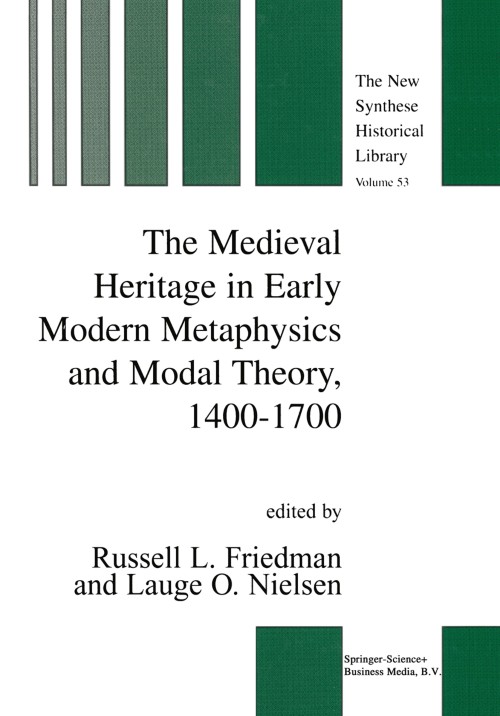
The Medieval Heritage in Early Modern Metaphysics and Modal Theory, 1400–1700 [electronic resource] / edited by R.L. Friedman, L.O. Nielsen.
Erişim Adresi
ISBN
9789401701792
Dil Kodu
İngilizce
Yer Numarası
DK/10418
Basım Bildirimi
1st ed. 2003.
Yayın Bilgisi
Dordrecht : Springer Netherlands : Imprint: Springer, 2003.
Fiziksel Niteleme
VI, 349 p. 1 illus. online resource.
Dizi
The New Synthese Historical Library, Texts and Studies in the History of Philosophy, 2352-2585 ; 53
İçindekiler Notu
1. Introduction -- 2. Via Antiqua and Via Moderna in the Fifteenth Century: Doctrinal, Institutional, and Church Political Factors in the Wegestreit -- 3. Ockham and Locke on Mental Language -- 4. Metaphysics as a Discipline: From the “Transcendental Philosophy of the Ancients” to Kant’s Notion of Transcendental Philosophy -- 5. God as First Principle and Metaphysics as a Science -- 6. Gabriel Biel and Later-Medieval Trinitarian Theology -- 7. The Question of the Validity of Logic in Late Medieval Thought -- 8. Uses of Philosophy in Reformation Thought: Melanchthon, Schegk, and Crellius -- 9. Divine Foreknowledge and Human Freedom: Auriol, Pomponazzi, and Luther on “Scholastic Subtleties” -- 10. The Ontological Source of Logical Possibility in Catholic Second Scholasticism -- 11. The Renaissance of Statistical Modalities in Early Modern Scholasticism -- 12. Modal Logic in Germany at the Beginning of the Seventeenth Century: Christoph Scheibler’s Opus Logicum -- 13. Leibniz on Compossibility: Some Scholastic Sources -- Index of Names.
Özet, vb.
On the most basic level, the articles brought together in the present volume aim to contribute to the charting of the (often subtle) links between the medieval and early modern periods in the fields of metaphysics, philosophical theology, and modal theory. In selecting this line of inquiry the volume is consciously intended to offer support for the stance that in the higher or speculative sciences no sharp divide exists between the later Middle Ages, on the one hand, and the Renaissance and early modern period, on the other. In adopting such an approach, one emphasizing historical continuity instead of discontinuity, the volume can be seen as challenging at least two related sets of convictions concerning the intellectual life of the period 1400-1700. First, prominent Renaissance and early modem thinkers portrayed their own intellectual projects and accomplishments as radical breaks with the scholasticism characteristic of the Middle Ages and also dominant in their own time; the volume to no small extent takes as its point of departure a reluctance - or, at least, a hesitation - to accept these bold claims. Second, a large part of nineteenth- and twentieth-century historiography has taken the Renaissance and early modern claims of fundamental innovation at face-value; in emphasizing the continuity that exists between the thought of the medieval and of the early modern periods, the volume is part of an attempt to offer a more balanced view of the intellectual production of the later period.
Konu
Philosophy.
Culture __ Study and teaching.
History.
Philosophy, Medieval.
Metaphysics.
Logic.
Philosophy.
Cultural Studies.
History.
Medieval Philosophy.
Metaphysics.
Logic.
Culture __ Study and teaching.
History.
Philosophy, Medieval.
Metaphysics.
Logic.
Philosophy.
Cultural Studies.
History.
Medieval Philosophy.
Metaphysics.
Logic.
Diğer Yazarlar
Kurum Adı
Eseri Alıntıla
Referansları kullanmadan önce gözden geçirmeniz ve varsa gerekli düzeltmeleri yapmanız önerilir.
Dijital Kaynak
MARC Görünümü
LEADER 05554nam a22006615i 4500
001 809129
003 TR_AnAIT
005 20260131024025
007 cr nn 008mamaa
008 130321s2003 ne | s |||| 0|eng d
020 |a9789401701792|9978-94-017-0179-2
024 7 |a10.1007/978-94-017-0179-2|2doi
041 |aeng
049 |aTürk Tarih Kurumu Kütüphanesi
050 4|aB1-5802
072 7|aHP|2bicssc
072 7|aPHI000000|2bisacsh
072 7|aQD|2thema
082 04|a100|223
090 |aDK/10418
245 14|aThe Medieval Heritage in Early Modern Metaphysics and Modal Theory, 1400–1700|h[electronic resource] /|cedited by R.L. Friedman, L.O. Nielsen.
250 |a1st ed. 2003.
264 1|aDordrecht :|bSpringer Netherlands :|bImprint: Springer,|c2003.
300 |aVI, 349 p. 1 illus.|bonline resource.
336 |atext|btxt|2rdacontent
337 |acomputer|bc|2rdamedia
338 |aonline resource|bcr|2rdacarrier
347 |atext file|bPDF|2rda
490 1 |aThe New Synthese Historical Library, Texts and Studies in the History of Philosophy,|x2352-2585 ;|v53
505 0 |a1. Introduction -- 2. Via Antiqua and Via Moderna in the Fifteenth Century: Doctrinal, Institutional, and Church Political Factors in the Wegestreit -- 3. Ockham and Locke on Mental Language -- 4. Metaphysics as a Discipline: From the “Transcendental Philosophy of the Ancients” to Kant’s Notion of Transcendental Philosophy -- 5. God as First Principle and Metaphysics as a Science -- 6. Gabriel Biel and Later-Medieval Trinitarian Theology -- 7. The Question of the Validity of Logic in Late Medieval Thought -- 8. Uses of Philosophy in Reformation Thought: Melanchthon, Schegk, and Crellius -- 9. Divine Foreknowledge and Human Freedom: Auriol, Pomponazzi, and Luther on “Scholastic Subtleties” -- 10. The Ontological Source of Logical Possibility in Catholic Second Scholasticism -- 11. The Renaissance of Statistical Modalities in Early Modern Scholasticism -- 12. Modal Logic in Germany at the Beginning of the Seventeenth Century: Christoph Scheibler’s Opus Logicum -- 13. Leibniz on Compossibility: Some Scholastic Sources -- Index of Names.
520 |aOn the most basic level, the articles brought together in the present volume aim to contribute to the charting of the (often subtle) links between the medieval and early modern periods in the fields of metaphysics, philosophical theology, and modal theory. In selecting this line of inquiry the volume is consciously intended to offer support for the stance that in the higher or speculative sciences no sharp divide exists between the later Middle Ages, on the one hand, and the Renaissance and early modern period, on the other. In adopting such an approach, one emphasizing historical continuity instead of discontinuity, the volume can be seen as challenging at least two related sets of convictions concerning the intellectual life of the period 1400-1700. First, prominent Renaissance and early modem thinkers portrayed their own intellectual projects and accomplishments as radical breaks with the scholasticism characteristic of the Middle Ages and also dominant in their own time; the volume to no small extent takes as its point of departure a reluctance - or, at least, a hesitation - to accept these bold claims. Second, a large part of nineteenth- and twentieth-century historiography has taken the Renaissance and early modern claims of fundamental innovation at face-value; in emphasizing the continuity that exists between the thought of the medieval and of the early modern periods, the volume is part of an attempt to offer a more balanced view of the intellectual production of the later period.
532 8 |aAccessibility summary: This PDF is not accessible. It is based on scanned pages and does not support features such as screen reader compatibility or described non-text content (images, graphs etc). However, it likely supports searchable and selectable text based on OCR (Optical Character Recognition). Users with accessibility needs may not be able to use this content effectively. Please contact us at accessibilitysupport@springernature.com if you require assistance or an alternative format.
532 8 |aInaccessible, or known limited accessibility
532 8 |aNo reading system accessibility options actively disabled
532 8 |aPublisher contact for further accessibility information: accessibilitysupport@springernature.com
650 0|aPhilosophy.
650 0|aCulture|xStudy and teaching.
650 0|aHistory.
650 0|aPhilosophy, Medieval.
650 0|aMetaphysics.
650 0|aLogic.
650 14|aPhilosophy.
650 24|aCultural Studies.
650 24|aHistory.
650 24|aMedieval Philosophy.
650 24|aMetaphysics.
650 24|aLogic.
700 1 |aFriedman, R.L.|eeditor.|4edt|4http://id.loc.gov/vocabulary/relators/edt
700 1 |aNielsen, L.O.|eeditor.|4edt|4http://id.loc.gov/vocabulary/relators/edt
710 2 |aSpringerLink (Online service)
773 0 |tSpringer Nature eBook
776 08|iPrinted edition:|z9781402016318
776 08|iPrinted edition:|z9789048164271
776 08|iPrinted edition:|z9789401701808
830 0|aThe New Synthese Historical Library, Texts and Studies in the History of Philosophy,|x2352-2585 ;|v53
856 40|uhttps://doi.org/10.1007/978-94-017-0179-2
912 |aZDB-2-SHU
912 |aZDB-2-SXPR
912 |aZDB-2-BAE
950 |aHumanities, Social Sciences and Law (SpringerNature-11648)
950 |aPhilosophy and Religion (R0) (SpringerNature-43725)
001 809129
003 TR_AnAIT
005 20260131024025
007 cr nn 008mamaa
008 130321s2003 ne | s |||| 0|eng d
020 |a9789401701792|9978-94-017-0179-2
024 7 |a10.1007/978-94-017-0179-2|2doi
041 |aeng
049 |aTürk Tarih Kurumu Kütüphanesi
050 4|aB1-5802
072 7|aHP|2bicssc
072 7|aPHI000000|2bisacsh
072 7|aQD|2thema
082 04|a100|223
090 |aDK/10418
245 14|aThe Medieval Heritage in Early Modern Metaphysics and Modal Theory, 1400–1700|h[electronic resource] /|cedited by R.L. Friedman, L.O. Nielsen.
250 |a1st ed. 2003.
264 1|aDordrecht :|bSpringer Netherlands :|bImprint: Springer,|c2003.
300 |aVI, 349 p. 1 illus.|bonline resource.
336 |atext|btxt|2rdacontent
337 |acomputer|bc|2rdamedia
338 |aonline resource|bcr|2rdacarrier
347 |atext file|bPDF|2rda
490 1 |aThe New Synthese Historical Library, Texts and Studies in the History of Philosophy,|x2352-2585 ;|v53
505 0 |a1. Introduction -- 2. Via Antiqua and Via Moderna in the Fifteenth Century: Doctrinal, Institutional, and Church Political Factors in the Wegestreit -- 3. Ockham and Locke on Mental Language -- 4. Metaphysics as a Discipline: From the “Transcendental Philosophy of the Ancients” to Kant’s Notion of Transcendental Philosophy -- 5. God as First Principle and Metaphysics as a Science -- 6. Gabriel Biel and Later-Medieval Trinitarian Theology -- 7. The Question of the Validity of Logic in Late Medieval Thought -- 8. Uses of Philosophy in Reformation Thought: Melanchthon, Schegk, and Crellius -- 9. Divine Foreknowledge and Human Freedom: Auriol, Pomponazzi, and Luther on “Scholastic Subtleties” -- 10. The Ontological Source of Logical Possibility in Catholic Second Scholasticism -- 11. The Renaissance of Statistical Modalities in Early Modern Scholasticism -- 12. Modal Logic in Germany at the Beginning of the Seventeenth Century: Christoph Scheibler’s Opus Logicum -- 13. Leibniz on Compossibility: Some Scholastic Sources -- Index of Names.
520 |aOn the most basic level, the articles brought together in the present volume aim to contribute to the charting of the (often subtle) links between the medieval and early modern periods in the fields of metaphysics, philosophical theology, and modal theory. In selecting this line of inquiry the volume is consciously intended to offer support for the stance that in the higher or speculative sciences no sharp divide exists between the later Middle Ages, on the one hand, and the Renaissance and early modern period, on the other. In adopting such an approach, one emphasizing historical continuity instead of discontinuity, the volume can be seen as challenging at least two related sets of convictions concerning the intellectual life of the period 1400-1700. First, prominent Renaissance and early modem thinkers portrayed their own intellectual projects and accomplishments as radical breaks with the scholasticism characteristic of the Middle Ages and also dominant in their own time; the volume to no small extent takes as its point of departure a reluctance - or, at least, a hesitation - to accept these bold claims. Second, a large part of nineteenth- and twentieth-century historiography has taken the Renaissance and early modern claims of fundamental innovation at face-value; in emphasizing the continuity that exists between the thought of the medieval and of the early modern periods, the volume is part of an attempt to offer a more balanced view of the intellectual production of the later period.
532 8 |aAccessibility summary: This PDF is not accessible. It is based on scanned pages and does not support features such as screen reader compatibility or described non-text content (images, graphs etc). However, it likely supports searchable and selectable text based on OCR (Optical Character Recognition). Users with accessibility needs may not be able to use this content effectively. Please contact us at accessibilitysupport@springernature.com if you require assistance or an alternative format.
532 8 |aInaccessible, or known limited accessibility
532 8 |aNo reading system accessibility options actively disabled
532 8 |aPublisher contact for further accessibility information: accessibilitysupport@springernature.com
650 0|aPhilosophy.
650 0|aCulture|xStudy and teaching.
650 0|aHistory.
650 0|aPhilosophy, Medieval.
650 0|aMetaphysics.
650 0|aLogic.
650 14|aPhilosophy.
650 24|aCultural Studies.
650 24|aHistory.
650 24|aMedieval Philosophy.
650 24|aMetaphysics.
650 24|aLogic.
700 1 |aFriedman, R.L.|eeditor.|4edt|4http://id.loc.gov/vocabulary/relators/edt
700 1 |aNielsen, L.O.|eeditor.|4edt|4http://id.loc.gov/vocabulary/relators/edt
710 2 |aSpringerLink (Online service)
773 0 |tSpringer Nature eBook
776 08|iPrinted edition:|z9781402016318
776 08|iPrinted edition:|z9789048164271
776 08|iPrinted edition:|z9789401701808
830 0|aThe New Synthese Historical Library, Texts and Studies in the History of Philosophy,|x2352-2585 ;|v53
856 40|uhttps://doi.org/10.1007/978-94-017-0179-2
912 |aZDB-2-SHU
912 |aZDB-2-SXPR
912 |aZDB-2-BAE
950 |aHumanities, Social Sciences and Law (SpringerNature-11648)
950 |aPhilosophy and Religion (R0) (SpringerNature-43725)
Materyaller
Depodan talep edilen materyal sadece kütüphane içerisinde kullanılmaktadır.
Materyal dışarıya ödünç verilmemektedir.
Materyal dışarıya ödünç verilmemektedir.
