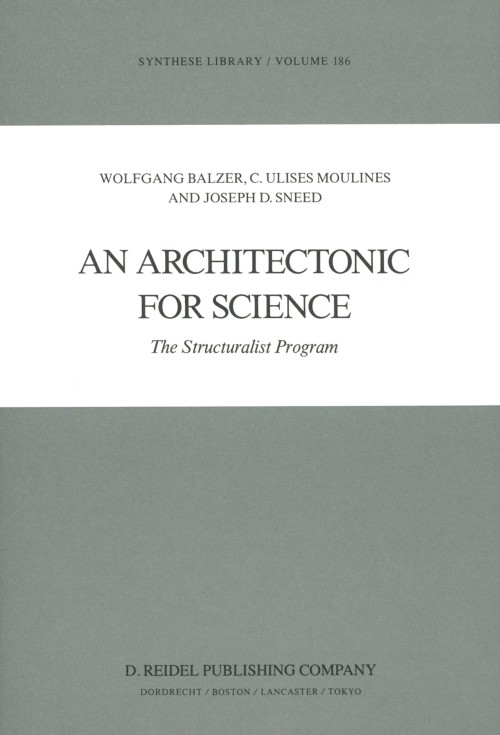
An Architectonic for Science [electronic resource] : The Structuralist Program / by W. Balzer, C.U. Moulines, J.D. Sneed.
Erişim Adresi
ISBN
9789400937659
Dil Kodu
İngilizce
Yer Numarası
DK/10453
Yazar
Basım Bildirimi
1st ed. 1987.
Yayın Bilgisi
Dordrecht : Springer Netherlands : Imprint: Springer, 1987.
Fiziksel Niteleme
XXXVIII, 440 p. online resource.
Dizi
Synthese Library, Studies in Epistemology, Logic, Methodology, and Philosophy of Science, 2542-8292 ; 186
İçindekiler Notu
I: Models and Structures -- I.0 Introduction -- I.1 Models and Potential Models -- I.2 Types and Structure Species -- I.3 Set-Theoretic Predicates and Lawlikeness -- I.4 Plausible Interpretations -- I.5 Example: Decision Theory -- I.6 Example: Collision Mechanics -- I.7 Example: Classical Particle Mechanics -- II: Theory-Elements -- II.0 Introduction -- II.1 Cores and Intended Applications -- II.2 Constraints -- II.3 Theoreticity, Partial Potential Models, and Links -- II.4 Theory-Cores Expanded -- II.5 Application Operators -- II.6 Intended Applications -- II.7 Idealized Theory-Elements and Empirical Claims -- III: Some Basic Theory-Elements -- III.0 Introduction -- III.1 Classical Collision Mechanics -- III.2 Relativistic Collision Mechanics -- III.3 Classical Particle Mechanics -- III.4 Daltonian Stoichiometry -- III.5 Simple Equilibrium Thermodynamics -- III.6 Lagrangian Mechanics -- III.7 Pure Exchange Economics -- IV: Theory-Nets -- IV.0 Introduction -- IV.1 Specializations -- IV.2 Theory-Nets -- IV.3 Theory-Net Content and Empirical Claim -- IV.4 The Theory-Net of Classical Particle Mechanics -- IV.5 The Theory-Net of Simple Equilibrium Thermodynamics -- V. The Diachronic Structure of Theories -- V.0 Introduction -- V.1 Pragmatic Primitive Concepts -- V.2 Theory-Evolutions -- V.3 The Evolution of CPM -- V.4 The Evolution of SETH -- VI: Intertheoretical Relations -- VI.0 Introduction -- VI.1 Global Intertheoretical Relations -- VI.2 Specialization and Theoretization -- VI.3 Types of Reduction -- VI.4 A General Concept of Reduction -- VI.5 Empirical Equivalence -- VI.6 Equivalence -- VI.7 Reduction, Language, and Incommensurability -- VII: Approximation -- VII.0 Introduction -- VII.1 Types of Approximation -- VII.2 Intratheoretical Approximation -- VII.3 Intertheoretical Approximation -- VIII: The Global Structure ofScience -- VIII.0 Introduction -- VIII.1 Theory-Holons -- VIII.2 Theoreticity Reconsidered -- VIII.3 Graphs and Paths -- VIII.4 Local Empirical Claims in Global Theory-Holons -- VIII.5 Intended Applications Reconsidered -- VIII.6 Foundationalism Versus Coherentism -- Name Index.
Özet, vb.
This book has grown out of eight years of close collaboration among its authors. From the very beginning we decided that its content should come out as the result of a truly common effort. That is, we did not "distribute" parts of the text planned to each one of us. On the contrary, we made a point that each single paragraph be the product of a common reflection. Genuine team-work is not as usual in philosophy as it is in other academic disciplines. We think, however, that this is more due to the idiosyncrasy of philosophers than to the nature of their subject. Close collaboration with positive results is as rewarding as anything can be, but it may also prove to be quite difficult to implement. In our case, part of the difficulties came from purely geographic separation. This caused unsuspected delays in coordinating the work. But more than this, as time passed, the accumulation of particular results and ideas outran our ability to fit them into an organic unity. Different styles of exposition, different ways of formalization, different levels of complexity were simultaneously present in a voluminous manuscript that had become completely unmanageable. In particular, a portion of the text had been conceived in the language of category theory and employed ideas of a rather abstract nature, while another part was expounded in the more conventional set-theoretic style, stressing intui tivity and concreteness.
Konu
Science __ Philosophy.
Mathematical logic.
System theory.
Mathematical physics.
Philosophy of Science.
Mathematical Logic and Foundations.
Complex Systems.
Theoretical, Mathematical and Computational Physics.
Mathematical logic.
System theory.
Mathematical physics.
Philosophy of Science.
Mathematical Logic and Foundations.
Complex Systems.
Theoretical, Mathematical and Computational Physics.
Diğer Yazarlar
Kurum Adı

Eseri Alıntıla
Referansları kullanmadan önce gözden geçirmeniz ve varsa gerekli düzeltmeleri yapmanız önerilir.
Dijital Kaynak
MARC Görünümü
LEADER 06607nam a22006375i 4500
001 809164
003 TR_AnAIT
005 20260131023927
007 cr nn 008mamaa
008 121227s1987 ne | s |||| 0|eng d
020 |a9789400937659|9978-94-009-3765-9
024 7 |a10.1007/978-94-009-3765-9|2doi
041 |aeng
049 |aTürk Tarih Kurumu Kütüphanesi
050 4|aQ174-175.3
050 4|aB67
072 7|aPDA|2bicssc
072 7|aSCI075000|2bisacsh
072 7|aPDA|2thema
082 04|a501|223
090 |aDK/10453
100 1 |aBalzer, W.|eauthor.|4aut|4http://id.loc.gov/vocabulary/relators/aut
245 13|aAn Architectonic for Science|h[electronic resource] :|bThe Structuralist Program /|cby W. Balzer, C.U. Moulines, J.D. Sneed.
250 |a1st ed. 1987.
264 1|aDordrecht :|bSpringer Netherlands :|bImprint: Springer,|c1987.
300 |aXXXVIII, 440 p.|bonline resource.
336 |atext|btxt|2rdacontent
337 |acomputer|bc|2rdamedia
338 |aonline resource|bcr|2rdacarrier
347 |atext file|bPDF|2rda
490 1 |aSynthese Library, Studies in Epistemology, Logic, Methodology, and Philosophy of Science,|x2542-8292 ;|v186
505 0 |aI: Models and Structures -- I.0 Introduction -- I.1 Models and Potential Models -- I.2 Types and Structure Species -- I.3 Set-Theoretic Predicates and Lawlikeness -- I.4 Plausible Interpretations -- I.5 Example: Decision Theory -- I.6 Example: Collision Mechanics -- I.7 Example: Classical Particle Mechanics -- II: Theory-Elements -- II.0 Introduction -- II.1 Cores and Intended Applications -- II.2 Constraints -- II.3 Theoreticity, Partial Potential Models, and Links -- II.4 Theory-Cores Expanded -- II.5 Application Operators -- II.6 Intended Applications -- II.7 Idealized Theory-Elements and Empirical Claims -- III: Some Basic Theory-Elements -- III.0 Introduction -- III.1 Classical Collision Mechanics -- III.2 Relativistic Collision Mechanics -- III.3 Classical Particle Mechanics -- III.4 Daltonian Stoichiometry -- III.5 Simple Equilibrium Thermodynamics -- III.6 Lagrangian Mechanics -- III.7 Pure Exchange Economics -- IV: Theory-Nets -- IV.0 Introduction -- IV.1 Specializations -- IV.2 Theory-Nets -- IV.3 Theory-Net Content and Empirical Claim -- IV.4 The Theory-Net of Classical Particle Mechanics -- IV.5 The Theory-Net of Simple Equilibrium Thermodynamics -- V. The Diachronic Structure of Theories -- V.0 Introduction -- V.1 Pragmatic Primitive Concepts -- V.2 Theory-Evolutions -- V.3 The Evolution of CPM -- V.4 The Evolution of SETH -- VI: Intertheoretical Relations -- VI.0 Introduction -- VI.1 Global Intertheoretical Relations -- VI.2 Specialization and Theoretization -- VI.3 Types of Reduction -- VI.4 A General Concept of Reduction -- VI.5 Empirical Equivalence -- VI.6 Equivalence -- VI.7 Reduction, Language, and Incommensurability -- VII: Approximation -- VII.0 Introduction -- VII.1 Types of Approximation -- VII.2 Intratheoretical Approximation -- VII.3 Intertheoretical Approximation -- VIII: The Global Structure ofScience -- VIII.0 Introduction -- VIII.1 Theory-Holons -- VIII.2 Theoreticity Reconsidered -- VIII.3 Graphs and Paths -- VIII.4 Local Empirical Claims in Global Theory-Holons -- VIII.5 Intended Applications Reconsidered -- VIII.6 Foundationalism Versus Coherentism -- Name Index.
520 |aThis book has grown out of eight years of close collaboration among its authors. From the very beginning we decided that its content should come out as the result of a truly common effort. That is, we did not "distribute" parts of the text planned to each one of us. On the contrary, we made a point that each single paragraph be the product of a common reflection. Genuine team-work is not as usual in philosophy as it is in other academic disciplines. We think, however, that this is more due to the idiosyncrasy of philosophers than to the nature of their subject. Close collaboration with positive results is as rewarding as anything can be, but it may also prove to be quite difficult to implement. In our case, part of the difficulties came from purely geographic separation. This caused unsuspected delays in coordinating the work. But more than this, as time passed, the accumulation of particular results and ideas outran our ability to fit them into an organic unity. Different styles of exposition, different ways of formalization, different levels of complexity were simultaneously present in a voluminous manuscript that had become completely unmanageable. In particular, a portion of the text had been conceived in the language of category theory and employed ideas of a rather abstract nature, while another part was expounded in the more conventional set-theoretic style, stressing intui tivity and concreteness.
532 8 |aAccessibility summary: This PDF is not accessible. It is based on scanned pages and does not support features such as screen reader compatibility or described non-text content (images, graphs etc). However, it likely supports searchable and selectable text based on OCR (Optical Character Recognition). Users with accessibility needs may not be able to use this content effectively. Please contact us at accessibilitysupport@springernature.com if you require assistance or an alternative format.
532 8 |aInaccessible, or known limited accessibility
532 8 |aNo reading system accessibility options actively disabled
532 8 |aPublisher contact for further accessibility information: accessibilitysupport@springernature.com
650 0|aScience|xPhilosophy.
650 0|aMathematical logic.
650 0|aSystem theory.
650 0|aMathematical physics.
650 14|aPhilosophy of Science.
650 24|aMathematical Logic and Foundations.
650 24|aComplex Systems.
650 24|aTheoretical, Mathematical and Computational Physics.
700 1 |aMoulines, C.U.|eauthor.|4aut|4http://id.loc.gov/vocabulary/relators/aut
700 1 |aSneed, J.D.|eauthor.|4aut|4http://id.loc.gov/vocabulary/relators/aut
710 2 |aSpringerLink (Online service)
773 0 |tSpringer Nature eBook
776 08|iPrinted edition:|z9789027724038
776 08|iPrinted edition:|z9789400937666
776 08|iPrinted edition:|z9789401081764
830 0|aSynthese Library, Studies in Epistemology, Logic, Methodology, and Philosophy of Science,|x2542-8292 ;|v186
856 40|uhttps://doi.org/10.1007/978-94-009-3765-9
912 |aZDB-2-SHU
912 |aZDB-2-SXPR
912 |aZDB-2-BAE
950 |aHumanities, Social Sciences and Law (SpringerNature-11648)
950 |aPhilosophy and Religion (R0) (SpringerNature-43725)
001 809164
003 TR_AnAIT
005 20260131023927
007 cr nn 008mamaa
008 121227s1987 ne | s |||| 0|eng d
020 |a9789400937659|9978-94-009-3765-9
024 7 |a10.1007/978-94-009-3765-9|2doi
041 |aeng
049 |aTürk Tarih Kurumu Kütüphanesi
050 4|aQ174-175.3
050 4|aB67
072 7|aPDA|2bicssc
072 7|aSCI075000|2bisacsh
072 7|aPDA|2thema
082 04|a501|223
090 |aDK/10453
100 1 |aBalzer, W.|eauthor.|4aut|4http://id.loc.gov/vocabulary/relators/aut
245 13|aAn Architectonic for Science|h[electronic resource] :|bThe Structuralist Program /|cby W. Balzer, C.U. Moulines, J.D. Sneed.
250 |a1st ed. 1987.
264 1|aDordrecht :|bSpringer Netherlands :|bImprint: Springer,|c1987.
300 |aXXXVIII, 440 p.|bonline resource.
336 |atext|btxt|2rdacontent
337 |acomputer|bc|2rdamedia
338 |aonline resource|bcr|2rdacarrier
347 |atext file|bPDF|2rda
490 1 |aSynthese Library, Studies in Epistemology, Logic, Methodology, and Philosophy of Science,|x2542-8292 ;|v186
505 0 |aI: Models and Structures -- I.0 Introduction -- I.1 Models and Potential Models -- I.2 Types and Structure Species -- I.3 Set-Theoretic Predicates and Lawlikeness -- I.4 Plausible Interpretations -- I.5 Example: Decision Theory -- I.6 Example: Collision Mechanics -- I.7 Example: Classical Particle Mechanics -- II: Theory-Elements -- II.0 Introduction -- II.1 Cores and Intended Applications -- II.2 Constraints -- II.3 Theoreticity, Partial Potential Models, and Links -- II.4 Theory-Cores Expanded -- II.5 Application Operators -- II.6 Intended Applications -- II.7 Idealized Theory-Elements and Empirical Claims -- III: Some Basic Theory-Elements -- III.0 Introduction -- III.1 Classical Collision Mechanics -- III.2 Relativistic Collision Mechanics -- III.3 Classical Particle Mechanics -- III.4 Daltonian Stoichiometry -- III.5 Simple Equilibrium Thermodynamics -- III.6 Lagrangian Mechanics -- III.7 Pure Exchange Economics -- IV: Theory-Nets -- IV.0 Introduction -- IV.1 Specializations -- IV.2 Theory-Nets -- IV.3 Theory-Net Content and Empirical Claim -- IV.4 The Theory-Net of Classical Particle Mechanics -- IV.5 The Theory-Net of Simple Equilibrium Thermodynamics -- V. The Diachronic Structure of Theories -- V.0 Introduction -- V.1 Pragmatic Primitive Concepts -- V.2 Theory-Evolutions -- V.3 The Evolution of CPM -- V.4 The Evolution of SETH -- VI: Intertheoretical Relations -- VI.0 Introduction -- VI.1 Global Intertheoretical Relations -- VI.2 Specialization and Theoretization -- VI.3 Types of Reduction -- VI.4 A General Concept of Reduction -- VI.5 Empirical Equivalence -- VI.6 Equivalence -- VI.7 Reduction, Language, and Incommensurability -- VII: Approximation -- VII.0 Introduction -- VII.1 Types of Approximation -- VII.2 Intratheoretical Approximation -- VII.3 Intertheoretical Approximation -- VIII: The Global Structure ofScience -- VIII.0 Introduction -- VIII.1 Theory-Holons -- VIII.2 Theoreticity Reconsidered -- VIII.3 Graphs and Paths -- VIII.4 Local Empirical Claims in Global Theory-Holons -- VIII.5 Intended Applications Reconsidered -- VIII.6 Foundationalism Versus Coherentism -- Name Index.
520 |aThis book has grown out of eight years of close collaboration among its authors. From the very beginning we decided that its content should come out as the result of a truly common effort. That is, we did not "distribute" parts of the text planned to each one of us. On the contrary, we made a point that each single paragraph be the product of a common reflection. Genuine team-work is not as usual in philosophy as it is in other academic disciplines. We think, however, that this is more due to the idiosyncrasy of philosophers than to the nature of their subject. Close collaboration with positive results is as rewarding as anything can be, but it may also prove to be quite difficult to implement. In our case, part of the difficulties came from purely geographic separation. This caused unsuspected delays in coordinating the work. But more than this, as time passed, the accumulation of particular results and ideas outran our ability to fit them into an organic unity. Different styles of exposition, different ways of formalization, different levels of complexity were simultaneously present in a voluminous manuscript that had become completely unmanageable. In particular, a portion of the text had been conceived in the language of category theory and employed ideas of a rather abstract nature, while another part was expounded in the more conventional set-theoretic style, stressing intui tivity and concreteness.
532 8 |aAccessibility summary: This PDF is not accessible. It is based on scanned pages and does not support features such as screen reader compatibility or described non-text content (images, graphs etc). However, it likely supports searchable and selectable text based on OCR (Optical Character Recognition). Users with accessibility needs may not be able to use this content effectively. Please contact us at accessibilitysupport@springernature.com if you require assistance or an alternative format.
532 8 |aInaccessible, or known limited accessibility
532 8 |aNo reading system accessibility options actively disabled
532 8 |aPublisher contact for further accessibility information: accessibilitysupport@springernature.com
650 0|aScience|xPhilosophy.
650 0|aMathematical logic.
650 0|aSystem theory.
650 0|aMathematical physics.
650 14|aPhilosophy of Science.
650 24|aMathematical Logic and Foundations.
650 24|aComplex Systems.
650 24|aTheoretical, Mathematical and Computational Physics.
700 1 |aMoulines, C.U.|eauthor.|4aut|4http://id.loc.gov/vocabulary/relators/aut
700 1 |aSneed, J.D.|eauthor.|4aut|4http://id.loc.gov/vocabulary/relators/aut
710 2 |aSpringerLink (Online service)
773 0 |tSpringer Nature eBook
776 08|iPrinted edition:|z9789027724038
776 08|iPrinted edition:|z9789400937666
776 08|iPrinted edition:|z9789401081764
830 0|aSynthese Library, Studies in Epistemology, Logic, Methodology, and Philosophy of Science,|x2542-8292 ;|v186
856 40|uhttps://doi.org/10.1007/978-94-009-3765-9
912 |aZDB-2-SHU
912 |aZDB-2-SXPR
912 |aZDB-2-BAE
950 |aHumanities, Social Sciences and Law (SpringerNature-11648)
950 |aPhilosophy and Religion (R0) (SpringerNature-43725)
Materyaller
Depodan talep edilen materyal sadece kütüphane içerisinde kullanılmaktadır.
Materyal dışarıya ödünç verilmemektedir.
