LEADER 04140nam a22005775i 4500
001 809183
003 TR_AnAIT
005 20260131023857
007 cr nn 008mamaa
008 130321s1994 ne | s |||| 0|eng d
020 |a9789401711999|9978-94-017-1199-9
024 7 |a10.1007/978-94-017-1199-9|2doi
041 |aeng
049 |aTürk Tarih Kurumu Kütüphanesi
050 4|aQA10.92-20
072 7|aJNU|2bicssc
072 7|aPB|2bicssc
072 7|aEDU029010|2bisacsh
072 7|aJNU|2thema
072 7|aPB|2thema
082 04|a510.71|223
090 |aDK/10472
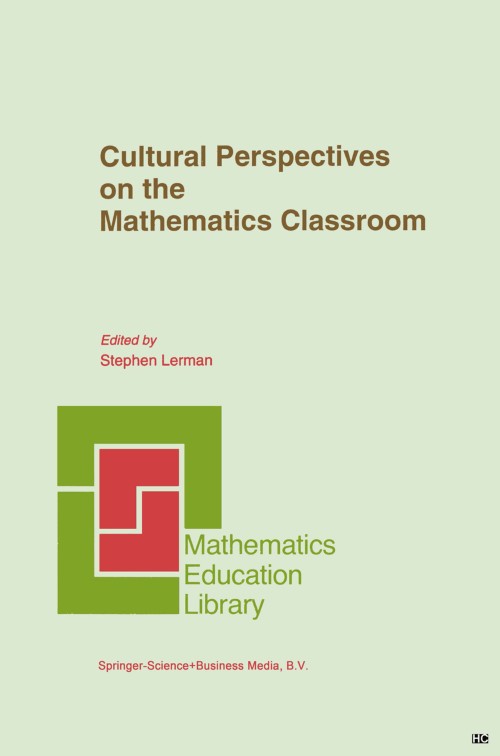
245 10|aCultural Perspectives on the Mathematics Classroom|h[electronic resource] /|cedited by Steve Lerman.
250 |a1st ed. 1994.
264 1|aDordrecht :|bSpringer Netherlands :|bImprint: Springer,|c1994.
300 |aVI, 215 p.|bonline resource.
336 |atext|btxt|2rdacontent
337 |acomputer|bc|2rdamedia
338 |aonline resource|bcr|2rdacarrier
347 |atext file|bPDF|2rda
490 1 |aMathematics Education Library,|x2214-983X ;|v14
505 0 |aThe Culture of the Mathematics Classroom: An Unknown Quantity? -- Sets, Lies and Stereotypes -- Mathematics by All -- Whose Culture Includes Mathematics? -- Anthropology in the Mathematics Classroom? -- What Happens When Robots Have Feelings? -- The Computer as a Catalyst in the Mathematics Classroom? -- Spoken Mathematical Classroom Culture: Artifice and Artificiality -- Patterns of Interaction and the Culture of Mathematics Classrooms -- Language and “Subjectivity” in the Mathematics Classroom -- Changing Focus in the Mathematics Classroom.
520 |aMathematics teaching and learning have been dominated by a concern for the intellectual readiness of the child, debates over rote learning versus understanding and, recently, mathematical processes and thinking. The gaze into today's mathematics classroom is firmly focused on the individual learner. Recently, however, studies of mathematics in social practices, including the market place and the home, have initiated a shift of focus. Culture has become identified as a key to understanding the basis on which the learner appropriates meaning. The chapters in this timely book attempt to engage with this shift of focus and offer original contributions to the debate about mathematics teaching and learning. They adopt theoretical perspectives while drawing on the classroom as both the source of investigation and the site of potential change and development. The book will be of fundamental interest to lecturers and researchers and to teachers concerned with the classroom as a cultural phenomenon.
532 8 |aAccessibility summary: This PDF is not accessible. It is based on scanned pages and does not support features such as screen reader compatibility or described non-text content (images, graphs etc). However, it likely supports searchable and selectable text based on OCR (Optical Character Recognition). Users with accessibility needs may not be able to use this content effectively. Please contact us at accessibilitysupport@springernature.com if you require assistance or an alternative format.
532 8 |aInaccessible, or known limited accessibility
532 8 |aNo reading system accessibility options actively disabled
532 8 |aPublisher contact for further accessibility information: accessibilitysupport@springernature.com
650 0|aMathematics|xStudy and teaching .
650 0|aEducation|xPhilosophy.
650 14|aMathematics Education.
650 24|aPhilosophy of Education.
700 1 |aLerman, Steve.|eeditor.|4edt|4http://id.loc.gov/vocabulary/relators/edt
710 2 |aSpringerLink (Online service)
773 0 |tSpringer Nature eBook
776 08|iPrinted edition:|z9780792329312
776 08|iPrinted edition:|z9789048144242
776 08|iPrinted edition:|z9789401712002
830 0|aMathematics Education Library,|x2214-983X ;|v14
856 40|uhttps://doi.org/10.1007/978-94-017-1199-9
912 |aZDB-2-SHU
912 |aZDB-2-SXED
912 |aZDB-2-BAE
950 |aHumanities, Social Sciences and Law (SpringerNature-11648)
950 |aEducation (R0) (SpringerNature-43721)