

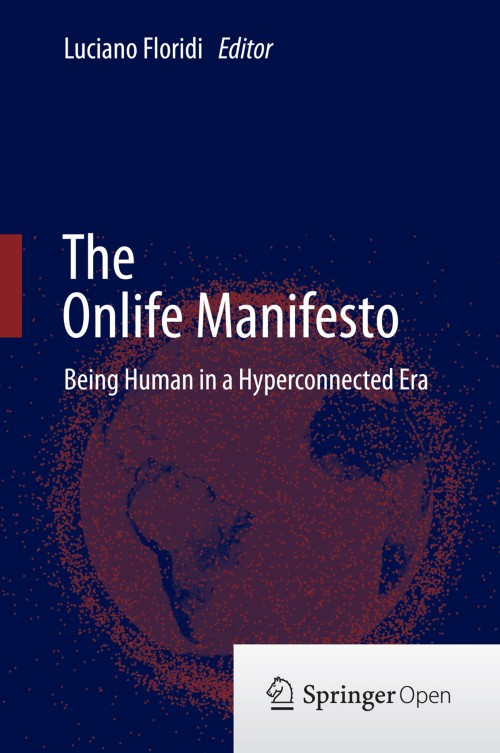
The Onlife Manifesto [electronic resource] : Being Human in a Hyperconnected Era / edited by Luciano Floridi.
Erişim Adresi
ISBN
9783319040936
Dil Kodu
İngilizce
Yer Numarası
DK/10478
Basım Bildirimi
1st ed. 2015.
Yayın Bilgisi
Cham : Springer International Publishing : Imprint: Springer, 2015.
Fiziksel Niteleme
XIV, 264 p. online resource.
İçindekiler Notu
Introduction; Luciano Floridi -- Preface -- The Onlife Manifesto -- Commentary by Ess; Charles Ess -- Commentary by Floridi; Luciano Floridi -- Commentary by Ganascia; Jean-Gabriel Ganascia -- Commentary by Hildebrandt; Mireille Hildebrandt -- Commentary by Laouris; Yiannis Laouris -- Commentary by Pagallo; Ugo Pagallo -- Commentary by Simon; Judith Simon -- Commentary by Thorseth; May Thorseth -- The Onlife Initiative -- Background Document: Rethinking public spaces in the digital transition -- Part I. Hyperconnectivity -- Hyperhistory and the Philosophy of Information Policies; Luciano Floridi -- Views and Examples on Hyper-connectivity; Jean-Gabriel Ganascia -- Part II. Identity, selfhood and attention -- The Onlife Manifesto Philosophical Backgrounds Media Usages and the Futures of Democracy and Equality; Charles Ess -- Towards a Grey Ecology; Stefana Broadbent and Claire Lobet-Maris -- Reengineering and Reinventing both Democracy and the Concept of Life in the Digital Era; Yiannis Laouris -- Part III. Complexity, responsibility and governance -- Distributed Epistemic Responsibility in a Hyperconnected Era; Judith Simon -- Good Onlife Governance: On Law, Spontaneous Orders, and Design; Ugo Pagallo -- Part IV. The public sphere in a computational era -- The Public(s) Onlife – A Call for Legal Protection by Design; Mireille Hildebrandt -- Rethinking the Human Condition in a Hyperconnected Era: Why Freedom is not about Sovereignty but about Beginnings; Nicole Dewandre -- Designing the public sphere: information technologies and the politics of mediation; Peter-Paul Verbeek -- Towards an Online Bill of Rights; Sarah Oates -- On Tolerance and Fictitious Publics; May Thorseth -- The Onlife Initiative – Conclusion.
Özet, vb.
What is the impact of information and communication technologies (ICTs) on the human condition? In order to address this question, in 2012 the European Commission organized a research project entitled The Onlife Initiative: concept reengineering for rethinking societal concerns in the digital transition. This volume collects the work of the Onlife Initiative. It explores how the development and widespread use of ICTs have a radical impact on the human condition. ICTs are not mere tools but rather social forces that are increasingly affecting our self-conception (who we are), our mutual interactions (how we socialise); our conception of reality (our metaphysics); and our interactions with reality (our agency). In each case, ICTs have a huge ethical, legal, and political significance, yet one with which we have begun to come to terms only recently. The impact exercised by ICTs is due to at least four major transformations: the blurring of the distinction between reality and virtuality; the blurring of the distinction between human, machine and nature; the reversal from information scarcity to information abundance; and the shift from the primacy of stand-alone things, properties, and binary relations, to the primacy of interactions, processes and networks. Such transformations are testing the foundations of our conceptual frameworks. Our current conceptual toolbox is no longer fitted to address new ICT-related challenges. This is not only a problem in itself. It is also a risk, because the lack of a clear understanding of our present time may easily lead to negative projections about the future. The goal of The Manifesto, and of the whole book that contextualises, is therefore that of contributing to the update of our philosophy. It is a constructive goal. The book is meant to be a positive contribution to rethinking the philosophy on which policies are built in a hyperconnected world, so that we may have a better chance of understanding our ICT-related problems and solving them satisfactorily. The Manifesto launches an open debate on the impacts of ICTs on public spaces, politics and societal expectations toward policymaking in the Digital Agenda for Europe’s remit. More broadly, it helps start a reflection on the way in which a hyperconnected world calls for rethinking the referential frameworks on which policies are built.
Konu
Technology __ Philosophy.
Economic development.
Mass media.
Philosophy of Technology.
Economic Development, Innovation and Growth.
Media Sociology.
Economic development.
Mass media.
Philosophy of Technology.
Economic Development, Innovation and Growth.
Media Sociology.
Diğer Yazarlar
Kurum Adı
Eseri Alıntıla
Referansları kullanmadan önce gözden geçirmeniz ve varsa gerekli düzeltmeleri yapmanız önerilir.
Dijital Kaynak
MARC Görünümü
LEADER 05934nam a22005415i 4500
001 809189
003 TR_AnAIT
005 20260131023849
007 cr nn 008mamaa
008 141115s2015 sz | s |||| 0|eng d
020 |a9783319040936|9978-3-319-04093-6
024 7 |a10.1007/978-3-319-04093-6|2doi
041 |aeng
049 |aTürk Tarih Kurumu Kütüphanesi
050 4|aT14
072 7|aHP|2bicssc
072 7|aTB|2bicssc
072 7|aSCI075000|2bisacsh
072 7|aQD|2thema
072 7|aTB|2thema
082 04|a601|223
090 |aDK/10478
245 14|aThe Onlife Manifesto|h[electronic resource] :|bBeing Human in a Hyperconnected Era /|cedited by Luciano Floridi.
250 |a1st ed. 2015.
264 1|aCham :|bSpringer International Publishing :|bImprint: Springer,|c2015.
300 |aXIV, 264 p.|bonline resource.
336 |atext|btxt|2rdacontent
337 |acomputer|bc|2rdamedia
338 |aonline resource|bcr|2rdacarrier
347 |atext file|bPDF|2rda
505 0 |aIntroduction; Luciano Floridi -- Preface -- The Onlife Manifesto -- Commentary by Ess; Charles Ess -- Commentary by Floridi; Luciano Floridi -- Commentary by Ganascia; Jean-Gabriel Ganascia -- Commentary by Hildebrandt; Mireille Hildebrandt -- Commentary by Laouris; Yiannis Laouris -- Commentary by Pagallo; Ugo Pagallo -- Commentary by Simon; Judith Simon -- Commentary by Thorseth; May Thorseth -- The Onlife Initiative -- Background Document: Rethinking public spaces in the digital transition -- Part I. Hyperconnectivity -- Hyperhistory and the Philosophy of Information Policies; Luciano Floridi -- Views and Examples on Hyper-connectivity; Jean-Gabriel Ganascia -- Part II. Identity, selfhood and attention -- The Onlife Manifesto Philosophical Backgrounds Media Usages and the Futures of Democracy and Equality; Charles Ess -- Towards a Grey Ecology; Stefana Broadbent and Claire Lobet-Maris -- Reengineering and Reinventing both Democracy and the Concept of Life in the Digital Era; Yiannis Laouris -- Part III. Complexity, responsibility and governance -- Distributed Epistemic Responsibility in a Hyperconnected Era; Judith Simon -- Good Onlife Governance: On Law, Spontaneous Orders, and Design; Ugo Pagallo -- Part IV. The public sphere in a computational era -- The Public(s) Onlife – A Call for Legal Protection by Design; Mireille Hildebrandt -- Rethinking the Human Condition in a Hyperconnected Era: Why Freedom is not about Sovereignty but about Beginnings; Nicole Dewandre -- Designing the public sphere: information technologies and the politics of mediation; Peter-Paul Verbeek -- Towards an Online Bill of Rights; Sarah Oates -- On Tolerance and Fictitious Publics; May Thorseth -- The Onlife Initiative – Conclusion.
506 0 |aOpen Access
520 |aWhat is the impact of information and communication technologies (ICTs) on the human condition? In order to address this question, in 2012 the European Commission organized a research project entitled The Onlife Initiative: concept reengineering for rethinking societal concerns in the digital transition. This volume collects the work of the Onlife Initiative. It explores how the development and widespread use of ICTs have a radical impact on the human condition. ICTs are not mere tools but rather social forces that are increasingly affecting our self-conception (who we are), our mutual interactions (how we socialise); our conception of reality (our metaphysics); and our interactions with reality (our agency). In each case, ICTs have a huge ethical, legal, and political significance, yet one with which we have begun to come to terms only recently. The impact exercised by ICTs is due to at least four major transformations: the blurring of the distinction between reality and virtuality; the blurring of the distinction between human, machine and nature; the reversal from information scarcity to information abundance; and the shift from the primacy of stand-alone things, properties, and binary relations, to the primacy of interactions, processes and networks. Such transformations are testing the foundations of our conceptual frameworks. Our current conceptual toolbox is no longer fitted to address new ICT-related challenges. This is not only a problem in itself. It is also a risk, because the lack of a clear understanding of our present time may easily lead to negative projections about the future. The goal of The Manifesto, and of the whole book that contextualises, is therefore that of contributing to the update of our philosophy. It is a constructive goal. The book is meant to be a positive contribution to rethinking the philosophy on which policies are built in a hyperconnected world, so that we may have a better chance of understanding our ICT-related problems and solving them satisfactorily. The Manifesto launches an open debate on the impacts of ICTs on public spaces, politics and societal expectations toward policymaking in the Digital Agenda for Europe’s remit. More broadly, it helps start a reflection on the way in which a hyperconnected world calls for rethinking the referential frameworks on which policies are built.
650 0|aTechnology|xPhilosophy.
650 0|aEconomic development.
650 0|aMass media.
650 14|aPhilosophy of Technology.
650 24|aEconomic Development, Innovation and Growth.
650 24|aMedia Sociology.
700 1 |aFloridi, Luciano.|eeditor.|4edt|4http://id.loc.gov/vocabulary/relators/edt
710 2 |aSpringerLink (Online service)
773 0 |tSpringer Nature eBook
776 08|iPrinted edition:|z9783319040929
776 08|iPrinted edition:|z9783319040943
776 08|iPrinted edition:|z9783319140193
856 40|uhttps://doi.org/10.1007/978-3-319-04093-6
912 |aZDB-2-SHU
912 |aZDB-2-SXPR
912 |aZDB-2-SOB
950 |aHumanities, Social Sciences and Law (SpringerNature-11648)
950 |aPhilosophy and Religion (R0) (SpringerNature-43725)
001 809189
003 TR_AnAIT
005 20260131023849
007 cr nn 008mamaa
008 141115s2015 sz | s |||| 0|eng d
020 |a9783319040936|9978-3-319-04093-6
024 7 |a10.1007/978-3-319-04093-6|2doi
041 |aeng
049 |aTürk Tarih Kurumu Kütüphanesi
050 4|aT14
072 7|aHP|2bicssc
072 7|aTB|2bicssc
072 7|aSCI075000|2bisacsh
072 7|aQD|2thema
072 7|aTB|2thema
082 04|a601|223
090 |aDK/10478
245 14|aThe Onlife Manifesto|h[electronic resource] :|bBeing Human in a Hyperconnected Era /|cedited by Luciano Floridi.
250 |a1st ed. 2015.
264 1|aCham :|bSpringer International Publishing :|bImprint: Springer,|c2015.
300 |aXIV, 264 p.|bonline resource.
336 |atext|btxt|2rdacontent
337 |acomputer|bc|2rdamedia
338 |aonline resource|bcr|2rdacarrier
347 |atext file|bPDF|2rda
505 0 |aIntroduction; Luciano Floridi -- Preface -- The Onlife Manifesto -- Commentary by Ess; Charles Ess -- Commentary by Floridi; Luciano Floridi -- Commentary by Ganascia; Jean-Gabriel Ganascia -- Commentary by Hildebrandt; Mireille Hildebrandt -- Commentary by Laouris; Yiannis Laouris -- Commentary by Pagallo; Ugo Pagallo -- Commentary by Simon; Judith Simon -- Commentary by Thorseth; May Thorseth -- The Onlife Initiative -- Background Document: Rethinking public spaces in the digital transition -- Part I. Hyperconnectivity -- Hyperhistory and the Philosophy of Information Policies; Luciano Floridi -- Views and Examples on Hyper-connectivity; Jean-Gabriel Ganascia -- Part II. Identity, selfhood and attention -- The Onlife Manifesto Philosophical Backgrounds Media Usages and the Futures of Democracy and Equality; Charles Ess -- Towards a Grey Ecology; Stefana Broadbent and Claire Lobet-Maris -- Reengineering and Reinventing both Democracy and the Concept of Life in the Digital Era; Yiannis Laouris -- Part III. Complexity, responsibility and governance -- Distributed Epistemic Responsibility in a Hyperconnected Era; Judith Simon -- Good Onlife Governance: On Law, Spontaneous Orders, and Design; Ugo Pagallo -- Part IV. The public sphere in a computational era -- The Public(s) Onlife – A Call for Legal Protection by Design; Mireille Hildebrandt -- Rethinking the Human Condition in a Hyperconnected Era: Why Freedom is not about Sovereignty but about Beginnings; Nicole Dewandre -- Designing the public sphere: information technologies and the politics of mediation; Peter-Paul Verbeek -- Towards an Online Bill of Rights; Sarah Oates -- On Tolerance and Fictitious Publics; May Thorseth -- The Onlife Initiative – Conclusion.
506 0 |aOpen Access
520 |aWhat is the impact of information and communication technologies (ICTs) on the human condition? In order to address this question, in 2012 the European Commission organized a research project entitled The Onlife Initiative: concept reengineering for rethinking societal concerns in the digital transition. This volume collects the work of the Onlife Initiative. It explores how the development and widespread use of ICTs have a radical impact on the human condition. ICTs are not mere tools but rather social forces that are increasingly affecting our self-conception (who we are), our mutual interactions (how we socialise); our conception of reality (our metaphysics); and our interactions with reality (our agency). In each case, ICTs have a huge ethical, legal, and political significance, yet one with which we have begun to come to terms only recently. The impact exercised by ICTs is due to at least four major transformations: the blurring of the distinction between reality and virtuality; the blurring of the distinction between human, machine and nature; the reversal from information scarcity to information abundance; and the shift from the primacy of stand-alone things, properties, and binary relations, to the primacy of interactions, processes and networks. Such transformations are testing the foundations of our conceptual frameworks. Our current conceptual toolbox is no longer fitted to address new ICT-related challenges. This is not only a problem in itself. It is also a risk, because the lack of a clear understanding of our present time may easily lead to negative projections about the future. The goal of The Manifesto, and of the whole book that contextualises, is therefore that of contributing to the update of our philosophy. It is a constructive goal. The book is meant to be a positive contribution to rethinking the philosophy on which policies are built in a hyperconnected world, so that we may have a better chance of understanding our ICT-related problems and solving them satisfactorily. The Manifesto launches an open debate on the impacts of ICTs on public spaces, politics and societal expectations toward policymaking in the Digital Agenda for Europe’s remit. More broadly, it helps start a reflection on the way in which a hyperconnected world calls for rethinking the referential frameworks on which policies are built.
650 0|aTechnology|xPhilosophy.
650 0|aEconomic development.
650 0|aMass media.
650 14|aPhilosophy of Technology.
650 24|aEconomic Development, Innovation and Growth.
650 24|aMedia Sociology.
700 1 |aFloridi, Luciano.|eeditor.|4edt|4http://id.loc.gov/vocabulary/relators/edt
710 2 |aSpringerLink (Online service)
773 0 |tSpringer Nature eBook
776 08|iPrinted edition:|z9783319040929
776 08|iPrinted edition:|z9783319040943
776 08|iPrinted edition:|z9783319140193
856 40|uhttps://doi.org/10.1007/978-3-319-04093-6
912 |aZDB-2-SHU
912 |aZDB-2-SXPR
912 |aZDB-2-SOB
950 |aHumanities, Social Sciences and Law (SpringerNature-11648)
950 |aPhilosophy and Religion (R0) (SpringerNature-43725)
Materyaller
Depodan talep edilen materyal sadece kütüphane içerisinde kullanılmaktadır.
Materyal dışarıya ödünç verilmemektedir.
Materyal dışarıya ödünç verilmemektedir.
