LEADER 04353nam a22005895i 4500
001 809239
003 TR_AnAIT
005 20260131023721
007 cr nn 008mamaa
008 121227s2003 ne | s |||| 0|eng d
020 |a9789401000376|9978-94-010-0037-6
024 7 |a10.1007/978-94-010-0037-6|2doi
041 |aeng
049 |aTürk Tarih Kurumu Kütüphanesi
050 4|aP98-98.5
072 7|aCFX|2bicssc
072 7|aCOM073000|2bisacsh
072 7|aCFX|2thema
082 04|a410.285|223
090 |aDK/10528
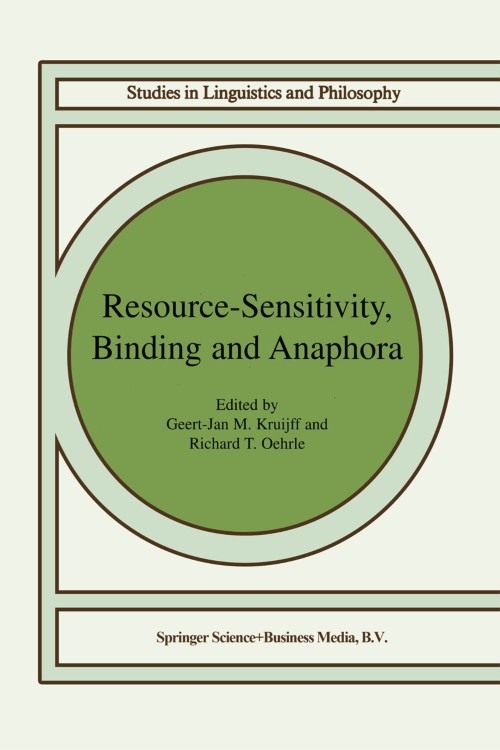
245 10|aResource-Sensitivity, Binding and Anaphora|h[electronic resource] /|cedited by Geert-Jan M. Kruijff, Richard T. Oehrle.
250 |a1st ed. 2003.
264 1|aDordrecht :|bSpringer Netherlands :|bImprint: Springer,|c2003.
300 |aXXII, 297 p.|bonline resource.
336 |atext|btxt|2rdacontent
337 |acomputer|bc|2rdamedia
338 |aonline resource|bcr|2rdacarrier
347 |atext file|bPDF|2rda
490 1 |aStudies in Linguistics and Philosophy,|x2215-034X ;|v80
505 0 |aI Resources, Structures, and Composition -- 1 Categorial Grammar at a Cross-Roads -- 2 Language, Lambdas, and Logic -- II Resources, Binding, and Anaphora -- 3 Binding without pronouns (and pronouns without binding) -- 4 Resource Sharing in Type Logical Grammar -- 5 Binding Across Boundaries -- 6 On Bound Anaphora in Type Logical Grammar -- 7 Structural Communication in Binding -- 8 Binding on the Fly: Cross-Sentential Anaphora in Variable-Free Semantics -- III Appendices -- 9 Resource-Sensitity-A Brief Guide -- 10 Some Precursors.
520 |aGeert-Jan Kruijff & Richard T. Oehrle A categorial grammar is both a grammar and a type inference system. As a result of this duality, the categorial framework offers a natural setting in which to study questions of grammatical composition, both empirically and abstractly. There are affinities in this perspective, of course, to basic questions in formal language theory. But the fact that categorial grammars are type in ference systems makes possible intrinsic connections among syntactic types, syntactic type inference, semantic types, and semantic type inference, a con nection less apparent in the standard constructions of formal language theory. Fixing a system of grammatical type inference T, we may explore what gram matical phenomena are compatible with T-and equally, what grammatical phenomena are not. Equally, fixing a class of grammatical phenomena g, we may seek to ascertain what systems of type inference characterize g. This dual perspective is a strong current in the categorial literature, going back to the classical papers of Ajdukiewicz, Bar-Hillel, Curry, and Lambek.
532 8 |aAccessibility summary: This PDF is not accessible. It is based on scanned pages and does not support features such as screen reader compatibility or described non-text content (images, graphs etc). However, it likely supports searchable and selectable text based on OCR (Optical Character Recognition). Users with accessibility needs may not be able to use this content effectively. Please contact us at accessibilitysupport@springernature.com if you require assistance or an alternative format.
532 8 |aInaccessible, or known limited accessibility
532 8 |aNo reading system accessibility options actively disabled
532 8 |aPublisher contact for further accessibility information: accessibilitysupport@springernature.com
650 0|aComputational linguistics.
650 0|aLogic.
650 0|aArtificial intelligence.
650 14|aComputational Linguistics.
650 24|aLogic.
650 24|aArtificial Intelligence.
700 1 |aKruijff, Geert-Jan M.|eeditor.|4edt|4http://id.loc.gov/vocabulary/relators/edt
700 1 |aOehrle, Richard T.|eeditor.|4edt|4http://id.loc.gov/vocabulary/relators/edt
710 2 |aSpringerLink (Online service)
773 0 |tSpringer Nature eBook
776 08|iPrinted edition:|z9781402016912
776 08|iPrinted edition:|z9781402016929
776 08|iPrinted edition:|z9789401000383
830 0|aStudies in Linguistics and Philosophy,|x2215-034X ;|v80
856 40|uhttps://doi.org/10.1007/978-94-010-0037-6
912 |aZDB-2-SHU
912 |aZDB-2-SXS
912 |aZDB-2-BAE
950 |aHumanities, Social Sciences and Law (SpringerNature-11648)
950 |aSocial Sciences (R0) (SpringerNature-43726)