

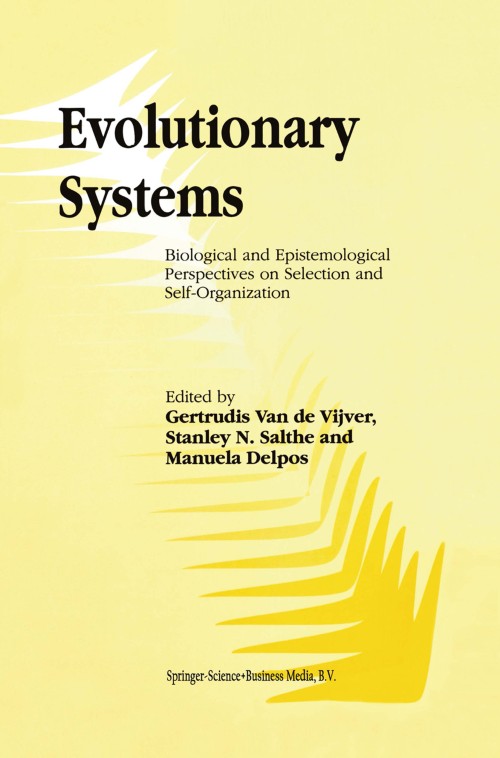
Evolutionary Systems [electronic resource] : Biological and Epistemological Perspectives on Selection and Self-Organization / edited by G. Vijver, Stanley N. Salthe, M. Delpos.
Erişim Adresi
ISBN
9789401715102
Dil Kodu
İngilizce
Yer Numarası
DK/10529
Basım Bildirimi
1st ed. 1998.
Yayın Bilgisi
Dordrecht : Springer Netherlands : Imprint: Springer, 1998.
Fiziksel Niteleme
XII, 438 p. online resource.
İçindekiler Notu
Evolution: Model or metaphor? -- The role of natural selection theory in understanding evolutionary systems -- Darwinism and developmentalism: Prospects for convergence -- Towards high evolvability dynamics -- The beginning of the end: On the origin of final cause -- Emergence of life and biological selection from the perspective of complex systems dynamics -- Self-organization and self-construction of order -- Self-organization and optimization: Conflicting or complementary approaches? -- Pleiotropy and the evolution of adaptibility -- The unified theory and selection processes -- Information increase in biological systems: How does adaptation fit? -- Canonical ensembles, evolution of competing species, and the arrow of time -- Spontaneous order, evolution, and autocatakinetics: The nomological basis for the emergence of meaning -- Pragmatic information and the emergence of meaning -- Emergence of chaos in evolving Volterra ecosystems -- Immanent causality: A Spinozist viewpoint on evolution and theory of action -- Causality as constraint -- Evolutionary systems and the four causes: A real Aristotelian story? -- Evolution as its own cause and effect -- Dealing with complex systems or how to decipher language and organisms -- The unfolding semiosphere -- Competence of natural languages for describing the physical origin of life -- Towards a “meta-ethic” derived from evolutionary lineages -- On some relations between cognitive and organic evolution -- Selected self-organization and the semiotics of evolutionary systems -- Towards an evolutionary semiotics: The emergence of new sign-functions in organisms and devices -- The evolution of the symbolic domain in living systems and artificial life -- Embodiment of natural and artificial agents -- Are life and meaning coextensive ?.
Özet, vb.
The three well known revolutions of the past centuries - the Copernican, the Darwinian and the Freudian - each in their own way had a deflating and mechanizing effect on the position of humans in nature. They opened up a richness of disillusion: earth acquired a more modest place in the universe, the human body and mind became products of a long material evolutionary history, and human reason, instead of being the central, immaterial, locus of understanding, was admitted into the theater of discourse only as a materialized and frequently out-of-control actor. Is there something objectionable to this picture? Formulated as such, probably not. Why should we resist the idea that we are in certain ways, and to some degree, physically, biologically or psychically determined? Why refuse to acknowledge the fact that we are materially situated in an ever evolving world? Why deny that the ways of inscription (traces of past events and processes) are co-determinative of further "evolutionary pathways"? Why minimize the idea that each intervention, of each natural being, is temporally and materially situated, and has, as such, the inevitable consequence of changing the world? The point is, however, that there are many, more or less radically different, ways to consider the "mechanization" of man and nature. There are, in particular, many ways to get the message of "material and evolutionary determination", as well as many levels at which this determination can be thought of as relevant or irrelevant.
Konu
Biology __ Philosophy.
Evolution (Biology).
System theory.
Mathematical physics.
Philosophy of Biology.
Evolutionary Biology.
Complex Systems.
Theoretical, Mathematical and Computational Physics.
Evolution (Biology).
System theory.
Mathematical physics.
Philosophy of Biology.
Evolutionary Biology.
Complex Systems.
Theoretical, Mathematical and Computational Physics.
Diğer Yazarlar
Kurum Adı
Eseri Alıntıla
Referansları kullanmadan önce gözden geçirmeniz ve varsa gerekli düzeltmeleri yapmanız önerilir.
Dijital Kaynak
MARC Görünümü
LEADER 06190nam a22006255i 4500
001 809240
003 TR_AnAIT
005 20260131023720
007 cr nn 008mamaa
008 130321s1998 ne | s |||| 0|eng d
020 |a9789401715102|9978-94-017-1510-2
024 7 |a10.1007/978-94-017-1510-2|2doi
041 |aeng
049 |aTürk Tarih Kurumu Kütüphanesi
050 4|aQH331
072 7|aHP|2bicssc
072 7|aPS|2bicssc
072 7|aSCI075000|2bisacsh
072 7|aQD|2thema
072 7|aPS|2thema
082 04|a570.1|223
090 |aDK/10529
245 10|aEvolutionary Systems|h[electronic resource] :|bBiological and Epistemological Perspectives on Selection and Self-Organization /|cedited by G. Vijver, Stanley N. Salthe, M. Delpos.
250 |a1st ed. 1998.
264 1|aDordrecht :|bSpringer Netherlands :|bImprint: Springer,|c1998.
300 |aXII, 438 p.|bonline resource.
336 |atext|btxt|2rdacontent
337 |acomputer|bc|2rdamedia
338 |aonline resource|bcr|2rdacarrier
347 |atext file|bPDF|2rda
505 0 |aEvolution: Model or metaphor? -- The role of natural selection theory in understanding evolutionary systems -- Darwinism and developmentalism: Prospects for convergence -- Towards high evolvability dynamics -- The beginning of the end: On the origin of final cause -- Emergence of life and biological selection from the perspective of complex systems dynamics -- Self-organization and self-construction of order -- Self-organization and optimization: Conflicting or complementary approaches? -- Pleiotropy and the evolution of adaptibility -- The unified theory and selection processes -- Information increase in biological systems: How does adaptation fit? -- Canonical ensembles, evolution of competing species, and the arrow of time -- Spontaneous order, evolution, and autocatakinetics: The nomological basis for the emergence of meaning -- Pragmatic information and the emergence of meaning -- Emergence of chaos in evolving Volterra ecosystems -- Immanent causality: A Spinozist viewpoint on evolution and theory of action -- Causality as constraint -- Evolutionary systems and the four causes: A real Aristotelian story? -- Evolution as its own cause and effect -- Dealing with complex systems or how to decipher language and organisms -- The unfolding semiosphere -- Competence of natural languages for describing the physical origin of life -- Towards a “meta-ethic” derived from evolutionary lineages -- On some relations between cognitive and organic evolution -- Selected self-organization and the semiotics of evolutionary systems -- Towards an evolutionary semiotics: The emergence of new sign-functions in organisms and devices -- The evolution of the symbolic domain in living systems and artificial life -- Embodiment of natural and artificial agents -- Are life and meaning coextensive ?.
520 |aThe three well known revolutions of the past centuries - the Copernican, the Darwinian and the Freudian - each in their own way had a deflating and mechanizing effect on the position of humans in nature. They opened up a richness of disillusion: earth acquired a more modest place in the universe, the human body and mind became products of a long material evolutionary history, and human reason, instead of being the central, immaterial, locus of understanding, was admitted into the theater of discourse only as a materialized and frequently out-of-control actor. Is there something objectionable to this picture? Formulated as such, probably not. Why should we resist the idea that we are in certain ways, and to some degree, physically, biologically or psychically determined? Why refuse to acknowledge the fact that we are materially situated in an ever evolving world? Why deny that the ways of inscription (traces of past events and processes) are co-determinative of further "evolutionary pathways"? Why minimize the idea that each intervention, of each natural being, is temporally and materially situated, and has, as such, the inevitable consequence of changing the world? The point is, however, that there are many, more or less radically different, ways to consider the "mechanization" of man and nature. There are, in particular, many ways to get the message of "material and evolutionary determination", as well as many levels at which this determination can be thought of as relevant or irrelevant.
532 8 |aAccessibility summary: This PDF is not accessible. It is based on scanned pages and does not support features such as screen reader compatibility or described non-text content (images, graphs etc). However, it likely supports searchable and selectable text based on OCR (Optical Character Recognition). Users with accessibility needs may not be able to use this content effectively. Please contact us at accessibilitysupport@springernature.com if you require assistance or an alternative format.
532 8 |aInaccessible, or known limited accessibility
532 8 |aNo reading system accessibility options actively disabled
532 8 |aPublisher contact for further accessibility information: accessibilitysupport@springernature.com
650 0|aBiology|xPhilosophy.
650 0|aEvolution (Biology).
650 0|aSystem theory.
650 0|aMathematical physics.
650 14|aPhilosophy of Biology.
650 24|aEvolutionary Biology.
650 24|aComplex Systems.
650 24|aTheoretical, Mathematical and Computational Physics.
700 1 |aVijver, G.|eeditor.|4edt|4http://id.loc.gov/vocabulary/relators/edt
700 1 |aSalthe, Stanley N.|eeditor.|4edt|4http://id.loc.gov/vocabulary/relators/edt
700 1 |aDelpos, M.|eeditor.|4edt|4http://id.loc.gov/vocabulary/relators/edt
710 2 |aSpringerLink (Online service)
773 0 |tSpringer Nature eBook
776 08|iPrinted edition:|z9780792352600
776 08|iPrinted edition:|z9789048151035
776 08|iPrinted edition:|z9789401715119
856 40|uhttps://doi.org/10.1007/978-94-017-1510-2
912 |aZDB-2-SHU
912 |aZDB-2-SXPR
912 |aZDB-2-BAE
950 |aHumanities, Social Sciences and Law (SpringerNature-11648)
950 |aPhilosophy and Religion (R0) (SpringerNature-43725)
001 809240
003 TR_AnAIT
005 20260131023720
007 cr nn 008mamaa
008 130321s1998 ne | s |||| 0|eng d
020 |a9789401715102|9978-94-017-1510-2
024 7 |a10.1007/978-94-017-1510-2|2doi
041 |aeng
049 |aTürk Tarih Kurumu Kütüphanesi
050 4|aQH331
072 7|aHP|2bicssc
072 7|aPS|2bicssc
072 7|aSCI075000|2bisacsh
072 7|aQD|2thema
072 7|aPS|2thema
082 04|a570.1|223
090 |aDK/10529
245 10|aEvolutionary Systems|h[electronic resource] :|bBiological and Epistemological Perspectives on Selection and Self-Organization /|cedited by G. Vijver, Stanley N. Salthe, M. Delpos.
250 |a1st ed. 1998.
264 1|aDordrecht :|bSpringer Netherlands :|bImprint: Springer,|c1998.
300 |aXII, 438 p.|bonline resource.
336 |atext|btxt|2rdacontent
337 |acomputer|bc|2rdamedia
338 |aonline resource|bcr|2rdacarrier
347 |atext file|bPDF|2rda
505 0 |aEvolution: Model or metaphor? -- The role of natural selection theory in understanding evolutionary systems -- Darwinism and developmentalism: Prospects for convergence -- Towards high evolvability dynamics -- The beginning of the end: On the origin of final cause -- Emergence of life and biological selection from the perspective of complex systems dynamics -- Self-organization and self-construction of order -- Self-organization and optimization: Conflicting or complementary approaches? -- Pleiotropy and the evolution of adaptibility -- The unified theory and selection processes -- Information increase in biological systems: How does adaptation fit? -- Canonical ensembles, evolution of competing species, and the arrow of time -- Spontaneous order, evolution, and autocatakinetics: The nomological basis for the emergence of meaning -- Pragmatic information and the emergence of meaning -- Emergence of chaos in evolving Volterra ecosystems -- Immanent causality: A Spinozist viewpoint on evolution and theory of action -- Causality as constraint -- Evolutionary systems and the four causes: A real Aristotelian story? -- Evolution as its own cause and effect -- Dealing with complex systems or how to decipher language and organisms -- The unfolding semiosphere -- Competence of natural languages for describing the physical origin of life -- Towards a “meta-ethic” derived from evolutionary lineages -- On some relations between cognitive and organic evolution -- Selected self-organization and the semiotics of evolutionary systems -- Towards an evolutionary semiotics: The emergence of new sign-functions in organisms and devices -- The evolution of the symbolic domain in living systems and artificial life -- Embodiment of natural and artificial agents -- Are life and meaning coextensive ?.
520 |aThe three well known revolutions of the past centuries - the Copernican, the Darwinian and the Freudian - each in their own way had a deflating and mechanizing effect on the position of humans in nature. They opened up a richness of disillusion: earth acquired a more modest place in the universe, the human body and mind became products of a long material evolutionary history, and human reason, instead of being the central, immaterial, locus of understanding, was admitted into the theater of discourse only as a materialized and frequently out-of-control actor. Is there something objectionable to this picture? Formulated as such, probably not. Why should we resist the idea that we are in certain ways, and to some degree, physically, biologically or psychically determined? Why refuse to acknowledge the fact that we are materially situated in an ever evolving world? Why deny that the ways of inscription (traces of past events and processes) are co-determinative of further "evolutionary pathways"? Why minimize the idea that each intervention, of each natural being, is temporally and materially situated, and has, as such, the inevitable consequence of changing the world? The point is, however, that there are many, more or less radically different, ways to consider the "mechanization" of man and nature. There are, in particular, many ways to get the message of "material and evolutionary determination", as well as many levels at which this determination can be thought of as relevant or irrelevant.
532 8 |aAccessibility summary: This PDF is not accessible. It is based on scanned pages and does not support features such as screen reader compatibility or described non-text content (images, graphs etc). However, it likely supports searchable and selectable text based on OCR (Optical Character Recognition). Users with accessibility needs may not be able to use this content effectively. Please contact us at accessibilitysupport@springernature.com if you require assistance or an alternative format.
532 8 |aInaccessible, or known limited accessibility
532 8 |aNo reading system accessibility options actively disabled
532 8 |aPublisher contact for further accessibility information: accessibilitysupport@springernature.com
650 0|aBiology|xPhilosophy.
650 0|aEvolution (Biology).
650 0|aSystem theory.
650 0|aMathematical physics.
650 14|aPhilosophy of Biology.
650 24|aEvolutionary Biology.
650 24|aComplex Systems.
650 24|aTheoretical, Mathematical and Computational Physics.
700 1 |aVijver, G.|eeditor.|4edt|4http://id.loc.gov/vocabulary/relators/edt
700 1 |aSalthe, Stanley N.|eeditor.|4edt|4http://id.loc.gov/vocabulary/relators/edt
700 1 |aDelpos, M.|eeditor.|4edt|4http://id.loc.gov/vocabulary/relators/edt
710 2 |aSpringerLink (Online service)
773 0 |tSpringer Nature eBook
776 08|iPrinted edition:|z9780792352600
776 08|iPrinted edition:|z9789048151035
776 08|iPrinted edition:|z9789401715119
856 40|uhttps://doi.org/10.1007/978-94-017-1510-2
912 |aZDB-2-SHU
912 |aZDB-2-SXPR
912 |aZDB-2-BAE
950 |aHumanities, Social Sciences and Law (SpringerNature-11648)
950 |aPhilosophy and Religion (R0) (SpringerNature-43725)
Materyaller
Depodan talep edilen materyal sadece kütüphane içerisinde kullanılmaktadır.
Materyal dışarıya ödünç verilmemektedir.
Materyal dışarıya ödünç verilmemektedir.
