

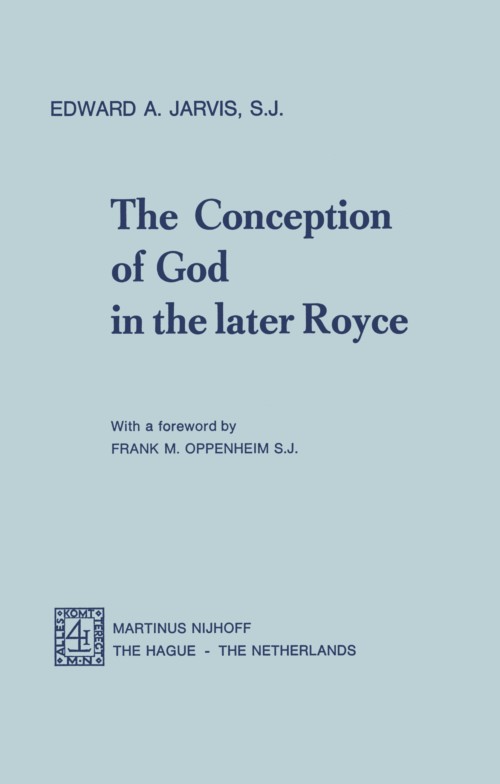
The Conception of God in the Later Royce [electronic resource] / by E.A. Jarvis.
Erişim Adresi
ISBN
9789401016599
Dil Kodu
İngilizce
Yer Numarası
DK/10530
Yazar
Basım Bildirimi
1st ed. 1975.
Yayın Bilgisi
Dordrecht : Springer Netherlands : Imprint: Springer, 1975.
Fiziksel Niteleme
XXIV, 199 p. online resource.
İçindekiler Notu
I. The Early Thought of Royce -- 1. Moral Theory -- 2. Empirical Theism -- 3. Postulates. The Right to Believe -- 4. Idealism as an Hypothesis Based on Postulates -- 5. Skepticism and the Possibility of Error -- 6. Common Sense and the Problem of Error -- 7. Solution and Conclusion to Absolute Idealism -- 8. Absolute Idealism and the Nature of Error -- 9. The Problem of Evil -- 10. The Conception of God. Critique -- II. The Middle Thought of Royce -- 1. Transition to “The World and the Individual” -- 2. “The World and the Individual”: Introduction -- 3. Realism -- 4. Mysticism -- 5. Critical Rationalism -- 6. The Internal and External Meaning of Ideas -- 7. The Fourth Conception of Being -- 8. The Proof of God’s Existence -- 9. The One, the Many, and the Infinite -- 10. The Temporal and the Eternal -- 11. The Moral Order and the Problem of Evil -- 12. Immortality -- 13. The Conception of God. Summary -- III. The Later Theory of Community -- 1. Transition to “The Problem of Christianity” -- 2. “The Problem of Christianity”: Introduction -- 3. The Moral Burden of the Individual -- 4. Guilt and Atonement -- 5. The Beloved Community -- 6. The Community and the Time-Process -- 7. The Body and Its Members -- 8. The Nature of Interpretation -- 9. The Will to Interpret -- IV. The Later Conception of God -- 1. The World of Interpretation -- 2. The Theoretical and the Practical -- 3. Peirce’s “Neglected Argument” -- 4. The Conception of God -- 5. Elements in Royce’s Later Conception of God Which are Similar to and Continuous with Earlier Conceptions -- 6. Elements in Royce’s Later Conception of God Which are Different from His Earlier Conceptions. Summary.
Özet, vb.
Dr. Jarvis kindly invited me to undertake this Foreword. According to his suggestion, I here intend to complement his work by creating a context for it. To do so, prior notice of a common misrepresentation of Royce and of his contemporary relevance seems needed, before briefly sketching his biography and interest in religion. Finally, to orient the reader to the present study, I will point out Royce's main works and the spirit of the man. In the year 2150 A. D. , what will people be saying about Harvard? If the reported prediction of a self -effacing William James comes true, the common answer will be, "Harvard? Oh, that's the place where Royce taught. " And yet, now that almost a century has passed since Royce began teaching at Harvard, most Americans do not recognize the name "Josiah Royce. " Of those who do, few know him as a significant American philosopher of community. And of these few, far fewer recall either that religious problems first drove Royce to philosophy or that he said such problems "of all human interests, deserve our best efforts and our utmost loyalty. " 1 Little wonder, then, that when Americans survey our "classic" philosophers-Peirce, James, Royce, Santayana, Dewey, Whitehead-few of them respond to Royce as the most explicitly and persistently religious philosopher of them all. Fortunately, however, popularity contests do not accurately weigh the merit of a philosopher.
Konu
Knowledge, Theory of.
Epistemology.
Epistemology.
Kurum Adı
Eseri Alıntıla
Referansları kullanmadan önce gözden geçirmeniz ve varsa gerekli düzeltmeleri yapmanız önerilir.
Dijital Kaynak
MARC Görünümü
LEADER 05364nam a22004935i 4500
001 809241
003 TR_AnAIT
005 20260131023719
007 cr nn 008mamaa
008 121227s1975 ne | s |||| 0|eng d
020 |a9789401016599|9978-94-010-1659-9
024 7 |a10.1007/978-94-010-1659-9|2doi
041 |aeng
049 |aTürk Tarih Kurumu Kütüphanesi
050 4|aBD143-237
072 7|aHPK|2bicssc
072 7|aPHI004000|2bisacsh
072 7|aQDTK|2thema
082 04|a120|223
090 |aDK/10530
100 1 |aJarvis, E.A.|eauthor.|4aut|4http://id.loc.gov/vocabulary/relators/aut
245 14|aThe Conception of God in the Later Royce|h[electronic resource] /|cby E.A. Jarvis.
250 |a1st ed. 1975.
264 1|aDordrecht :|bSpringer Netherlands :|bImprint: Springer,|c1975.
300 |aXXIV, 199 p.|bonline resource.
336 |atext|btxt|2rdacontent
337 |acomputer|bc|2rdamedia
338 |aonline resource|bcr|2rdacarrier
347 |atext file|bPDF|2rda
505 0 |aI. The Early Thought of Royce -- 1. Moral Theory -- 2. Empirical Theism -- 3. Postulates. The Right to Believe -- 4. Idealism as an Hypothesis Based on Postulates -- 5. Skepticism and the Possibility of Error -- 6. Common Sense and the Problem of Error -- 7. Solution and Conclusion to Absolute Idealism -- 8. Absolute Idealism and the Nature of Error -- 9. The Problem of Evil -- 10. The Conception of God. Critique -- II. The Middle Thought of Royce -- 1. Transition to “The World and the Individual” -- 2. “The World and the Individual”: Introduction -- 3. Realism -- 4. Mysticism -- 5. Critical Rationalism -- 6. The Internal and External Meaning of Ideas -- 7. The Fourth Conception of Being -- 8. The Proof of God’s Existence -- 9. The One, the Many, and the Infinite -- 10. The Temporal and the Eternal -- 11. The Moral Order and the Problem of Evil -- 12. Immortality -- 13. The Conception of God. Summary -- III. The Later Theory of Community -- 1. Transition to “The Problem of Christianity” -- 2. “The Problem of Christianity”: Introduction -- 3. The Moral Burden of the Individual -- 4. Guilt and Atonement -- 5. The Beloved Community -- 6. The Community and the Time-Process -- 7. The Body and Its Members -- 8. The Nature of Interpretation -- 9. The Will to Interpret -- IV. The Later Conception of God -- 1. The World of Interpretation -- 2. The Theoretical and the Practical -- 3. Peirce’s “Neglected Argument” -- 4. The Conception of God -- 5. Elements in Royce’s Later Conception of God Which are Similar to and Continuous with Earlier Conceptions -- 6. Elements in Royce’s Later Conception of God Which are Different from His Earlier Conceptions. Summary.
520 |aDr. Jarvis kindly invited me to undertake this Foreword. According to his suggestion, I here intend to complement his work by creating a context for it. To do so, prior notice of a common misrepresentation of Royce and of his contemporary relevance seems needed, before briefly sketching his biography and interest in religion. Finally, to orient the reader to the present study, I will point out Royce's main works and the spirit of the man. In the year 2150 A. D. , what will people be saying about Harvard? If the reported prediction of a self -effacing William James comes true, the common answer will be, "Harvard? Oh, that's the place where Royce taught. " And yet, now that almost a century has passed since Royce began teaching at Harvard, most Americans do not recognize the name "Josiah Royce. " Of those who do, few know him as a significant American philosopher of community. And of these few, far fewer recall either that religious problems first drove Royce to philosophy or that he said such problems "of all human interests, deserve our best efforts and our utmost loyalty. " 1 Little wonder, then, that when Americans survey our "classic" philosophers-Peirce, James, Royce, Santayana, Dewey, Whitehead-few of them respond to Royce as the most explicitly and persistently religious philosopher of them all. Fortunately, however, popularity contests do not accurately weigh the merit of a philosopher.
532 8 |aAccessibility summary: This PDF is not accessible. It is based on scanned pages and does not support features such as screen reader compatibility or described non-text content (images, graphs etc). However, it likely supports searchable and selectable text based on OCR (Optical Character Recognition). Users with accessibility needs may not be able to use this content effectively. Please contact us at accessibilitysupport@springernature.com if you require assistance or an alternative format.
532 8 |aInaccessible, or known limited accessibility
532 8 |aNo reading system accessibility options actively disabled
532 8 |aPublisher contact for further accessibility information: accessibilitysupport@springernature.com
650 0|aKnowledge, Theory of.
650 14|aEpistemology.
710 2 |aSpringerLink (Online service)
773 0 |tSpringer Nature eBook
776 08|iPrinted edition:|z9789024717132
776 08|iPrinted edition:|z9789401016605
856 40|uhttps://doi.org/10.1007/978-94-010-1659-9
912 |aZDB-2-SHU
912 |aZDB-2-SXPR
912 |aZDB-2-BAE
950 |aHumanities, Social Sciences and Law (SpringerNature-11648)
950 |aPhilosophy and Religion (R0) (SpringerNature-43725)
001 809241
003 TR_AnAIT
005 20260131023719
007 cr nn 008mamaa
008 121227s1975 ne | s |||| 0|eng d
020 |a9789401016599|9978-94-010-1659-9
024 7 |a10.1007/978-94-010-1659-9|2doi
041 |aeng
049 |aTürk Tarih Kurumu Kütüphanesi
050 4|aBD143-237
072 7|aHPK|2bicssc
072 7|aPHI004000|2bisacsh
072 7|aQDTK|2thema
082 04|a120|223
090 |aDK/10530
100 1 |aJarvis, E.A.|eauthor.|4aut|4http://id.loc.gov/vocabulary/relators/aut
245 14|aThe Conception of God in the Later Royce|h[electronic resource] /|cby E.A. Jarvis.
250 |a1st ed. 1975.
264 1|aDordrecht :|bSpringer Netherlands :|bImprint: Springer,|c1975.
300 |aXXIV, 199 p.|bonline resource.
336 |atext|btxt|2rdacontent
337 |acomputer|bc|2rdamedia
338 |aonline resource|bcr|2rdacarrier
347 |atext file|bPDF|2rda
505 0 |aI. The Early Thought of Royce -- 1. Moral Theory -- 2. Empirical Theism -- 3. Postulates. The Right to Believe -- 4. Idealism as an Hypothesis Based on Postulates -- 5. Skepticism and the Possibility of Error -- 6. Common Sense and the Problem of Error -- 7. Solution and Conclusion to Absolute Idealism -- 8. Absolute Idealism and the Nature of Error -- 9. The Problem of Evil -- 10. The Conception of God. Critique -- II. The Middle Thought of Royce -- 1. Transition to “The World and the Individual” -- 2. “The World and the Individual”: Introduction -- 3. Realism -- 4. Mysticism -- 5. Critical Rationalism -- 6. The Internal and External Meaning of Ideas -- 7. The Fourth Conception of Being -- 8. The Proof of God’s Existence -- 9. The One, the Many, and the Infinite -- 10. The Temporal and the Eternal -- 11. The Moral Order and the Problem of Evil -- 12. Immortality -- 13. The Conception of God. Summary -- III. The Later Theory of Community -- 1. Transition to “The Problem of Christianity” -- 2. “The Problem of Christianity”: Introduction -- 3. The Moral Burden of the Individual -- 4. Guilt and Atonement -- 5. The Beloved Community -- 6. The Community and the Time-Process -- 7. The Body and Its Members -- 8. The Nature of Interpretation -- 9. The Will to Interpret -- IV. The Later Conception of God -- 1. The World of Interpretation -- 2. The Theoretical and the Practical -- 3. Peirce’s “Neglected Argument” -- 4. The Conception of God -- 5. Elements in Royce’s Later Conception of God Which are Similar to and Continuous with Earlier Conceptions -- 6. Elements in Royce’s Later Conception of God Which are Different from His Earlier Conceptions. Summary.
520 |aDr. Jarvis kindly invited me to undertake this Foreword. According to his suggestion, I here intend to complement his work by creating a context for it. To do so, prior notice of a common misrepresentation of Royce and of his contemporary relevance seems needed, before briefly sketching his biography and interest in religion. Finally, to orient the reader to the present study, I will point out Royce's main works and the spirit of the man. In the year 2150 A. D. , what will people be saying about Harvard? If the reported prediction of a self -effacing William James comes true, the common answer will be, "Harvard? Oh, that's the place where Royce taught. " And yet, now that almost a century has passed since Royce began teaching at Harvard, most Americans do not recognize the name "Josiah Royce. " Of those who do, few know him as a significant American philosopher of community. And of these few, far fewer recall either that religious problems first drove Royce to philosophy or that he said such problems "of all human interests, deserve our best efforts and our utmost loyalty. " 1 Little wonder, then, that when Americans survey our "classic" philosophers-Peirce, James, Royce, Santayana, Dewey, Whitehead-few of them respond to Royce as the most explicitly and persistently religious philosopher of them all. Fortunately, however, popularity contests do not accurately weigh the merit of a philosopher.
532 8 |aAccessibility summary: This PDF is not accessible. It is based on scanned pages and does not support features such as screen reader compatibility or described non-text content (images, graphs etc). However, it likely supports searchable and selectable text based on OCR (Optical Character Recognition). Users with accessibility needs may not be able to use this content effectively. Please contact us at accessibilitysupport@springernature.com if you require assistance or an alternative format.
532 8 |aInaccessible, or known limited accessibility
532 8 |aNo reading system accessibility options actively disabled
532 8 |aPublisher contact for further accessibility information: accessibilitysupport@springernature.com
650 0|aKnowledge, Theory of.
650 14|aEpistemology.
710 2 |aSpringerLink (Online service)
773 0 |tSpringer Nature eBook
776 08|iPrinted edition:|z9789024717132
776 08|iPrinted edition:|z9789401016605
856 40|uhttps://doi.org/10.1007/978-94-010-1659-9
912 |aZDB-2-SHU
912 |aZDB-2-SXPR
912 |aZDB-2-BAE
950 |aHumanities, Social Sciences and Law (SpringerNature-11648)
950 |aPhilosophy and Religion (R0) (SpringerNature-43725)
Materyaller
Depodan talep edilen materyal sadece kütüphane içerisinde kullanılmaktadır.
Materyal dışarıya ödünç verilmemektedir.
Materyal dışarıya ödünç verilmemektedir.
