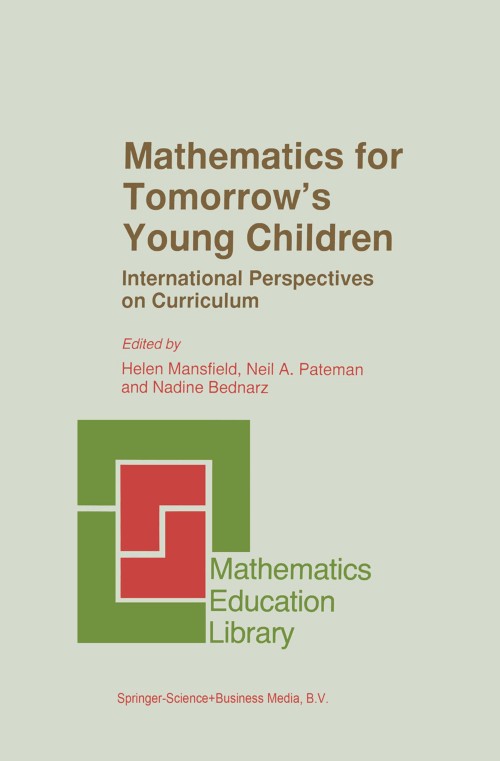
Mathematics for Tomorrow’s Young Children [electronic resource] / edited by C.S. Mansfield, N.A. Pateman, N. Bednarz.
Erişim Adresi
ISBN
9789401722117
Dil Kodu
İngilizce
Yer Numarası
DK/10604
Basım Bildirimi
1st ed. 1996.
Yayın Bilgisi
Dordrecht : Springer Netherlands : Imprint: Springer, 1996.
Fiziksel Niteleme
XI, 329 p. online resource.
Dizi
Mathematics Education Library, 2214-983X ; 16
İçindekiler Notu
1.1: Young Children’s Mathematical Learning: Complexities and Subtleties -- 2.1: Constructivism and Activity Theory: A Consideration of Their Similarities and Differences as They Relate to Mathematics Education -- 2.2: A Sociocultural View of the Mathematics Education of Young Children -- 2.3: Social-Cultural Approaches in Early Childhood Mathematics Education: A Discussion -- 3.1: The Psychological Nature of Concepts -- 3.2: What Concepts are and How Concepts are Formed -- 3.3: Young Children’s Formation of Numerical Concepts: Or 8 = 9 + 7 -- 3.4: Concept Formation Process and an Individual Child’s Intelligence -- 4.1: Interactions between Children in Mathematics Class: An Example Concerning the Concept of Number -- 4.2: What is the Difference between One, UN and YI? -- 4.3: How do Social Interactions among Children Contribute to Learning? -- 4.4: Cultural and Social Environmental Hurdles a Tanzanian Child Must Jump in the Acquisition of Mathematics Concepts -- 5.1: Limitations of Iconic and Symbolic Representations of Arithmetical Concepts in Early Grades of Primary School -- 5.2: Language Activity, Conceptualization and Problem -- 5.3: Children Talking Mathematically in Multilingual Classrooms: Issues in the Role of Language -- 5.4: Use of Language in Elementary Geometry by Students and Textbooks -- 6.1: Concept Development in Early Childhood Mathematics: Teachers’ Theories and Research -- 6.2: Teachers’ Beliefs about Concept Formation and Curriculum Decision-Making in Early Mathematics -- 6.3: Classroom Models for Young Children’s Mathematical Ideas -- 6.4: Joensuu and Mathematical Thinking -- 7.1: Future Research Directions in Young Children’s Early Learning of Mathematics.
Özet, vb.
Social constructivism is just one view of learning that places emphasis on the social aspects of learning. Other theoretical positions, such as activity theory, also emphasise the importance of social interactions. Along with social constructivism, Vygotsky's writings on children's learning have recently also undergone close scru tiny and researchers are attempting a synthesis of aspects ofVygotskian theory and social constructivism. This re-examination of Vygotsky's work is taking place in many other subject fields besides mathematics, such as language learning by young children. It is interesting to speculate why Vygotsky's writings have appealed to so many researchers in different cultures and decades later than his own times. Given the recent increased emphasis on the social nature of learning and on the interactions between student, teacher and context factors, a finer grained analysis of the nature of different theories of learning now seems to be critical, and it was considered that different views of students' learning of mathematics needed to be acknowledged in the discussions of the Working Group.
Konu
Mathematics __ Study and teaching .
Mathematics Education.
Diğer Yazarlar
Kurum Adı

Eseri Alıntıla
Referansları kullanmadan önce gözden geçirmeniz ve varsa gerekli düzeltmeleri yapmanız önerilir.
Dijital Kaynak
MARC Görünümü
LEADER 05545nam a22005775i 4500
001 809315
003 TR_AnAIT
005 20260131023514
007 cr nn 008mamaa
008 130305s1996 ne | s |||| 0|eng d
020 |a9789401722117|9978-94-017-2211-7
024 7 |a10.1007/978-94-017-2211-7|2doi
041 |aeng
049 |aTürk Tarih Kurumu Kütüphanesi
050 4|aQA10.92-20
072 7|aJNU|2bicssc
072 7|aPB|2bicssc
072 7|aEDU029010|2bisacsh
072 7|aJNU|2thema
072 7|aPB|2thema
082 04|a510.71|223
090 |aDK/10604
245 10|aMathematics for Tomorrow’s Young Children|h[electronic resource] /|cedited by C.S. Mansfield, N.A. Pateman, N. Bednarz.
250 |a1st ed. 1996.
264 1|aDordrecht :|bSpringer Netherlands :|bImprint: Springer,|c1996.
300 |aXI, 329 p.|bonline resource.
336 |atext|btxt|2rdacontent
337 |acomputer|bc|2rdamedia
338 |aonline resource|bcr|2rdacarrier
347 |atext file|bPDF|2rda
490 1 |aMathematics Education Library,|x2214-983X ;|v16
505 0 |a1.1: Young Children’s Mathematical Learning: Complexities and Subtleties -- 2.1: Constructivism and Activity Theory: A Consideration of Their Similarities and Differences as They Relate to Mathematics Education -- 2.2: A Sociocultural View of the Mathematics Education of Young Children -- 2.3: Social-Cultural Approaches in Early Childhood Mathematics Education: A Discussion -- 3.1: The Psychological Nature of Concepts -- 3.2: What Concepts are and How Concepts are Formed -- 3.3: Young Children’s Formation of Numerical Concepts: Or 8 = 9 + 7 -- 3.4: Concept Formation Process and an Individual Child’s Intelligence -- 4.1: Interactions between Children in Mathematics Class: An Example Concerning the Concept of Number -- 4.2: What is the Difference between One, UN and YI? -- 4.3: How do Social Interactions among Children Contribute to Learning? -- 4.4: Cultural and Social Environmental Hurdles a Tanzanian Child Must Jump in the Acquisition of Mathematics Concepts -- 5.1: Limitations of Iconic and Symbolic Representations of Arithmetical Concepts in Early Grades of Primary School -- 5.2: Language Activity, Conceptualization and Problem -- 5.3: Children Talking Mathematically in Multilingual Classrooms: Issues in the Role of Language -- 5.4: Use of Language in Elementary Geometry by Students and Textbooks -- 6.1: Concept Development in Early Childhood Mathematics: Teachers’ Theories and Research -- 6.2: Teachers’ Beliefs about Concept Formation and Curriculum Decision-Making in Early Mathematics -- 6.3: Classroom Models for Young Children’s Mathematical Ideas -- 6.4: Joensuu and Mathematical Thinking -- 7.1: Future Research Directions in Young Children’s Early Learning of Mathematics.
520 |aSocial constructivism is just one view of learning that places emphasis on the social aspects of learning. Other theoretical positions, such as activity theory, also emphasise the importance of social interactions. Along with social constructivism, Vygotsky's writings on children's learning have recently also undergone close scru tiny and researchers are attempting a synthesis of aspects ofVygotskian theory and social constructivism. This re-examination of Vygotsky's work is taking place in many other subject fields besides mathematics, such as language learning by young children. It is interesting to speculate why Vygotsky's writings have appealed to so many researchers in different cultures and decades later than his own times. Given the recent increased emphasis on the social nature of learning and on the interactions between student, teacher and context factors, a finer grained analysis of the nature of different theories of learning now seems to be critical, and it was considered that different views of students' learning of mathematics needed to be acknowledged in the discussions of the Working Group.
532 8 |aAccessibility summary: This PDF is not accessible. It is based on scanned pages and does not support features such as screen reader compatibility or described non-text content (images, graphs etc). However, it likely supports searchable and selectable text based on OCR (Optical Character Recognition). Users with accessibility needs may not be able to use this content effectively. Please contact us at accessibilitysupport@springernature.com if you require assistance or an alternative format.
532 8 |aInaccessible, or known limited accessibility
532 8 |aNo reading system accessibility options actively disabled
532 8 |aPublisher contact for further accessibility information: accessibilitysupport@springernature.com
650 0|aMathematics|xStudy and teaching .
650 14|aMathematics Education.
700 1 |aMansfield, C.S.|eeditor.|4edt|4http://id.loc.gov/vocabulary/relators/edt
700 1 |aPateman, N.A.|eeditor.|4edt|4http://id.loc.gov/vocabulary/relators/edt
700 1 |aBednarz, N.|eeditor.|4edt|4http://id.loc.gov/vocabulary/relators/edt
710 2 |aSpringerLink (Online service)
773 0 |tSpringer Nature eBook
776 08|iPrinted edition:|z9780792339984
776 08|iPrinted edition:|z9789048146901
776 08|iPrinted edition:|z9789401722124
830 0|aMathematics Education Library,|x2214-983X ;|v16
856 40|uhttps://doi.org/10.1007/978-94-017-2211-7
912 |aZDB-2-SHU
912 |aZDB-2-SXED
912 |aZDB-2-BAE
950 |aHumanities, Social Sciences and Law (SpringerNature-11648)
950 |aEducation (R0) (SpringerNature-43721)
001 809315
003 TR_AnAIT
005 20260131023514
007 cr nn 008mamaa
008 130305s1996 ne | s |||| 0|eng d
020 |a9789401722117|9978-94-017-2211-7
024 7 |a10.1007/978-94-017-2211-7|2doi
041 |aeng
049 |aTürk Tarih Kurumu Kütüphanesi
050 4|aQA10.92-20
072 7|aJNU|2bicssc
072 7|aPB|2bicssc
072 7|aEDU029010|2bisacsh
072 7|aJNU|2thema
072 7|aPB|2thema
082 04|a510.71|223
090 |aDK/10604
245 10|aMathematics for Tomorrow’s Young Children|h[electronic resource] /|cedited by C.S. Mansfield, N.A. Pateman, N. Bednarz.
250 |a1st ed. 1996.
264 1|aDordrecht :|bSpringer Netherlands :|bImprint: Springer,|c1996.
300 |aXI, 329 p.|bonline resource.
336 |atext|btxt|2rdacontent
337 |acomputer|bc|2rdamedia
338 |aonline resource|bcr|2rdacarrier
347 |atext file|bPDF|2rda
490 1 |aMathematics Education Library,|x2214-983X ;|v16
505 0 |a1.1: Young Children’s Mathematical Learning: Complexities and Subtleties -- 2.1: Constructivism and Activity Theory: A Consideration of Their Similarities and Differences as They Relate to Mathematics Education -- 2.2: A Sociocultural View of the Mathematics Education of Young Children -- 2.3: Social-Cultural Approaches in Early Childhood Mathematics Education: A Discussion -- 3.1: The Psychological Nature of Concepts -- 3.2: What Concepts are and How Concepts are Formed -- 3.3: Young Children’s Formation of Numerical Concepts: Or 8 = 9 + 7 -- 3.4: Concept Formation Process and an Individual Child’s Intelligence -- 4.1: Interactions between Children in Mathematics Class: An Example Concerning the Concept of Number -- 4.2: What is the Difference between One, UN and YI? -- 4.3: How do Social Interactions among Children Contribute to Learning? -- 4.4: Cultural and Social Environmental Hurdles a Tanzanian Child Must Jump in the Acquisition of Mathematics Concepts -- 5.1: Limitations of Iconic and Symbolic Representations of Arithmetical Concepts in Early Grades of Primary School -- 5.2: Language Activity, Conceptualization and Problem -- 5.3: Children Talking Mathematically in Multilingual Classrooms: Issues in the Role of Language -- 5.4: Use of Language in Elementary Geometry by Students and Textbooks -- 6.1: Concept Development in Early Childhood Mathematics: Teachers’ Theories and Research -- 6.2: Teachers’ Beliefs about Concept Formation and Curriculum Decision-Making in Early Mathematics -- 6.3: Classroom Models for Young Children’s Mathematical Ideas -- 6.4: Joensuu and Mathematical Thinking -- 7.1: Future Research Directions in Young Children’s Early Learning of Mathematics.
520 |aSocial constructivism is just one view of learning that places emphasis on the social aspects of learning. Other theoretical positions, such as activity theory, also emphasise the importance of social interactions. Along with social constructivism, Vygotsky's writings on children's learning have recently also undergone close scru tiny and researchers are attempting a synthesis of aspects ofVygotskian theory and social constructivism. This re-examination of Vygotsky's work is taking place in many other subject fields besides mathematics, such as language learning by young children. It is interesting to speculate why Vygotsky's writings have appealed to so many researchers in different cultures and decades later than his own times. Given the recent increased emphasis on the social nature of learning and on the interactions between student, teacher and context factors, a finer grained analysis of the nature of different theories of learning now seems to be critical, and it was considered that different views of students' learning of mathematics needed to be acknowledged in the discussions of the Working Group.
532 8 |aAccessibility summary: This PDF is not accessible. It is based on scanned pages and does not support features such as screen reader compatibility or described non-text content (images, graphs etc). However, it likely supports searchable and selectable text based on OCR (Optical Character Recognition). Users with accessibility needs may not be able to use this content effectively. Please contact us at accessibilitysupport@springernature.com if you require assistance or an alternative format.
532 8 |aInaccessible, or known limited accessibility
532 8 |aNo reading system accessibility options actively disabled
532 8 |aPublisher contact for further accessibility information: accessibilitysupport@springernature.com
650 0|aMathematics|xStudy and teaching .
650 14|aMathematics Education.
700 1 |aMansfield, C.S.|eeditor.|4edt|4http://id.loc.gov/vocabulary/relators/edt
700 1 |aPateman, N.A.|eeditor.|4edt|4http://id.loc.gov/vocabulary/relators/edt
700 1 |aBednarz, N.|eeditor.|4edt|4http://id.loc.gov/vocabulary/relators/edt
710 2 |aSpringerLink (Online service)
773 0 |tSpringer Nature eBook
776 08|iPrinted edition:|z9780792339984
776 08|iPrinted edition:|z9789048146901
776 08|iPrinted edition:|z9789401722124
830 0|aMathematics Education Library,|x2214-983X ;|v16
856 40|uhttps://doi.org/10.1007/978-94-017-2211-7
912 |aZDB-2-SHU
912 |aZDB-2-SXED
912 |aZDB-2-BAE
950 |aHumanities, Social Sciences and Law (SpringerNature-11648)
950 |aEducation (R0) (SpringerNature-43721)
Materyaller
Depodan talep edilen materyal sadece kütüphane içerisinde kullanılmaktadır.
Materyal dışarıya ödünç verilmemektedir.
