LEADER 04184nam a22005655i 4500
001 809323
003 TR_AnAIT
005 20260131023456
007 cr nn 008mamaa
008 130202s2004 ne | s |||| 0|eng d
020 |a9789401704663|9978-94-017-0466-3
024 7 |a10.1007/978-94-017-0466-3|2doi
041 |aeng
049 |aTürk Tarih Kurumu Kütüphanesi
050 4|aBC1-199
072 7|aHPL|2bicssc
072 7|aPHI011000|2bisacsh
072 7|aQDTL|2thema
082 04|a160|223
090 |aDK/10612
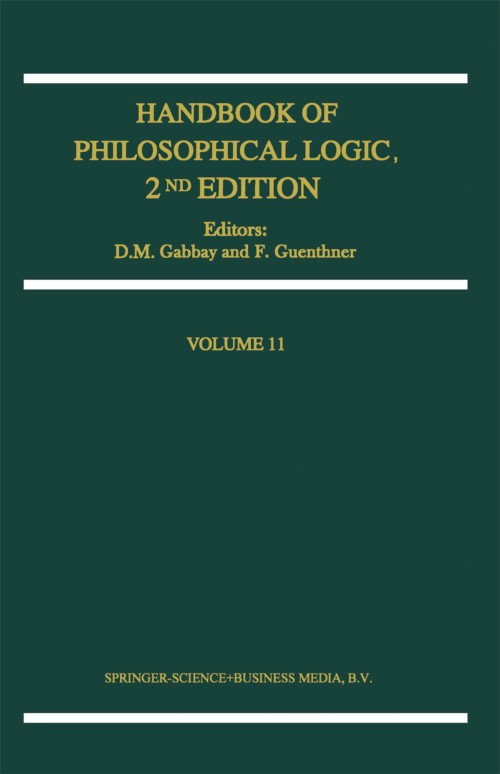
245 10|aHandbook of Philosophical Logic|h[electronic resource] /|cedited by Dov M. Gabbay, Franz Guenthner.
250 |a2nd ed. 2004.
264 1|aDordrecht :|bSpringer Netherlands :|bImprint: Springer,|c2004.
300 |aXIII, 323 p.|bonline resource.
336 |atext|btxt|2rdacontent
337 |acomputer|bc|2rdamedia
338 |aonline resource|bcr|2rdacarrier
347 |atext file|bPDF|2rda
490 1 |aHandbook of Philosophical Logic,|x3004-9938 ;|v11
505 0 |aModal Logic and Self-Reference -- Diagonalization in Logic and Mathematics -- Semantics and the Liar Paradox -- The Logic of Fiction.
520 |aIt is with great pleasure that we are presenting to the community the second edition of this extraordinary handbook. It has been over 15 years since the publication of the first edition and there have been great changes in the landscape of philosophical logic since then. The first edition has proved invaluable to generations of students and researchers in formal philosophy and language, as well as to consumers of logic in many applied areas. The main logic article in the Encyclopaedia Britannica 1999 has described the first edition as 'the best starting point for exploring any of the topics in logic'. We are confident that the second edition will prove to be just as good! The first edition was the second handbook published for the logic commu nity. It followed the North Holland one volume Handbook of Mathematical Logic, published in 1977, edited by the late Jon Barwise. The four volume Handbook of Philosophical Logic, published 1983-1989 came at a fortunate temporal junction at the evolution of logic. This was the time when logic was gaining ground in computer science and artificial intelligence circles. These areas were under increasing commercial pressure to provide devices which help and/or replace the human in his daily activity. This pressure required the use of logic in the modelling of human activity and organisa tion on the one hand and to provide the theoretical basis for the computer program constructs on the other.
532 8 |aAccessibility summary: This PDF is not accessible. It is based on scanned pages and does not support features such as screen reader compatibility or described non-text content (images, graphs etc). However, it likely supports searchable and selectable text based on OCR (Optical Character Recognition). Users with accessibility needs may not be able to use this content effectively. Please contact us at accessibilitysupport@springernature.com if you require assistance or an alternative format.
532 8 |aInaccessible, or known limited accessibility
532 8 |aNo reading system accessibility options actively disabled
532 8 |aPublisher contact for further accessibility information: accessibilitysupport@springernature.com
650 0|aLogic.
650 0|aComputational linguistics.
650 14|aLogic.
650 24|aComputational Linguistics.
700 1 |aGabbay, Dov M.|eeditor.|4edt|4http://id.loc.gov/vocabulary/relators/edt
700 1 |aGuenthner, Franz.|eeditor.|4edt|4http://id.loc.gov/vocabulary/relators/edt
710 2 |aSpringerLink (Online service)
773 0 |tSpringer Nature eBook
776 08|iPrinted edition:|z9781402019661
776 08|iPrinted edition:|z9789048165544
776 08|iPrinted edition:|z9789401704670
830 0|aHandbook of Philosophical Logic,|x3004-9938 ;|v11
856 40|uhttps://doi.org/10.1007/978-94-017-0466-3
912 |aZDB-2-SHU
912 |aZDB-2-SXPR
912 |aZDB-2-BAE
950 |aHumanities, Social Sciences and Law (SpringerNature-11648)
950 |aPhilosophy and Religion (R0) (SpringerNature-43725)