

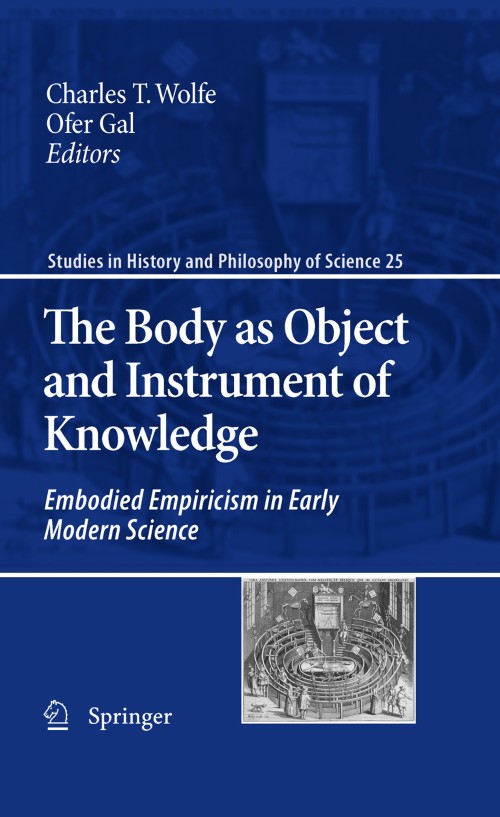
The Body as Object and Instrument of Knowledge [electronic resource] : Embodied Empiricism in Early Modern Science / edited by Charles T. Wolfe, Ofer Gal.
Erişim Adresi
ISBN
9789048136865
Dil Kodu
İngilizce
Yer Numarası
DK/10613
Basım Bildirimi
1st ed. 2010.
Yayın Bilgisi
Dordrecht : Springer Netherlands : Imprint: Springer, 2010.
Fiziksel Niteleme
X, 350 p. online resource.
Dizi
Studies in History and Philosophy of Science, 2215-1958 ; 25
İçindekiler Notu
Embodied Empiricism -- The Body as Object -- Victories for Empiricism, Failures for Theory: Medicine and Science in the Seventeenth Century -- Practical Experience in Anatomy -- Early Modern Empiricism and the Discourse of the Senses -- Alkahest and Fire: Debating Matter, Chymistry, and Natural History at the Early Parisian Academy of Sciences -- John Locke and Helmontian Medicine -- The Body as Instrument -- Empiricism Without the Senses: How the Instrument Replaced the Eye -- Mastering the Appetites of Matter. Francis Bacon’s Sylva Sylvarum -- ‘A Corporall Philosophy’: Language and ‘Body-Making’ in the Work of John Bulwer (1606–1656) -- Memory and Empirical Information: Samuel Hartlib, John Beale and Robert Boyle -- Lamarck on Feelings: From Worms to Humans -- Embodied Minds -- Carelessness and Inattention: Mind-Wandering and the Physiology of Fantasy from Locke to Hume -- Instrumental or Immersed Experience: Pleasure, Pain and Object Perception in Locke -- Empiricism and Its Roots in the Ancient Medical Tradition -- Embodied Stimuli: Bonnet’s Statue of a Sensitive Agent -- Empiricist Heresies in Early Modern Medical Thought.
Özet, vb.
It was in 1660s England, according to the received view, in the Royal Society of London, that science acquired the form of empirical enquiry we recognize as our own: an open, collaborative experimental practice, mediated by specially-designed instruments, supported by civil discourse, stressing accuracy and replicability. Guided by the philosophy of Francis Bacon, by Protestant ideas of thisworldly benevolence, by gentlemanly codes of decorum and by a dominant interest in mechanics and the mechanical structure of the universe, the members of the Royal Society created a novel experimental practice that superseded former modes of empirical inquiry, from Aristotelian observations to alchemical experimentation. This volume focuses on the development of empiricism as an interest in the body – as both the object of research and the subject of experience. Re-embodying empiricism shifts the focus of interest to the ‘life sciences’; medicine, physiology, natural history. In fact, manyof the active members of the Royal Society were physicians, and a significant number of those, disciples of William Harvey and through him, inheritors of the empirical anatomy practices developed in Padua during the 16th century. Indeed, the primary research interests of the early Royal Society were concentrated on the body, human and animal, and its functions much more than on mechanics. Similarly, the Académie des Sciences directly contradicted its self-imposed mandate to investigate Nature in mechanistic fashion, devoting a significant portion of its Mémoires to questions concerning life, reproduction and monsters, consulting empirical botanists, apothecaries and chemists, and keeping closer to experience than to the Cartesian standards of well-founded knowledge. These highlighted empirical studies of the body, were central in a workshop in the beginning of 2009 organized by the unit for History and Philosophy of Science in Sydney. The papers that were presented by some of the leading figures in this area are presented in this volume.
Konu
Science __ Philosophy.
Philosophy of Science.
Philosophy of Science.
Diğer Yazarlar
Kurum Adı
Eseri Alıntıla
Referansları kullanmadan önce gözden geçirmeniz ve varsa gerekli düzeltmeleri yapmanız önerilir.
Dijital Kaynak
MARC Görünümü
LEADER 05065nam a22004935i 4500
001 809324
003 TR_AnAIT
005 20260131023455
007 cr nn 008mamaa
008 100407s2010 ne | s |||| 0|eng d
020 |a9789048136865|9978-90-481-3686-5
024 7 |a10.1007/978-90-481-3686-5|2doi
041 |aeng
049 |aTürk Tarih Kurumu Kütüphanesi
050 4|aQ174-175.3
050 4|aB67
072 7|aPDA|2bicssc
072 7|aSCI075000|2bisacsh
072 7|aPDA|2thema
082 04|a501|223
090 |aDK/10613
245 14|aThe Body as Object and Instrument of Knowledge|h[electronic resource] :|bEmbodied Empiricism in Early Modern Science /|cedited by Charles T. Wolfe, Ofer Gal.
250 |a1st ed. 2010.
264 1|aDordrecht :|bSpringer Netherlands :|bImprint: Springer,|c2010.
300 |aX, 350 p.|bonline resource.
336 |atext|btxt|2rdacontent
337 |acomputer|bc|2rdamedia
338 |aonline resource|bcr|2rdacarrier
347 |atext file|bPDF|2rda
490 1 |aStudies in History and Philosophy of Science,|x2215-1958 ;|v25
505 0 |aEmbodied Empiricism -- The Body as Object -- Victories for Empiricism, Failures for Theory: Medicine and Science in the Seventeenth Century -- Practical Experience in Anatomy -- Early Modern Empiricism and the Discourse of the Senses -- Alkahest and Fire: Debating Matter, Chymistry, and Natural History at the Early Parisian Academy of Sciences -- John Locke and Helmontian Medicine -- The Body as Instrument -- Empiricism Without the Senses: How the Instrument Replaced the Eye -- Mastering the Appetites of Matter. Francis Bacon’s Sylva Sylvarum -- ‘A Corporall Philosophy’: Language and ‘Body-Making’ in the Work of John Bulwer (1606–1656) -- Memory and Empirical Information: Samuel Hartlib, John Beale and Robert Boyle -- Lamarck on Feelings: From Worms to Humans -- Embodied Minds -- Carelessness and Inattention: Mind-Wandering and the Physiology of Fantasy from Locke to Hume -- Instrumental or Immersed Experience: Pleasure, Pain and Object Perception in Locke -- Empiricism and Its Roots in the Ancient Medical Tradition -- Embodied Stimuli: Bonnet’s Statue of a Sensitive Agent -- Empiricist Heresies in Early Modern Medical Thought.
520 |aIt was in 1660s England, according to the received view, in the Royal Society of London, that science acquired the form of empirical enquiry we recognize as our own: an open, collaborative experimental practice, mediated by specially-designed instruments, supported by civil discourse, stressing accuracy and replicability. Guided by the philosophy of Francis Bacon, by Protestant ideas of thisworldly benevolence, by gentlemanly codes of decorum and by a dominant interest in mechanics and the mechanical structure of the universe, the members of the Royal Society created a novel experimental practice that superseded former modes of empirical inquiry, from Aristotelian observations to alchemical experimentation. This volume focuses on the development of empiricism as an interest in the body – as both the object of research and the subject of experience. Re-embodying empiricism shifts the focus of interest to the ‘life sciences’; medicine, physiology, natural history. In fact, manyof the active members of the Royal Society were physicians, and a significant number of those, disciples of William Harvey and through him, inheritors of the empirical anatomy practices developed in Padua during the 16th century. Indeed, the primary research interests of the early Royal Society were concentrated on the body, human and animal, and its functions much more than on mechanics. Similarly, the Académie des Sciences directly contradicted its self-imposed mandate to investigate Nature in mechanistic fashion, devoting a significant portion of its Mémoires to questions concerning life, reproduction and monsters, consulting empirical botanists, apothecaries and chemists, and keeping closer to experience than to the Cartesian standards of well-founded knowledge. These highlighted empirical studies of the body, were central in a workshop in the beginning of 2009 organized by the unit for History and Philosophy of Science in Sydney. The papers that were presented by some of the leading figures in this area are presented in this volume.
650 0|aScience|xPhilosophy.
650 14|aPhilosophy of Science.
700 1 |aWolfe, Charles T.|eeditor.|4edt|4http://id.loc.gov/vocabulary/relators/edt
700 1 |aGal, Ofer.|eeditor.|4edt|4http://id.loc.gov/vocabulary/relators/edt
710 2 |aSpringerLink (Online service)
773 0 |tSpringer Nature eBook
776 08|iPrinted edition:|z9789048136858
776 08|iPrinted edition:|z9789048136995
776 08|iPrinted edition:|z9789400732018
830 0|aStudies in History and Philosophy of Science,|x2215-1958 ;|v25
856 40|uhttps://doi.org/10.1007/978-90-481-3686-5
912 |aZDB-2-SHU
912 |aZDB-2-SXPR
950 |aHumanities, Social Sciences and Law (SpringerNature-11648)
950 |aPhilosophy and Religion (R0) (SpringerNature-43725)
001 809324
003 TR_AnAIT
005 20260131023455
007 cr nn 008mamaa
008 100407s2010 ne | s |||| 0|eng d
020 |a9789048136865|9978-90-481-3686-5
024 7 |a10.1007/978-90-481-3686-5|2doi
041 |aeng
049 |aTürk Tarih Kurumu Kütüphanesi
050 4|aQ174-175.3
050 4|aB67
072 7|aPDA|2bicssc
072 7|aSCI075000|2bisacsh
072 7|aPDA|2thema
082 04|a501|223
090 |aDK/10613
245 14|aThe Body as Object and Instrument of Knowledge|h[electronic resource] :|bEmbodied Empiricism in Early Modern Science /|cedited by Charles T. Wolfe, Ofer Gal.
250 |a1st ed. 2010.
264 1|aDordrecht :|bSpringer Netherlands :|bImprint: Springer,|c2010.
300 |aX, 350 p.|bonline resource.
336 |atext|btxt|2rdacontent
337 |acomputer|bc|2rdamedia
338 |aonline resource|bcr|2rdacarrier
347 |atext file|bPDF|2rda
490 1 |aStudies in History and Philosophy of Science,|x2215-1958 ;|v25
505 0 |aEmbodied Empiricism -- The Body as Object -- Victories for Empiricism, Failures for Theory: Medicine and Science in the Seventeenth Century -- Practical Experience in Anatomy -- Early Modern Empiricism and the Discourse of the Senses -- Alkahest and Fire: Debating Matter, Chymistry, and Natural History at the Early Parisian Academy of Sciences -- John Locke and Helmontian Medicine -- The Body as Instrument -- Empiricism Without the Senses: How the Instrument Replaced the Eye -- Mastering the Appetites of Matter. Francis Bacon’s Sylva Sylvarum -- ‘A Corporall Philosophy’: Language and ‘Body-Making’ in the Work of John Bulwer (1606–1656) -- Memory and Empirical Information: Samuel Hartlib, John Beale and Robert Boyle -- Lamarck on Feelings: From Worms to Humans -- Embodied Minds -- Carelessness and Inattention: Mind-Wandering and the Physiology of Fantasy from Locke to Hume -- Instrumental or Immersed Experience: Pleasure, Pain and Object Perception in Locke -- Empiricism and Its Roots in the Ancient Medical Tradition -- Embodied Stimuli: Bonnet’s Statue of a Sensitive Agent -- Empiricist Heresies in Early Modern Medical Thought.
520 |aIt was in 1660s England, according to the received view, in the Royal Society of London, that science acquired the form of empirical enquiry we recognize as our own: an open, collaborative experimental practice, mediated by specially-designed instruments, supported by civil discourse, stressing accuracy and replicability. Guided by the philosophy of Francis Bacon, by Protestant ideas of thisworldly benevolence, by gentlemanly codes of decorum and by a dominant interest in mechanics and the mechanical structure of the universe, the members of the Royal Society created a novel experimental practice that superseded former modes of empirical inquiry, from Aristotelian observations to alchemical experimentation. This volume focuses on the development of empiricism as an interest in the body – as both the object of research and the subject of experience. Re-embodying empiricism shifts the focus of interest to the ‘life sciences’; medicine, physiology, natural history. In fact, manyof the active members of the Royal Society were physicians, and a significant number of those, disciples of William Harvey and through him, inheritors of the empirical anatomy practices developed in Padua during the 16th century. Indeed, the primary research interests of the early Royal Society were concentrated on the body, human and animal, and its functions much more than on mechanics. Similarly, the Académie des Sciences directly contradicted its self-imposed mandate to investigate Nature in mechanistic fashion, devoting a significant portion of its Mémoires to questions concerning life, reproduction and monsters, consulting empirical botanists, apothecaries and chemists, and keeping closer to experience than to the Cartesian standards of well-founded knowledge. These highlighted empirical studies of the body, were central in a workshop in the beginning of 2009 organized by the unit for History and Philosophy of Science in Sydney. The papers that were presented by some of the leading figures in this area are presented in this volume.
650 0|aScience|xPhilosophy.
650 14|aPhilosophy of Science.
700 1 |aWolfe, Charles T.|eeditor.|4edt|4http://id.loc.gov/vocabulary/relators/edt
700 1 |aGal, Ofer.|eeditor.|4edt|4http://id.loc.gov/vocabulary/relators/edt
710 2 |aSpringerLink (Online service)
773 0 |tSpringer Nature eBook
776 08|iPrinted edition:|z9789048136858
776 08|iPrinted edition:|z9789048136995
776 08|iPrinted edition:|z9789400732018
830 0|aStudies in History and Philosophy of Science,|x2215-1958 ;|v25
856 40|uhttps://doi.org/10.1007/978-90-481-3686-5
912 |aZDB-2-SHU
912 |aZDB-2-SXPR
950 |aHumanities, Social Sciences and Law (SpringerNature-11648)
950 |aPhilosophy and Religion (R0) (SpringerNature-43725)
Materyaller
Depodan talep edilen materyal sadece kütüphane içerisinde kullanılmaktadır.
Materyal dışarıya ödünç verilmemektedir.
Materyal dışarıya ödünç verilmemektedir.
