LEADER 04255nam a22005895i 4500
001 809346
003 TR_AnAIT
005 20260131023424
007 cr nn 008mamaa
008 121227s2000 ne | s |||| 0|eng d
020 |a9789401139946|9978-94-011-3994-6
024 7 |a10.1007/978-94-011-3994-6|2doi
041 |aeng
049 |aTürk Tarih Kurumu Kütüphanesi
050 4|aLB1-3640
050 4|aB63
072 7|aJNA|2bicssc
072 7|aEDU040000|2bisacsh
072 7|aJNA|2thema
082 04|a370.1|223
090 |aDK/10635
100 1 |aMatthews, Michael.|eauthor.|4aut|4http://id.loc.gov/vocabulary/relators/aut
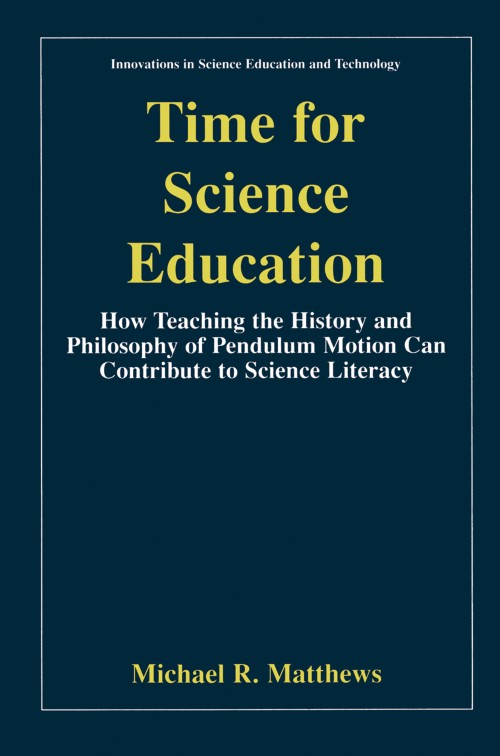
245 10|aTime for Science Education|h[electronic resource] :|bHow Teaching the History and Philosophy of Pendulum Motion can Contribute to Science Literacy /|cby Michael Matthews.
250 |a1st ed. 2000.
264 1|aDordrecht :|bSpringer Netherlands :|bImprint: Springer,|c2000.
300 |aXXVIII, 440 p. 27 illus.|bonline resource.
336 |atext|btxt|2rdacontent
337 |acomputer|bc|2rdamedia
338 |aonline resource|bcr|2rdacarrier
347 |atext file|bPDF|2rda
490 1 |aInnovations in Science Education and Technology,|x2213-2236 ;|v8
520 |aThe book's argument depends, as do most proposals in education, upon cer tain positions in the philosophy of education. I believe that education should be primarily concerned with developing understanding, with initiation into worth while traditions of intellectual achievement, and with developing capacities for clear, analytic and critical thought. These have been the long-accepted goals of liberal education. In a liberal education, students should come to know and appre ciate a variety of disciplines, know them at an appropriate depth, see the interconnectedness of the disciplines, or the modes of thought, and finally have some critical disposition toward what is being learned, to be genuinely open minded about intellectual things. These liberal goals are contrasted with goals such as professional training, job preparation, promotion of self-esteem, social engineering, entertainment, or countless other putative purposes of schooling that are enunciated by politicians, administrators, and educators. The book's argument might be consistent with other views of education especially ones about the training of specialists (sometimes called a professional view of education)-but the argument fits best with a liberal view of education. The liberal hope has always been that if education is done well, then other per sonal and social goods will follow. The development of informed, critical, and moral capacities is the cornerstone for personal and social achievements.
532 8 |aAccessibility summary: This PDF is not accessible. It is based on scanned pages and does not support features such as screen reader compatibility or described non-text content (images, graphs etc). However, it likely supports searchable and selectable text based on OCR (Optical Character Recognition). Users with accessibility needs may not be able to use this content effectively. Please contact us at accessibilitysupport@springernature.com if you require assistance or an alternative format.
532 8 |aInaccessible, or known limited accessibility
532 8 |aNo reading system accessibility options actively disabled
532 8 |aPublisher contact for further accessibility information: accessibilitysupport@springernature.com
650 0|aEducation|xPhilosophy.
650 0|aHistory.
650 0|aScience|xPhilosophy.
650 0|aMathematical physics.
650 14|aPhilosophy of Education.
650 24|aHistory.
650 24|aPhilosophy of Science.
650 24|aTheoretical, Mathematical and Computational Physics.
710 2 |aSpringerLink (Online service)
773 0 |tSpringer Nature eBook
776 08|iPrinted edition:|z9780306458804
776 08|iPrinted edition:|z9789401139953
830 0|aInnovations in Science Education and Technology,|x2213-2236 ;|v8
856 40|uhttps://doi.org/10.1007/978-94-011-3994-6
912 |aZDB-2-SHU
912 |aZDB-2-SXPR
912 |aZDB-2-BAE
950 |aHumanities, Social Sciences and Law (SpringerNature-11648)
950 |aPhilosophy and Religion (R0) (SpringerNature-43725)