LEADER 04248nam a22004935i 4500
001 809413
003 TR_AnAIT
005 20260131023248
007 cr nn 008mamaa
008 121227s1973 ne | s |||| 0|eng d
020 |a9789401023696|9978-94-010-2369-6
024 7 |a10.1007/978-94-010-2369-6|2doi
041 |aeng
049 |aTürk Tarih Kurumu Kütüphanesi
050 4|aB800.2-804
072 7|aHPCD|2bicssc
072 7|aPHI016000|2bisacsh
072 7|aQDH|2thema
082 04|a190.903|223
090 |aDK/10702
100 1 |aFeibleman, J.K.|eauthor.|4aut|4http://id.loc.gov/vocabulary/relators/aut
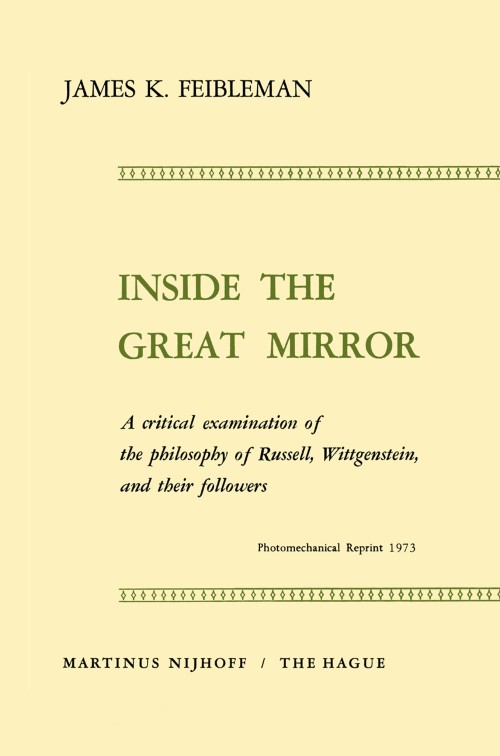
245 10|aInside the Great Mirror|h[electronic resource] :|bA Critical Examination of the Philosophy of Russell, Wittgenstein, and their Followers /|cby J.K. Feibleman.
250 |a1st ed. 1973.
264 1|aDordrecht :|bSpringer Netherlands :|bImprint: Springer,|c1973.
300 |a228 p.|bonline resource.
336 |atext|btxt|2rdacontent
337 |acomputer|bc|2rdamedia
338 |aonline resource|bcr|2rdacarrier
347 |atext file|bPDF|2rda
505 0 |aRussell’s Early Philosophy -- An Inventory of the World -- Infidelity to Realism -- A Commentary to Wittgenstein’s Tractatus -- to the Commentary -- A Commentary to the Tractatus Logico-Philosophicus -- Conclusions from the Commentary -- The Viennese and English Disciples -- Viennese Positivism in the United States -- Linguistic Analysis Versus Metaphysics -- The Saving Elements -- The Metaphysics of Logical Positivism -- Reflections after Wittgenstein’s Philosophical Investigations.
520 |aphysical realist heavily bverlaid with the interpretation afforded by linguistic analysis, so he changed, too. But at the time, which was approximately during the second decade of the twentieth century, they were no doubt very close in their views. Russell acknowledged the influence of Wittgenstein in several places in the 1918 lectures on logical atomism. Wittgenstein might not have written the Tractatus had Russell not given the lectures on logical atomism, or at least had he not maintained the views there expressed. Certainly it is true in a very large sense that the Tractatus may be interpreted as a commentary on the 1918 lectures of Russell. Wittgenstein certainly did not hear them but, as Russell said, the topics were discussed together; and the debt of the Tractatus to the views of the contents of the lectures is obvious. Since Wittgenstein was the pupil and Russell the teacher, we may assume, despite the mutual influence, that the greater effect was Russell's. There is no space in which to go into a thorough analysis of the predecessors of Wittgenstein and of the influences upon him. In addition, there is not sufficient data. One clue, however, we are given. One of his friends has informed us that Wittgenstein "did read and enjoy Plato" and "recognized congenial features" in his philosophical method 1, although, to be sure, Wittgenstein is not said to have been a great reader of philosophy.
532 8 |aAccessibility summary: This PDF is not accessible. It is based on scanned pages and does not support features such as screen reader compatibility or described non-text content (images, graphs etc). However, it likely supports searchable and selectable text based on OCR (Optical Character Recognition). Users with accessibility needs may not be able to use this content effectively. Please contact us at accessibilitysupport@springernature.com if you require assistance or an alternative format.
532 8 |aInaccessible, or known limited accessibility
532 8 |aNo reading system accessibility options actively disabled
532 8 |aPublisher contact for further accessibility information: accessibilitysupport@springernature.com
650 0|aPhilosophy, Modern.
650 14|aEarly Modern Philosophy.
710 2 |aSpringerLink (Online service)
773 0 |tSpringer Nature eBook
776 08|iPrinted edition:|z9789024700455
776 08|iPrinted edition:|z9789401023702
856 40|uhttps://doi.org/10.1007/978-94-010-2369-6
912 |aZDB-2-SHU
912 |aZDB-2-SXPR
912 |aZDB-2-BAE
950 |aHumanities, Social Sciences and Law (SpringerNature-11648)
950 |aPhilosophy and Religion (R0) (SpringerNature-43725)