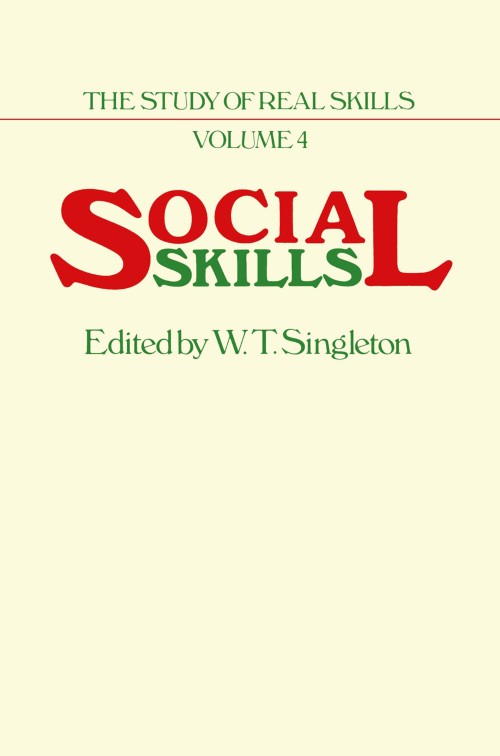
Social Skills [electronic resource] / by W. T. Singleton.
Erişim Adresi
ISBN
9789401178198
Dil Kodu
İngilizce
Yer Numarası
DK/10710
Yazar
Basım Bildirimi
1st ed. 1983.
Yayın Bilgisi
Dordrecht : Springer Netherlands : Imprint: Springer, 1983.
Fiziksel Niteleme
XIX, 307 p. 18 illus. online resource.
İçindekiler Notu
1 Individual Differences -- 2 The School Teacher -- 3 The University Teacher -- 4 The General Practitioner -- 5 The Hospital Doctor -- 6 The Occupational Physician -- 7 The Physiotherapist -- 8 The Psychotherapist -- 9 The Police Officer: Myths and realities -- 10 The Judge -- 11 The Referee -- 12 The Professional Negotiator: Roles, resources and the run of the cards -- 13 The Salesman -- 14 The Industrial Sales Team -- 15 The French: A cross-cultural comparison -- 16 Learning Conversations: the skill of managing learning -- 17 Final Discussion -- Author Index.
Özet, vb.
w. T. SINGLETON THE CONCEPT This is the fourth in a series of books devoted to the study of real skills. A skilled person is one who achieves his objectives effectively, that is by an optimal expenditure of effort, attention and other resources working within his native capacities of strength, vision, intelligence, sensitivity and so forth. It is difficult if not impossible to measure in a quantitative sense. There is, however, no question about its presence or absence. The differences between a highly skilled performer and a mediocre one are so readily manifest that there is no ambiguity. The student of skill is a person interested in what these differences are and how they originate. The importance and the difficulty of skill study is that the concept is a universal one for human activity. The movement of one limb can be skilled or unskilled within the context of a task, so also can the way a leader addresses a large meeting of his followers. For these and other equally disparate activities there are certain descriptive terms which always seem to be applicable: continuity, sequencing, timing, together with a subtle combination of sensi tivity, adaptability and imperturbability. What happens at any instant is set precisely with the flow from what has already happened to what is going to happen. The order of events has a determinate logic which may not be obvious to the observer except with the benefit of hindsight.
Konu
Culture __ Study and teaching.
Geology.
Medicine __ Research.
Biology __ Research.
Earth sciences.
Cultural Studies.
Geology.
Biomedical Research.
Earth Sciences.
Geology.
Medicine __ Research.
Biology __ Research.
Earth sciences.
Cultural Studies.
Geology.
Biomedical Research.
Earth Sciences.
Kurum Adı

Eseri Alıntıla
Referansları kullanmadan önce gözden geçirmeniz ve varsa gerekli düzeltmeleri yapmanız önerilir.
Dijital Kaynak
MARC Görünümü
LEADER 04512nam a22005895i 4500
001 809421
003 TR_AnAIT
005 20260131023239
007 cr nn 008mamaa
008 130125s1983 ne | s |||| 0|eng d
020 |a9789401178198|9978-94-011-7819-8
024 7 |a10.1007/978-94-011-7819-8|2doi
041 |aeng
049 |aTürk Tarih Kurumu Kütüphanesi
050 4|aHM623
072 7|aJFC|2bicssc
072 7|aSOC002010|2bisacsh
072 7|aJBCC|2thema
082 04|a306|223
090 |aDK/10710
100 1 |aSingleton, W. T.|eauthor.|4aut|4http://id.loc.gov/vocabulary/relators/aut
245 10|aSocial Skills|h[electronic resource] /|cby W. T. Singleton.
250 |a1st ed. 1983.
264 1|aDordrecht :|bSpringer Netherlands :|bImprint: Springer,|c1983.
300 |aXIX, 307 p. 18 illus.|bonline resource.
336 |atext|btxt|2rdacontent
337 |acomputer|bc|2rdamedia
338 |aonline resource|bcr|2rdacarrier
347 |atext file|bPDF|2rda
505 0 |a1 Individual Differences -- 2 The School Teacher -- 3 The University Teacher -- 4 The General Practitioner -- 5 The Hospital Doctor -- 6 The Occupational Physician -- 7 The Physiotherapist -- 8 The Psychotherapist -- 9 The Police Officer: Myths and realities -- 10 The Judge -- 11 The Referee -- 12 The Professional Negotiator: Roles, resources and the run of the cards -- 13 The Salesman -- 14 The Industrial Sales Team -- 15 The French: A cross-cultural comparison -- 16 Learning Conversations: the skill of managing learning -- 17 Final Discussion -- Author Index.
520 |aw. T. SINGLETON THE CONCEPT This is the fourth in a series of books devoted to the study of real skills. A skilled person is one who achieves his objectives effectively, that is by an optimal expenditure of effort, attention and other resources working within his native capacities of strength, vision, intelligence, sensitivity and so forth. It is difficult if not impossible to measure in a quantitative sense. There is, however, no question about its presence or absence. The differences between a highly skilled performer and a mediocre one are so readily manifest that there is no ambiguity. The student of skill is a person interested in what these differences are and how they originate. The importance and the difficulty of skill study is that the concept is a universal one for human activity. The movement of one limb can be skilled or unskilled within the context of a task, so also can the way a leader addresses a large meeting of his followers. For these and other equally disparate activities there are certain descriptive terms which always seem to be applicable: continuity, sequencing, timing, together with a subtle combination of sensi tivity, adaptability and imperturbability. What happens at any instant is set precisely with the flow from what has already happened to what is going to happen. The order of events has a determinate logic which may not be obvious to the observer except with the benefit of hindsight.
532 8 |aAccessibility summary: This PDF is not accessible. It is based on scanned pages and does not support features such as screen reader compatibility or described non-text content (images, graphs etc). However, it likely supports searchable and selectable text based on OCR (Optical Character Recognition). Users with accessibility needs may not be able to use this content effectively. Please contact us at accessibilitysupport@springernature.com if you require assistance or an alternative format.
532 8 |aInaccessible, or known limited accessibility
532 8 |aNo reading system accessibility options actively disabled
532 8 |aPublisher contact for further accessibility information: accessibilitysupport@springernature.com
650 0|aCulture|xStudy and teaching.
650 0|aGeology.
650 0|aMedicine|xResearch.
650 0|aBiology|xResearch.
650 0|aEarth sciences.
650 14|aCultural Studies.
650 24|aGeology.
650 24|aBiomedical Research.
650 24|aEarth Sciences.
710 2 |aSpringerLink (Online service)
773 0 |tSpringer Nature eBook
776 08|iPrinted edition:|z9780942068122
776 08|iPrinted edition:|z9789401178204
776 08|iPrinted edition:|z9789401178211
856 40|uhttps://doi.org/10.1007/978-94-011-7819-8
912 |aZDB-2-SHU
912 |aZDB-2-SXS
912 |aZDB-2-BAE
950 |aHumanities, Social Sciences and Law (SpringerNature-11648)
950 |aSocial Sciences (R0) (SpringerNature-43726)
001 809421
003 TR_AnAIT
005 20260131023239
007 cr nn 008mamaa
008 130125s1983 ne | s |||| 0|eng d
020 |a9789401178198|9978-94-011-7819-8
024 7 |a10.1007/978-94-011-7819-8|2doi
041 |aeng
049 |aTürk Tarih Kurumu Kütüphanesi
050 4|aHM623
072 7|aJFC|2bicssc
072 7|aSOC002010|2bisacsh
072 7|aJBCC|2thema
082 04|a306|223
090 |aDK/10710
100 1 |aSingleton, W. T.|eauthor.|4aut|4http://id.loc.gov/vocabulary/relators/aut
245 10|aSocial Skills|h[electronic resource] /|cby W. T. Singleton.
250 |a1st ed. 1983.
264 1|aDordrecht :|bSpringer Netherlands :|bImprint: Springer,|c1983.
300 |aXIX, 307 p. 18 illus.|bonline resource.
336 |atext|btxt|2rdacontent
337 |acomputer|bc|2rdamedia
338 |aonline resource|bcr|2rdacarrier
347 |atext file|bPDF|2rda
505 0 |a1 Individual Differences -- 2 The School Teacher -- 3 The University Teacher -- 4 The General Practitioner -- 5 The Hospital Doctor -- 6 The Occupational Physician -- 7 The Physiotherapist -- 8 The Psychotherapist -- 9 The Police Officer: Myths and realities -- 10 The Judge -- 11 The Referee -- 12 The Professional Negotiator: Roles, resources and the run of the cards -- 13 The Salesman -- 14 The Industrial Sales Team -- 15 The French: A cross-cultural comparison -- 16 Learning Conversations: the skill of managing learning -- 17 Final Discussion -- Author Index.
520 |aw. T. SINGLETON THE CONCEPT This is the fourth in a series of books devoted to the study of real skills. A skilled person is one who achieves his objectives effectively, that is by an optimal expenditure of effort, attention and other resources working within his native capacities of strength, vision, intelligence, sensitivity and so forth. It is difficult if not impossible to measure in a quantitative sense. There is, however, no question about its presence or absence. The differences between a highly skilled performer and a mediocre one are so readily manifest that there is no ambiguity. The student of skill is a person interested in what these differences are and how they originate. The importance and the difficulty of skill study is that the concept is a universal one for human activity. The movement of one limb can be skilled or unskilled within the context of a task, so also can the way a leader addresses a large meeting of his followers. For these and other equally disparate activities there are certain descriptive terms which always seem to be applicable: continuity, sequencing, timing, together with a subtle combination of sensi tivity, adaptability and imperturbability. What happens at any instant is set precisely with the flow from what has already happened to what is going to happen. The order of events has a determinate logic which may not be obvious to the observer except with the benefit of hindsight.
532 8 |aAccessibility summary: This PDF is not accessible. It is based on scanned pages and does not support features such as screen reader compatibility or described non-text content (images, graphs etc). However, it likely supports searchable and selectable text based on OCR (Optical Character Recognition). Users with accessibility needs may not be able to use this content effectively. Please contact us at accessibilitysupport@springernature.com if you require assistance or an alternative format.
532 8 |aInaccessible, or known limited accessibility
532 8 |aNo reading system accessibility options actively disabled
532 8 |aPublisher contact for further accessibility information: accessibilitysupport@springernature.com
650 0|aCulture|xStudy and teaching.
650 0|aGeology.
650 0|aMedicine|xResearch.
650 0|aBiology|xResearch.
650 0|aEarth sciences.
650 14|aCultural Studies.
650 24|aGeology.
650 24|aBiomedical Research.
650 24|aEarth Sciences.
710 2 |aSpringerLink (Online service)
773 0 |tSpringer Nature eBook
776 08|iPrinted edition:|z9780942068122
776 08|iPrinted edition:|z9789401178204
776 08|iPrinted edition:|z9789401178211
856 40|uhttps://doi.org/10.1007/978-94-011-7819-8
912 |aZDB-2-SHU
912 |aZDB-2-SXS
912 |aZDB-2-BAE
950 |aHumanities, Social Sciences and Law (SpringerNature-11648)
950 |aSocial Sciences (R0) (SpringerNature-43726)
Materyaller
Depodan talep edilen materyal sadece kütüphane içerisinde kullanılmaktadır.
Materyal dışarıya ödünç verilmemektedir.
