

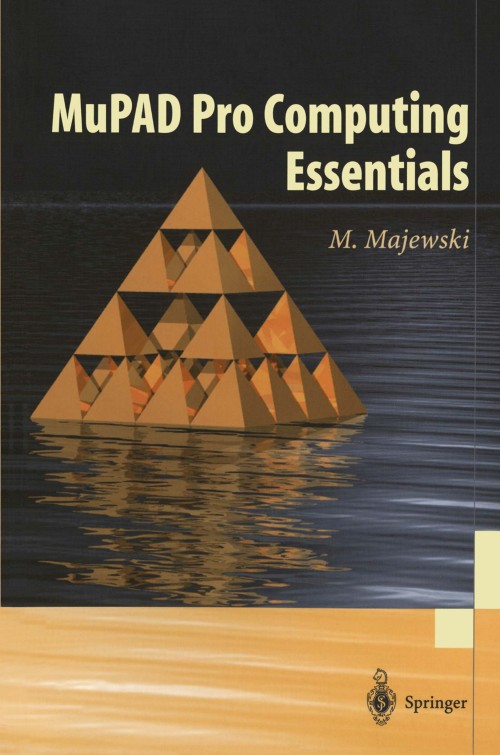
MuPAD Pro Computing Essentials [electronic resource] / by Miroslaw Majewski.
Erişim Adresi
ISBN
9783642979101
Dil Kodu
İngilizce
Yer Numarası
DK/10753
Yazar
Basım Bildirimi
1st ed. 2002.
Yayın Bilgisi
Berlin, Heidelberg : Springer Berlin Heidelberg : Imprint: Springer, 2002.
Fiziksel Niteleme
VII, 456 p. online resource.
İçindekiler Notu
What is special in MuPAD -- Quick introduction to MuPAD -- MuPAD graphs -- Set theory and discrete mathematics with MuPAD -- Calculus of one variable with MuPAD -- Multivariate calculus with MuPAD -- Complex numbers -- Linear algebra and vector spaces with MuPAD -- Introduction to statistics with MuPAD -- Advanced features in MuPAD -- Appendix A: MuPAD libraries -- Appendix B: Customizing MuPAD.
Özet, vb.
In this book, the author creates a fascinating mosaic of opportunities for teaching, learning, and discovering mathematics with the MuPAD computer algebra system. He shows how to write intuitive programs and develops interactive environments for exploring mathematics at different levels. The text is based on a large number of representative examples from undergraduate mathematics. The material has been extensively classroom-tested and should appeal to both traditionalists and innovators. A web site with examples, MuPAD graphs, exercises and solutions supports the book.
Konu
Learning, Psychology of.
Algebra.
Computer software.
Mathematics __ Data processing.
Instructional Psychology.
Algebra.
Mathematical Software.
Computational Science and Engineering.
Algebra.
Computer software.
Mathematics __ Data processing.
Instructional Psychology.
Algebra.
Mathematical Software.
Computational Science and Engineering.
Kurum Adı
