LEADER 04129nam a22005055i 4500
001 809466
003 TR_AnAIT
005 20260131023144
007 cr nn 008mamaa
008 101204s2011 ne | s |||| 0|eng d
020 |a9789048189694|9978-90-481-8969-4
024 7 |a10.1007/978-90-481-8969-4|2doi
041 |aeng
049 |aTürk Tarih Kurumu Kütüphanesi
050 4|aHB848-3697
072 7|aJHBD|2bicssc
072 7|aSOC006000|2bisacsh
072 7|aJHBD|2thema
082 04|a304.6|223
090 |aDK/10755
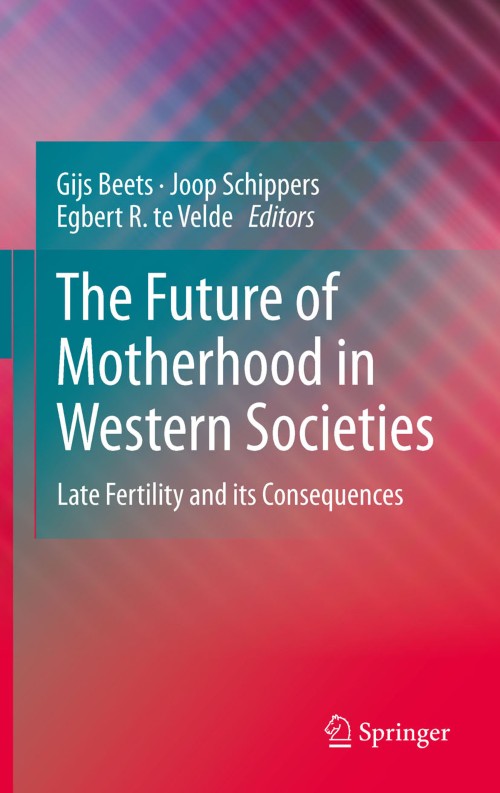
245 14|aThe Future of Motherhood in Western Societies|h[electronic resource] :|bLate Fertility and its Consequences /|cedited by Gijs Beets, Joop Schippers, Egbert R. te Velde.
250 |a1st ed. 2011.
264 1|aDordrecht :|bSpringer Netherlands :|bImprint: Springer,|c2011.
300 |aXII, 222 p.|bonline resource.
336 |atext|btxt|2rdacontent
337 |acomputer|bc|2rdamedia
338 |aonline resource|bcr|2rdacarrier
347 |atext file|bPDF|2rda
505 0 |aPreface -- Introduction -- Chapter 1: Is women's emancipation still compatible with motherhood on Western societies? Egbgert R. te Velde -- Chapter 2: Males and females: the big little difference: Jan A.R.A.M. van Hooff -- Chapter 3: Sexual differentiation of the human brain and male/female behaviour: Dick F. Swaab -- Chapter 4: On the societal impact of mdern contraception: Dirk J. van de Kaa -- Chapter 5: The demography of the age at first birth: the close relationship between having children and postponement: Gijs Beets -- Chapter 6: The economic rationality of late parenthood: Joop Schippers -- Chapter 7: The complexity of parenthood in modern societies: Anneke van Doorne-Huiskes & Ingrid Doorten -- Chapter 8: The importance of children and families in welfare states: G¢sta Esping-Andersen -- Chapter 9: The post-career mom: reproductive technology and the promise of reproductive choice: Elisabeth Beck-Gernsheim -- Chapter 10: On delayed fatherhood: the social and subjective 'logics' at work in men's lives (a UK study): Karen Henwood -- Fiona Shirani & Joanne Kellett -- Chapter 11: Women's lifestyle preferences in the 21st century: Catherine Hakim -- Chapter 12: The future of motherhood: conclusions and discussion -- Annex. List of authors.
520 |aiMost couples wish to have children, but when is the best time to have the first child and when is postponement justified? The answers vary from couple to couple and involve many factors including conflicting goals of the parents, housing, career paths, income, parental leave policies and child care arrangements. Nonetheless, the biological clock never stops ticking, and assisted reproductive technology cannot guarantee a successful outcome. This book offers a holistic overview of the process of postponement and its background in modern Western societies both at the personal and societal levels. It includes contributions from reproductive, evolutionary biological and neurological sciences as well as from the fields of demography, economics, sociology and psychology. It argues that governments could support couples by a cafeteria-like set of arrangements from which one can compose a package according to personal preferences that can facilitate to a break in the rising age of first motherhood.
650 0|aDemography.
650 0|aPopulation.
650 0|aSociology.
650 14|aPopulation and Demography.
650 24|aSociology.
700 1 |aBeets, Gijs.|eeditor.|4edt|4http://id.loc.gov/vocabulary/relators/edt
700 1 |aSchippers, Joop.|eeditor.|4edt|4http://id.loc.gov/vocabulary/relators/edt
700 1 |ate Velde, Egbert R.|eeditor.|4edt|4http://id.loc.gov/vocabulary/relators/edt
710 2 |aSpringerLink (Online service)
773 0 |tSpringer Nature eBook
776 08|iPrinted edition:|z9789048189687
776 08|iPrinted edition:|z9789048189700
776 08|iPrinted edition:|z9789400790247
856 40|uhttps://doi.org/10.1007/978-90-481-8969-4
912 |aZDB-2-SHU
912 |aZDB-2-SXS
950 |aHumanities, Social Sciences and Law (SpringerNature-11648)
950 |aSocial Sciences (R0) (SpringerNature-43726)