LEADER 03508nam a22005295i 4500
001 809480
003 TR_AnAIT
005 20260131023123
007 cr nn 008mamaa
008 111214s2012 xxu| s |||| 0|eng d
020 |a9781461415398|9978-1-4614-1539-8
024 7 |a10.1007/978-1-4614-1539-8|2doi
041 |aeng
049 |aTürk Tarih Kurumu Kütüphanesi
050 4|aLB1028.3
072 7|aJNV|2bicssc
072 7|aEDU000000|2bisacsh
072 7|aJNV|2thema
082 04|a371.33|223
090 |aDK/10769
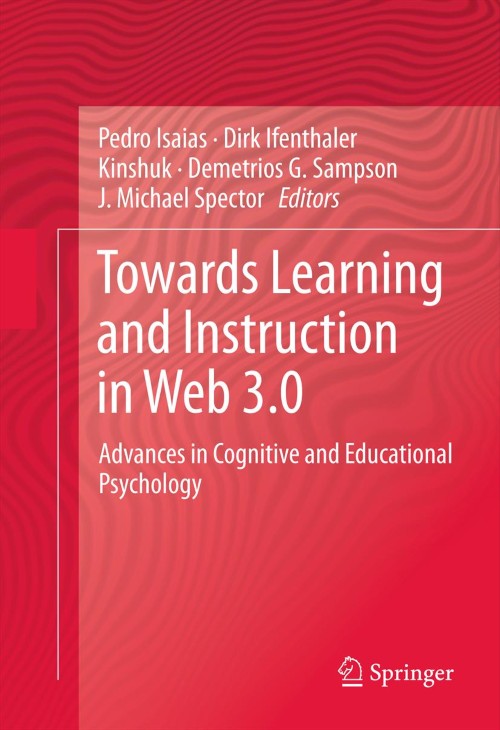
245 10|aTowards Learning and Instruction in Web 3.0|h[electronic resource] :|bAdvances in Cognitive and Educational Psychology /|cedited by Pedro Isaias, Dirk Ifenthaler, Kinshuk, Demetrios G. Sampson, J. Michael Spector.
250 |a1st ed. 2012.
264 1|aNew York, NY :|bSpringer New York :|bImprint: Springer,|c2012.
300 |aXXVI, 326 p.|bonline resource.
336 |atext|btxt|2rdacontent
337 |acomputer|bc|2rdamedia
338 |aonline resource|bcr|2rdacarrier
347 |atext file|bPDF|2rda
520 |aTowards Learning and Instruction in Web 3.0 addresses evolving learning processes, innovative pedagogies, and technology-based educational applications in the digital age. This innovative volume addresses paradigms such as just-in-time learning, constructivism, student-centered learning and collaborative approaches which have emerged and are being supported by technological advancements such as simulations,virtual reality and multi-agents systems. It provides context by touching on technological as well as psychological and pedagogical issues related to the developments of Web 3.0. As the convergence of cognitive and educational psychology continues to increase and in turn, profoundly effects both the academic and professional spheres within Education, this volume is an indispensible tool for understanding and being able to use Web 3.0 in meaningful and productive ways. The text, by international experts in their respective fields, includes selected expanded papers from CELDA (Cognition and Exploratory Learning in the Digital Age) 2010 (http://www.celda-conf.org/). Written in a clear style, it will become a source book for researchers, professors, and teacher educators alike. .
650 0|aEducational technology.
650 0|aCognitive psychology.
650 0|aEducational psychology.
650 14|aDigital Education and Educational Technology.
650 24|aCognitive Psychology.
650 24|aEducational Psychology.
700 1 |aIsaias, Pedro.|eeditor.|4edt|4http://id.loc.gov/vocabulary/relators/edt
700 1 |aIfenthaler, Dirk.|eeditor.|4edt|4http://id.loc.gov/vocabulary/relators/edt
700 1 |aKinshuk.|eeditor.|4edt|4http://id.loc.gov/vocabulary/relators/edt
700 1 |aSampson, Demetrios G.|eeditor.|0(orcid)0000-0002-0174-0137|1https://orcid.org/0000-0002-0174-0137|4edt|4http://id.loc.gov/vocabulary/relators/edt
700 1 |aSpector, J. Michael.|eeditor.|0(orcid)0000-0002-6270-3073|1https://orcid.org/0000-0002-6270-3073|4edt|4http://id.loc.gov/vocabulary/relators/edt
710 2 |aSpringerLink (Online service)
773 0 |tSpringer Nature eBook
776 08|iPrinted edition:|z9781461415381
776 08|iPrinted edition:|z9781461415404
776 08|iPrinted edition:|z9781489994226
856 40|uhttps://doi.org/10.1007/978-1-4614-1539-8
912 |aZDB-2-SHU
912 |aZDB-2-SXED
950 |aHumanities, Social Sciences and Law (SpringerNature-11648)
950 |aEducation (R0) (SpringerNature-43721)