

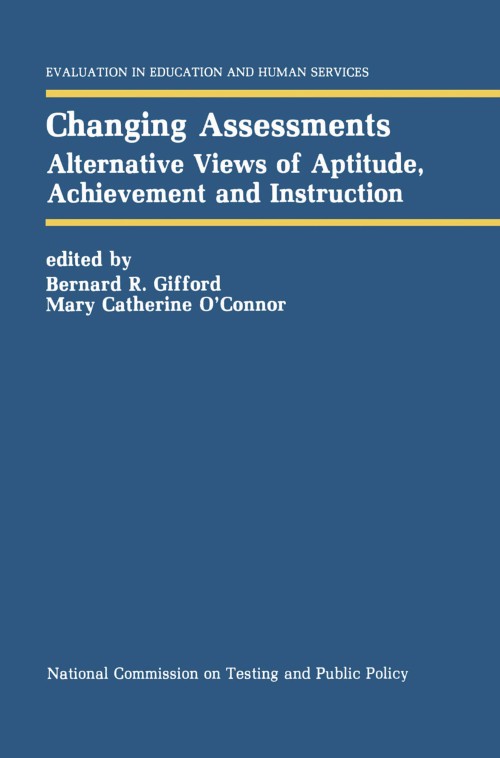
Changing Assessments [electronic resource] : Alternative Views of Aptitude, Achievement and Instruction / edited by Bernard R. Gifford, Mary Catherine O'Connor.
Erişim Adresi
ISBN
9789401129688
Dil Kodu
İngilizce
Yer Numarası
DK/10773
Basım Bildirimi
1st ed. 1992.
Yayın Bilgisi
Dordrecht : Springer Netherlands : Imprint: Springer, 1992.
Fiziksel Niteleme
XI, 337 p. online resource.
Dizi
Evaluation in Education and Human Services ; 30
İçindekiler Notu
Rethinking Aptitude, Achievement, and Instruction: Cognitive Science Research and the Framing of Assessment Policy -- Assessing the Thinking Curriculum: New Tools for Educational Reform -- Assessment in Context: The Alternative to Standardized Testing -- Interactive Learning Environments: A New Look at Assessment and Instruction -- CAT: A Program of Comprehensive Abilities Testing -- Commentary: Understanding What We Measure and Measuring What We Understand -- Commentary: What Policy Makers Who Mandate Tests Should Know About the New Psychology of Intellectual Ability and Learning.
Özet, vb.
Bernard R. Gifford As we edge toward the year 2000, the information age is a reality; the global marketplace is increasingly competitive; and the U.S. labor force is shrinking. Today more than ever, our nation's economic and social well-being hinges on our ability to tap our human resources-to identify talent, to nurture it, and to assess abilities and disabilities in ways that help every individual reach his or her full potential. In pursuing that goal, decision-makers in education, industry, and government are relying increasingly on standardized tests: sets of question- with identical directions, time limits and tasks for all test-takers-designed to permit an inference about what someone knows or can do in a particular area. CALIBRATING DIFFERENCE Our emphasis on standardized testing rests on a premise that is so basic it often escapes notice: that we humans are different from each other in ways that are both meaningful and measurable. We differ in terms of cognitive ability; aptitude for performing different kinds of mental and physical tasks; temperament; and interests. But somehow, without sufficient examination, we have taken a great collective leap from that commonplace to the notion that there are precise, measurable gradations of innate ability that can be used to direct children to the right classrooms, and adults to the right job slots.
Konu
Educational tests and measurements.
Artificial intelligence.
Economic policy.
Assessment and Testing.
Artificial Intelligence.
Economic Policy.
Artificial intelligence.
Economic policy.
Assessment and Testing.
Artificial Intelligence.
Economic Policy.
Diğer Yazarlar
Kurum Adı
Eseri Alıntıla
Referansları kullanmadan önce gözden geçirmeniz ve varsa gerekli düzeltmeleri yapmanız önerilir.
Dijital Kaynak
MARC Görünümü
LEADER 04734nam a22005895i 4500
001 809484
003 TR_AnAIT
005 20260131023119
007 cr nn 008mamaa
008 121227s1992 ne | s |||| 0|eng d
020 |a9789401129688|9978-94-011-2968-8
024 7 |a10.1007/978-94-011-2968-8|2doi
041 |aeng
049 |aTürk Tarih Kurumu Kütüphanesi
050 4|aLB3050-3060.87
072 7|aJNKD|2bicssc
072 7|aEDU030000|2bisacsh
072 7|aJNDH|2thema
082 04|a371.26|223
090 |aDK/10773
245 10|aChanging Assessments|h[electronic resource] :|bAlternative Views of Aptitude, Achievement and Instruction /|cedited by Bernard R. Gifford, Mary Catherine O'Connor.
250 |a1st ed. 1992.
264 1|aDordrecht :|bSpringer Netherlands :|bImprint: Springer,|c1992.
300 |aXI, 337 p.|bonline resource.
336 |atext|btxt|2rdacontent
337 |acomputer|bc|2rdamedia
338 |aonline resource|bcr|2rdacarrier
347 |atext file|bPDF|2rda
490 1 |aEvaluation in Education and Human Services ;|v30
505 0 |aRethinking Aptitude, Achievement, and Instruction: Cognitive Science Research and the Framing of Assessment Policy -- Assessing the Thinking Curriculum: New Tools for Educational Reform -- Assessment in Context: The Alternative to Standardized Testing -- Interactive Learning Environments: A New Look at Assessment and Instruction -- CAT: A Program of Comprehensive Abilities Testing -- Commentary: Understanding What We Measure and Measuring What We Understand -- Commentary: What Policy Makers Who Mandate Tests Should Know About the New Psychology of Intellectual Ability and Learning.
520 |aBernard R. Gifford As we edge toward the year 2000, the information age is a reality; the global marketplace is increasingly competitive; and the U.S. labor force is shrinking. Today more than ever, our nation's economic and social well-being hinges on our ability to tap our human resources-to identify talent, to nurture it, and to assess abilities and disabilities in ways that help every individual reach his or her full potential. In pursuing that goal, decision-makers in education, industry, and government are relying increasingly on standardized tests: sets of question- with identical directions, time limits and tasks for all test-takers-designed to permit an inference about what someone knows or can do in a particular area. CALIBRATING DIFFERENCE Our emphasis on standardized testing rests on a premise that is so basic it often escapes notice: that we humans are different from each other in ways that are both meaningful and measurable. We differ in terms of cognitive ability; aptitude for performing different kinds of mental and physical tasks; temperament; and interests. But somehow, without sufficient examination, we have taken a great collective leap from that commonplace to the notion that there are precise, measurable gradations of innate ability that can be used to direct children to the right classrooms, and adults to the right job slots.
532 8 |aAccessibility summary: This PDF is not accessible. It is based on scanned pages and does not support features such as screen reader compatibility or described non-text content (images, graphs etc). However, it likely supports searchable and selectable text based on OCR (Optical Character Recognition). Users with accessibility needs may not be able to use this content effectively. Please contact us at accessibilitysupport@springernature.com if you require assistance or an alternative format.
532 8 |aInaccessible, or known limited accessibility
532 8 |aNo reading system accessibility options actively disabled
532 8 |aPublisher contact for further accessibility information: accessibilitysupport@springernature.com
650 0|aEducational tests and measurements.
650 0|aArtificial intelligence.
650 0|aEconomic policy.
650 14|aAssessment and Testing.
650 24|aArtificial Intelligence.
650 24|aEconomic Policy.
700 1 |aGifford, Bernard R.|eeditor.|4edt|4http://id.loc.gov/vocabulary/relators/edt
700 1 |aO'Connor, Mary Catherine.|eeditor.|4edt|4http://id.loc.gov/vocabulary/relators/edt
710 2 |aSpringerLink (Online service)
773 0 |tSpringer Nature eBook
776 08|iPrinted edition:|z9780792391777
776 08|iPrinted edition:|z9789401129695
776 08|iPrinted edition:|z9789401053181
830 0|aEvaluation in Education and Human Services ;|v30
856 40|uhttps://doi.org/10.1007/978-94-011-2968-8
912 |aZDB-2-SHU
912 |aZDB-2-SXED
912 |aZDB-2-BAE
950 |aHumanities, Social Sciences and Law (SpringerNature-11648)
950 |aEducation (R0) (SpringerNature-43721)
001 809484
003 TR_AnAIT
005 20260131023119
007 cr nn 008mamaa
008 121227s1992 ne | s |||| 0|eng d
020 |a9789401129688|9978-94-011-2968-8
024 7 |a10.1007/978-94-011-2968-8|2doi
041 |aeng
049 |aTürk Tarih Kurumu Kütüphanesi
050 4|aLB3050-3060.87
072 7|aJNKD|2bicssc
072 7|aEDU030000|2bisacsh
072 7|aJNDH|2thema
082 04|a371.26|223
090 |aDK/10773
245 10|aChanging Assessments|h[electronic resource] :|bAlternative Views of Aptitude, Achievement and Instruction /|cedited by Bernard R. Gifford, Mary Catherine O'Connor.
250 |a1st ed. 1992.
264 1|aDordrecht :|bSpringer Netherlands :|bImprint: Springer,|c1992.
300 |aXI, 337 p.|bonline resource.
336 |atext|btxt|2rdacontent
337 |acomputer|bc|2rdamedia
338 |aonline resource|bcr|2rdacarrier
347 |atext file|bPDF|2rda
490 1 |aEvaluation in Education and Human Services ;|v30
505 0 |aRethinking Aptitude, Achievement, and Instruction: Cognitive Science Research and the Framing of Assessment Policy -- Assessing the Thinking Curriculum: New Tools for Educational Reform -- Assessment in Context: The Alternative to Standardized Testing -- Interactive Learning Environments: A New Look at Assessment and Instruction -- CAT: A Program of Comprehensive Abilities Testing -- Commentary: Understanding What We Measure and Measuring What We Understand -- Commentary: What Policy Makers Who Mandate Tests Should Know About the New Psychology of Intellectual Ability and Learning.
520 |aBernard R. Gifford As we edge toward the year 2000, the information age is a reality; the global marketplace is increasingly competitive; and the U.S. labor force is shrinking. Today more than ever, our nation's economic and social well-being hinges on our ability to tap our human resources-to identify talent, to nurture it, and to assess abilities and disabilities in ways that help every individual reach his or her full potential. In pursuing that goal, decision-makers in education, industry, and government are relying increasingly on standardized tests: sets of question- with identical directions, time limits and tasks for all test-takers-designed to permit an inference about what someone knows or can do in a particular area. CALIBRATING DIFFERENCE Our emphasis on standardized testing rests on a premise that is so basic it often escapes notice: that we humans are different from each other in ways that are both meaningful and measurable. We differ in terms of cognitive ability; aptitude for performing different kinds of mental and physical tasks; temperament; and interests. But somehow, without sufficient examination, we have taken a great collective leap from that commonplace to the notion that there are precise, measurable gradations of innate ability that can be used to direct children to the right classrooms, and adults to the right job slots.
532 8 |aAccessibility summary: This PDF is not accessible. It is based on scanned pages and does not support features such as screen reader compatibility or described non-text content (images, graphs etc). However, it likely supports searchable and selectable text based on OCR (Optical Character Recognition). Users with accessibility needs may not be able to use this content effectively. Please contact us at accessibilitysupport@springernature.com if you require assistance or an alternative format.
532 8 |aInaccessible, or known limited accessibility
532 8 |aNo reading system accessibility options actively disabled
532 8 |aPublisher contact for further accessibility information: accessibilitysupport@springernature.com
650 0|aEducational tests and measurements.
650 0|aArtificial intelligence.
650 0|aEconomic policy.
650 14|aAssessment and Testing.
650 24|aArtificial Intelligence.
650 24|aEconomic Policy.
700 1 |aGifford, Bernard R.|eeditor.|4edt|4http://id.loc.gov/vocabulary/relators/edt
700 1 |aO'Connor, Mary Catherine.|eeditor.|4edt|4http://id.loc.gov/vocabulary/relators/edt
710 2 |aSpringerLink (Online service)
773 0 |tSpringer Nature eBook
776 08|iPrinted edition:|z9780792391777
776 08|iPrinted edition:|z9789401129695
776 08|iPrinted edition:|z9789401053181
830 0|aEvaluation in Education and Human Services ;|v30
856 40|uhttps://doi.org/10.1007/978-94-011-2968-8
912 |aZDB-2-SHU
912 |aZDB-2-SXED
912 |aZDB-2-BAE
950 |aHumanities, Social Sciences and Law (SpringerNature-11648)
950 |aEducation (R0) (SpringerNature-43721)
Materyaller
Depodan talep edilen materyal sadece kütüphane içerisinde kullanılmaktadır.
Materyal dışarıya ödünç verilmemektedir.
Materyal dışarıya ödünç verilmemektedir.
