LEADER 04037nam a22005895i 4500
001 809491
003 TR_AnAIT
005 20260131023112
007 cr nn 008mamaa
008 121227s1996 ne | s |||| 0|eng d
020 |a9789400903395|9978-94-009-0339-5
024 7 |a10.1007/978-94-009-0339-5|2doi
041 |aeng
049 |aTürk Tarih Kurumu Kütüphanesi
050 4|aQA10.92-20
072 7|aJNU|2bicssc
072 7|aPB|2bicssc
072 7|aEDU029010|2bisacsh
072 7|aJNU|2thema
072 7|aPB|2thema
082 04|a510.71|223
090 |aDK/10780
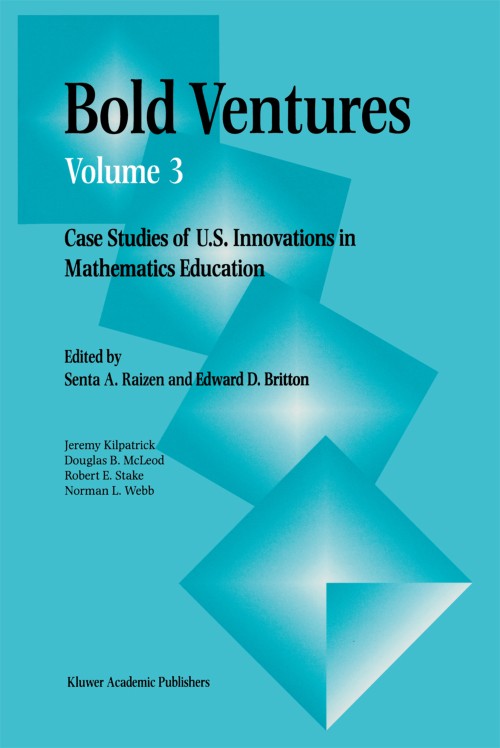
245 10|aBold Ventures|h[electronic resource] :|bCase Studies of U.S. Innovations in Mathematics Education /|cedited by S. Raizen, E.D. Britton.
250 |a1st ed. 1996.
264 1|aDordrecht :|bSpringer Netherlands :|bImprint: Springer,|c1996.
300 |aXIII, 376 p.|bonline resource.
336 |atext|btxt|2rdacontent
337 |acomputer|bc|2rdamedia
338 |aonline resource|bcr|2rdacarrier
347 |atext file|bPDF|2rda
505 0 |aIntroduction: Study Background -- 1. Setting the Standards: NCTM’s Role in the Reform of Mathematics Education -- 2. Teaching and Learning Cross-Country Mathematics: A Story of Innovation in Precalculus -- 3. The Urban Mathematics Collaborative Project: A Study of Teacher, Community, and Reform -- Acronyms and Abbreviations.
520 |aThis book presents comprehensive results from case studies of three innovations in mathematics education that have much to offer toward understanding current reforms in this field. Each chapter tells the story of a case in rich detail, with extensi ve documentation, and in the voices of many of the participants-the innovators, the teachers, the students. Similarly, Volume 2 of Bold Ventures pre sents the results from case studies of five innovations in science education. Volume 1 provides a cross-case analysis of all eight innovations. Many U.S. readers certainly will be very familiar with the name of at least if not all of the mathematics innovations discussed in this volume-for one example, the NCTM Standards-and probably with their general substance. Much of the education community's familiarity with these" arises from the pro jects' own dissemination efforts. The research reported in this volume, however, is one of the few detailed studies of these innovations undertaken by researchers outside the projects themselves.
532 8 |aAccessibility summary: This PDF is not accessible. It is based on scanned pages and does not support features such as screen reader compatibility or described non-text content (images, graphs etc). However, it likely supports searchable and selectable text based on OCR (Optical Character Recognition). Users with accessibility needs may not be able to use this content effectively. Please contact us at accessibilitysupport@springernature.com if you require assistance or an alternative format.
532 8 |aInaccessible, or known limited accessibility
532 8 |aNo reading system accessibility options actively disabled
532 8 |aPublisher contact for further accessibility information: accessibilitysupport@springernature.com
650 0|aMathematics|xStudy and teaching .
650 0|aScience|xStudy and teaching.
650 0|aEducational tests and measurements.
650 14|aMathematics Education.
650 24|aScience Education.
650 24|aAssessment and Testing.
700 1 |aRaizen, S.|eeditor.|4edt|4http://id.loc.gov/vocabulary/relators/edt
700 1 |aBritton, E.D.|eeditor.|4edt|4http://id.loc.gov/vocabulary/relators/edt
710 2 |aSpringerLink (Online service)
773 0 |tSpringer Nature eBook
776 08|iPrinted edition:|z9780792342335
776 08|iPrinted edition:|z9789400903401
776 08|iPrinted edition:|z9789401066396
856 40|uhttps://doi.org/10.1007/978-94-009-0339-5
912 |aZDB-2-SHU
912 |aZDB-2-SXED
912 |aZDB-2-BAE
950 |aHumanities, Social Sciences and Law (SpringerNature-11648)
950 |aEducation (R0) (SpringerNature-43721)