

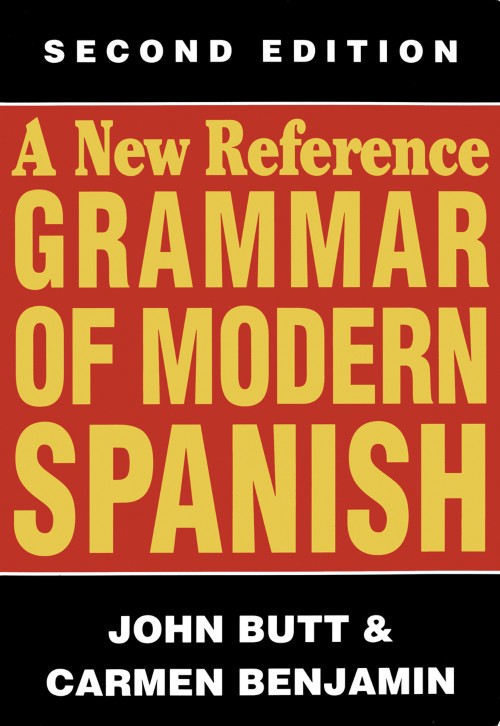
A New Reference Grammar of Modern Spanish [electronic resource] / by John Butt, Carmen Benjamin.
Erişim Adresi
ISBN
9781461583684
Dil Kodu
İngilizce
Yer Numarası
DK/10806
Yazar
Basım Bildirimi
2nd ed. 1994.
Yayın Bilgisi
New York, NY : Springer US : Imprint: Springer, 1994.
Fiziksel Niteleme
XIV, 520 p. online resource.
İçindekiler Notu
1 Gender of nouns -- 2 Plural of nouns -- 3 Articles -- 4 Adjectives -- 5 Comparison of adjectives and adverbs -- 6 Demonstrative adjectives and pronouns -- 7 Neuter article and pronouns -- 8 Possessive adjectives and pronouns -- 9 Miscellaneous adjectives and pronouns -- 10 Numerals -- 11 Personal pronouns -- 12 Le/les and lo/la/los/las -- 13 Forms of verbs -- 14 Use of indicative (non-continuous) verb forms -- 15 Continuous forms of the verb -- 16 The subjunctive -- 17 The imperative -- 18 The infinitive -- 19 Participles -- 20 The gerund -- 21 Modal auxiliary verbs -- 22 Personal a -- 23 Negation -- 24 Interrogation and exclamation -- 25 Conditional sentences -- 26 Pronominal verbs -- 27 Verbs of becoming -- 28 Passive and impersonal sentences -- 29 Ser and estar -- 30 Existential sentences(’there is/are’, etc.) -- 31 Adverbs -- 32 Expressions of time -- 33 Conjunctions -- 34 Prepositions -- 35 Relative clauses and pronouns -- 36 Nominalizers and cleft sentences -- 37 Word order -- 38 Diminutive, augmentative and pejorative suffixes -- 39 Spelling, accent rules, punctuation and word division -- Bibliography and sources -- Index of English words -- Index of Spanish words and grammatical points.
Özet, vb.
(abridged and revised) This reference grammar offers intermediate and advanced students a reason ably comprehensive guide to the morphology and syntax of educated speech and plain prose in Spain and Latin America at the end of the twentieth century. Spanish is the main, usually the sole official language of twenty-one countries,} and it is set fair to overtake English by the year 2000 in numbers 2 of native speakers. This vast geographical and political diversity ensures that Spanish is a good deal less unified than French, German or even English, the latter more or less internationally standardized according to either American or British norms. Until the 1960s, the criteria of internationally correct Spanish were dictated by the Real Academia Espanola, but the prestige of this institution has now sunk so low that its most solemn decrees are hardly taken seriously - witness the fate of the spelling reforms listed in the Nuevas normas de prosodia y ortograjia, which were supposed to come into force in all Spanish-speaking countries in 1959 and, nearly forty years later, are still selectively ignored by publishers and literate persons everywhere. The fact is that in Spanish 'correctness' is nowadays decided, as it is in all living languages, by the consensus of native speakers; but consensus about linguistic usage is obviously difficult to achieve between more than twenty independent, widely scattered and sometimes mutually hostile countries. Peninsular Spanish is itself in flux.
Konu
Romance languages.
Medicine __ Research.
Biology __ Research.
Romance Languages.
Biomedical Research.
Medicine __ Research.
Biology __ Research.
Romance Languages.
Biomedical Research.
Diğer Yazarlar
Kurum Adı
Eseri Alıntıla
Referansları kullanmadan önce gözden geçirmeniz ve varsa gerekli düzeltmeleri yapmanız önerilir.
Dijital Kaynak
MARC Görünümü
LEADER 05246nam a22005655i 4500
001 809517
003 TR_AnAIT
005 20260131023025
007 cr nn 008mamaa
008 121227s1994 xxu| s |||| 0|eng d
020 |a9781461583684|9978-1-4615-8368-4
024 7 |a10.1007/978-1-4615-8368-4|2doi
041 |aeng
049 |aTürk Tarih Kurumu Kütüphanesi
050 4|aPC1-5498
072 7|aCB|2bicssc
072 7|a2AD|2bicssc
072 7|aFOR000000|2bisacsh
072 7|aCB|x2AD|2thema
082 04|a440|223
090 |aDK/10806
100 1 |aButt, John.|eauthor.|4aut|4http://id.loc.gov/vocabulary/relators/aut
245 12|aA New Reference Grammar of Modern Spanish|h[electronic resource] /|cby John Butt, Carmen Benjamin.
250 |a2nd ed. 1994.
264 1|aNew York, NY :|bSpringer US :|bImprint: Springer,|c1994.
300 |aXIV, 520 p.|bonline resource.
336 |atext|btxt|2rdacontent
337 |acomputer|bc|2rdamedia
338 |aonline resource|bcr|2rdacarrier
347 |atext file|bPDF|2rda
505 0 |a1 Gender of nouns -- 2 Plural of nouns -- 3 Articles -- 4 Adjectives -- 5 Comparison of adjectives and adverbs -- 6 Demonstrative adjectives and pronouns -- 7 Neuter article and pronouns -- 8 Possessive adjectives and pronouns -- 9 Miscellaneous adjectives and pronouns -- 10 Numerals -- 11 Personal pronouns -- 12 Le/les and lo/la/los/las -- 13 Forms of verbs -- 14 Use of indicative (non-continuous) verb forms -- 15 Continuous forms of the verb -- 16 The subjunctive -- 17 The imperative -- 18 The infinitive -- 19 Participles -- 20 The gerund -- 21 Modal auxiliary verbs -- 22 Personal a -- 23 Negation -- 24 Interrogation and exclamation -- 25 Conditional sentences -- 26 Pronominal verbs -- 27 Verbs of becoming -- 28 Passive and impersonal sentences -- 29 Ser and estar -- 30 Existential sentences(’there is/are’, etc.) -- 31 Adverbs -- 32 Expressions of time -- 33 Conjunctions -- 34 Prepositions -- 35 Relative clauses and pronouns -- 36 Nominalizers and cleft sentences -- 37 Word order -- 38 Diminutive, augmentative and pejorative suffixes -- 39 Spelling, accent rules, punctuation and word division -- Bibliography and sources -- Index of English words -- Index of Spanish words and grammatical points.
520 |a(abridged and revised) This reference grammar offers intermediate and advanced students a reason ably comprehensive guide to the morphology and syntax of educated speech and plain prose in Spain and Latin America at the end of the twentieth century. Spanish is the main, usually the sole official language of twenty-one countries,} and it is set fair to overtake English by the year 2000 in numbers 2 of native speakers. This vast geographical and political diversity ensures that Spanish is a good deal less unified than French, German or even English, the latter more or less internationally standardized according to either American or British norms. Until the 1960s, the criteria of internationally correct Spanish were dictated by the Real Academia Espanola, but the prestige of this institution has now sunk so low that its most solemn decrees are hardly taken seriously - witness the fate of the spelling reforms listed in the Nuevas normas de prosodia y ortograjia, which were supposed to come into force in all Spanish-speaking countries in 1959 and, nearly forty years later, are still selectively ignored by publishers and literate persons everywhere. The fact is that in Spanish 'correctness' is nowadays decided, as it is in all living languages, by the consensus of native speakers; but consensus about linguistic usage is obviously difficult to achieve between more than twenty independent, widely scattered and sometimes mutually hostile countries. Peninsular Spanish is itself in flux.
532 8 |aAccessibility summary: This PDF is not accessible. It is based on scanned pages and does not support features such as screen reader compatibility or described non-text content (images, graphs etc). However, it likely supports searchable and selectable text based on OCR (Optical Character Recognition). Users with accessibility needs may not be able to use this content effectively. Please contact us at accessibilitysupport@springernature.com if you require assistance or an alternative format.
532 8 |aInaccessible, or known limited accessibility
532 8 |aNo reading system accessibility options actively disabled
532 8 |aPublisher contact for further accessibility information: accessibilitysupport@springernature.com
650 0|aRomance languages.
650 0|aMedicine|xResearch.
650 0|aBiology|xResearch.
650 14|aRomance Languages.
650 24|aBiomedical Research.
700 1 |aBenjamin, Carmen.|eauthor.|4aut|4http://id.loc.gov/vocabulary/relators/aut
710 2 |aSpringerLink (Online service)
773 0 |tSpringer Nature eBook
776 08|iPrinted edition:|z9780340583906
776 08|iPrinted edition:|z9781461583691
776 08|iPrinted edition:|z9781461583707
856 40|uhttps://doi.org/10.1007/978-1-4615-8368-4
912 |aZDB-2-SHU
912 |aZDB-2-SXS
912 |aZDB-2-BAE
950 |aHumanities, Social Sciences and Law (SpringerNature-11648)
950 |aSocial Sciences (R0) (SpringerNature-43726)
001 809517
003 TR_AnAIT
005 20260131023025
007 cr nn 008mamaa
008 121227s1994 xxu| s |||| 0|eng d
020 |a9781461583684|9978-1-4615-8368-4
024 7 |a10.1007/978-1-4615-8368-4|2doi
041 |aeng
049 |aTürk Tarih Kurumu Kütüphanesi
050 4|aPC1-5498
072 7|aCB|2bicssc
072 7|a2AD|2bicssc
072 7|aFOR000000|2bisacsh
072 7|aCB|x2AD|2thema
082 04|a440|223
090 |aDK/10806
100 1 |aButt, John.|eauthor.|4aut|4http://id.loc.gov/vocabulary/relators/aut
245 12|aA New Reference Grammar of Modern Spanish|h[electronic resource] /|cby John Butt, Carmen Benjamin.
250 |a2nd ed. 1994.
264 1|aNew York, NY :|bSpringer US :|bImprint: Springer,|c1994.
300 |aXIV, 520 p.|bonline resource.
336 |atext|btxt|2rdacontent
337 |acomputer|bc|2rdamedia
338 |aonline resource|bcr|2rdacarrier
347 |atext file|bPDF|2rda
505 0 |a1 Gender of nouns -- 2 Plural of nouns -- 3 Articles -- 4 Adjectives -- 5 Comparison of adjectives and adverbs -- 6 Demonstrative adjectives and pronouns -- 7 Neuter article and pronouns -- 8 Possessive adjectives and pronouns -- 9 Miscellaneous adjectives and pronouns -- 10 Numerals -- 11 Personal pronouns -- 12 Le/les and lo/la/los/las -- 13 Forms of verbs -- 14 Use of indicative (non-continuous) verb forms -- 15 Continuous forms of the verb -- 16 The subjunctive -- 17 The imperative -- 18 The infinitive -- 19 Participles -- 20 The gerund -- 21 Modal auxiliary verbs -- 22 Personal a -- 23 Negation -- 24 Interrogation and exclamation -- 25 Conditional sentences -- 26 Pronominal verbs -- 27 Verbs of becoming -- 28 Passive and impersonal sentences -- 29 Ser and estar -- 30 Existential sentences(’there is/are’, etc.) -- 31 Adverbs -- 32 Expressions of time -- 33 Conjunctions -- 34 Prepositions -- 35 Relative clauses and pronouns -- 36 Nominalizers and cleft sentences -- 37 Word order -- 38 Diminutive, augmentative and pejorative suffixes -- 39 Spelling, accent rules, punctuation and word division -- Bibliography and sources -- Index of English words -- Index of Spanish words and grammatical points.
520 |a(abridged and revised) This reference grammar offers intermediate and advanced students a reason ably comprehensive guide to the morphology and syntax of educated speech and plain prose in Spain and Latin America at the end of the twentieth century. Spanish is the main, usually the sole official language of twenty-one countries,} and it is set fair to overtake English by the year 2000 in numbers 2 of native speakers. This vast geographical and political diversity ensures that Spanish is a good deal less unified than French, German or even English, the latter more or less internationally standardized according to either American or British norms. Until the 1960s, the criteria of internationally correct Spanish were dictated by the Real Academia Espanola, but the prestige of this institution has now sunk so low that its most solemn decrees are hardly taken seriously - witness the fate of the spelling reforms listed in the Nuevas normas de prosodia y ortograjia, which were supposed to come into force in all Spanish-speaking countries in 1959 and, nearly forty years later, are still selectively ignored by publishers and literate persons everywhere. The fact is that in Spanish 'correctness' is nowadays decided, as it is in all living languages, by the consensus of native speakers; but consensus about linguistic usage is obviously difficult to achieve between more than twenty independent, widely scattered and sometimes mutually hostile countries. Peninsular Spanish is itself in flux.
532 8 |aAccessibility summary: This PDF is not accessible. It is based on scanned pages and does not support features such as screen reader compatibility or described non-text content (images, graphs etc). However, it likely supports searchable and selectable text based on OCR (Optical Character Recognition). Users with accessibility needs may not be able to use this content effectively. Please contact us at accessibilitysupport@springernature.com if you require assistance or an alternative format.
532 8 |aInaccessible, or known limited accessibility
532 8 |aNo reading system accessibility options actively disabled
532 8 |aPublisher contact for further accessibility information: accessibilitysupport@springernature.com
650 0|aRomance languages.
650 0|aMedicine|xResearch.
650 0|aBiology|xResearch.
650 14|aRomance Languages.
650 24|aBiomedical Research.
700 1 |aBenjamin, Carmen.|eauthor.|4aut|4http://id.loc.gov/vocabulary/relators/aut
710 2 |aSpringerLink (Online service)
773 0 |tSpringer Nature eBook
776 08|iPrinted edition:|z9780340583906
776 08|iPrinted edition:|z9781461583691
776 08|iPrinted edition:|z9781461583707
856 40|uhttps://doi.org/10.1007/978-1-4615-8368-4
912 |aZDB-2-SHU
912 |aZDB-2-SXS
912 |aZDB-2-BAE
950 |aHumanities, Social Sciences and Law (SpringerNature-11648)
950 |aSocial Sciences (R0) (SpringerNature-43726)
Materyaller
Depodan talep edilen materyal sadece kütüphane içerisinde kullanılmaktadır.
Materyal dışarıya ödünç verilmemektedir.
Materyal dışarıya ödünç verilmemektedir.
