

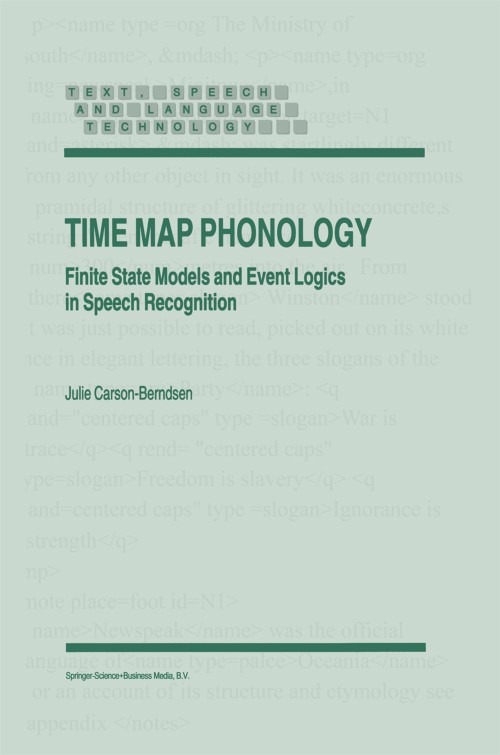
Time Map Phonology [electronic resource] : Finite State Models and Event Logics in Speech Recognition / by J. Carson-Berndsen.
Erişim Adresi
ISBN
9789401735346
Dil Kodu
İngilizce
Yer Numarası
DK/10808
Yazar
Basım Bildirimi
1st ed. 1998.
Yayın Bilgisi
Dordrecht : Springer Netherlands : Imprint: Springer, 1998.
Fiziksel Niteleme
XII, 248 p. online resource.
Dizi
Text, Speech and Language Technology, 2542-9388 ; 5
İçindekiler Notu
1 Introduction -- 2 Phonology and Computation -- 3 Finite State Techniques in Computational Phonology -- 4 The Event Concept in Time Map Phonology -- 5 Phonotactic Descriptions and Their Representation -- 6 Excursus: Constraint-Based Segmental Phonological Parsing -- 7 Constraint-Based Phonological Parsing: An Event-Based Approach -- 8 SILPA -- 9 Evaluation -- 10 Conclusion -- Appendix A Sampa Phonetic Alphabet for German -- Appendix B The Chomsky Hierarchy -- Appendix C Event-Based Phonotactic Network for German.
Özet, vb.
This book is a revised version of my doctoral thesis which was submitted in April 1993. The main extension is a chapter on evaluation of the system de scribed in Chapter 8 as this is clearly an issue which was not treated in the original version. This required the collection of data, the development of a concept for diagnostic evaluation of linguistic word recognition systems and, of course, the actual evaluation of the system itself. The revisions made primarily concern the presentation of the latest version of the SILPA system described in an additional Subsection 8. 3, the development environment for SILPA in Sec tion 8. 4, the diagnostic evaluation of the system as an additional Chapter 9. Some updates are included in the discussion of phonology and computation in Chapter 2 and finite state techniques in computational phonology in Chapter 3. The thesis was designed primarily as a contribution to the area of compu tational phonology. However, it addresses issues which are relevant within the disciplines of general linguistics, computational linguistics and, in particular, speech technology, in providing a detailed declarative, computationally inter preted linguistic model for application in spoken language processing. Time Map Phonology is a novel, constraint-based approach based on a two-stage temporal interpretation of phonological categories as events.
Konu
Computational linguistics.
Signal processing.
Artificial intelligence.
Philology.
Computational Linguistics.
Signal, Speech and Image Processing.
Artificial Intelligence.
Philology.
Signal processing.
Artificial intelligence.
Philology.
Computational Linguistics.
Signal, Speech and Image Processing.
Artificial Intelligence.
Philology.
Kurum Adı
Eseri Alıntıla
Referansları kullanmadan önce gözden geçirmeniz ve varsa gerekli düzeltmeleri yapmanız önerilir.
Dijital Kaynak
MARC Görünümü
LEADER 04629nam a22006015i 4500
001 809519
003 TR_AnAIT
005 20260131023022
007 cr nn 008mamaa
008 130125s1998 ne | s |||| 0|eng d
020 |a9789401735346|9978-94-017-3534-6
024 7 |a10.1007/978-94-017-3534-6|2doi
041 |aeng
049 |aTürk Tarih Kurumu Kütüphanesi
050 4|aP98-98.5
072 7|aCFX|2bicssc
072 7|aCOM073000|2bisacsh
072 7|aCFX|2thema
082 04|a410.285|223
090 |aDK/10808
100 1 |aCarson-Berndsen, J.|eauthor.|4aut|4http://id.loc.gov/vocabulary/relators/aut
245 10|aTime Map Phonology|h[electronic resource] :|bFinite State Models and Event Logics in Speech Recognition /|cby J. Carson-Berndsen.
250 |a1st ed. 1998.
264 1|aDordrecht :|bSpringer Netherlands :|bImprint: Springer,|c1998.
300 |aXII, 248 p.|bonline resource.
336 |atext|btxt|2rdacontent
337 |acomputer|bc|2rdamedia
338 |aonline resource|bcr|2rdacarrier
347 |atext file|bPDF|2rda
490 1 |aText, Speech and Language Technology,|x2542-9388 ;|v5
505 0 |a1 Introduction -- 2 Phonology and Computation -- 3 Finite State Techniques in Computational Phonology -- 4 The Event Concept in Time Map Phonology -- 5 Phonotactic Descriptions and Their Representation -- 6 Excursus: Constraint-Based Segmental Phonological Parsing -- 7 Constraint-Based Phonological Parsing: An Event-Based Approach -- 8 SILPA -- 9 Evaluation -- 10 Conclusion -- Appendix A Sampa Phonetic Alphabet for German -- Appendix B The Chomsky Hierarchy -- Appendix C Event-Based Phonotactic Network for German.
520 |aThis book is a revised version of my doctoral thesis which was submitted in April 1993. The main extension is a chapter on evaluation of the system de scribed in Chapter 8 as this is clearly an issue which was not treated in the original version. This required the collection of data, the development of a concept for diagnostic evaluation of linguistic word recognition systems and, of course, the actual evaluation of the system itself. The revisions made primarily concern the presentation of the latest version of the SILPA system described in an additional Subsection 8. 3, the development environment for SILPA in Sec tion 8. 4, the diagnostic evaluation of the system as an additional Chapter 9. Some updates are included in the discussion of phonology and computation in Chapter 2 and finite state techniques in computational phonology in Chapter 3. The thesis was designed primarily as a contribution to the area of compu tational phonology. However, it addresses issues which are relevant within the disciplines of general linguistics, computational linguistics and, in particular, speech technology, in providing a detailed declarative, computationally inter preted linguistic model for application in spoken language processing. Time Map Phonology is a novel, constraint-based approach based on a two-stage temporal interpretation of phonological categories as events.
532 8 |aAccessibility summary: This PDF is not accessible. It is based on scanned pages and does not support features such as screen reader compatibility or described non-text content (images, graphs etc). However, it likely supports searchable and selectable text based on OCR (Optical Character Recognition). Users with accessibility needs may not be able to use this content effectively. Please contact us at accessibilitysupport@springernature.com if you require assistance or an alternative format.
532 8 |aInaccessible, or known limited accessibility
532 8 |aNo reading system accessibility options actively disabled
532 8 |aPublisher contact for further accessibility information: accessibilitysupport@springernature.com
650 0|aComputational linguistics.
650 0|aSignal processing.
650 0|aArtificial intelligence.
650 0|aPhilology.
650 14|aComputational Linguistics.
650 24|aSignal, Speech and Image Processing.
650 24|aArtificial Intelligence.
650 24|aPhilology.
710 2 |aSpringerLink (Online service)
773 0 |tSpringer Nature eBook
776 08|iPrinted edition:|z9780792348832
776 08|iPrinted edition:|z9789048149698
776 08|iPrinted edition:|z9789401735353
830 0|aText, Speech and Language Technology,|x2542-9388 ;|v5
856 40|uhttps://doi.org/10.1007/978-94-017-3534-6
912 |aZDB-2-SHU
912 |aZDB-2-SXS
912 |aZDB-2-BAE
950 |aHumanities, Social Sciences and Law (SpringerNature-11648)
950 |aSocial Sciences (R0) (SpringerNature-43726)
001 809519
003 TR_AnAIT
005 20260131023022
007 cr nn 008mamaa
008 130125s1998 ne | s |||| 0|eng d
020 |a9789401735346|9978-94-017-3534-6
024 7 |a10.1007/978-94-017-3534-6|2doi
041 |aeng
049 |aTürk Tarih Kurumu Kütüphanesi
050 4|aP98-98.5
072 7|aCFX|2bicssc
072 7|aCOM073000|2bisacsh
072 7|aCFX|2thema
082 04|a410.285|223
090 |aDK/10808
100 1 |aCarson-Berndsen, J.|eauthor.|4aut|4http://id.loc.gov/vocabulary/relators/aut
245 10|aTime Map Phonology|h[electronic resource] :|bFinite State Models and Event Logics in Speech Recognition /|cby J. Carson-Berndsen.
250 |a1st ed. 1998.
264 1|aDordrecht :|bSpringer Netherlands :|bImprint: Springer,|c1998.
300 |aXII, 248 p.|bonline resource.
336 |atext|btxt|2rdacontent
337 |acomputer|bc|2rdamedia
338 |aonline resource|bcr|2rdacarrier
347 |atext file|bPDF|2rda
490 1 |aText, Speech and Language Technology,|x2542-9388 ;|v5
505 0 |a1 Introduction -- 2 Phonology and Computation -- 3 Finite State Techniques in Computational Phonology -- 4 The Event Concept in Time Map Phonology -- 5 Phonotactic Descriptions and Their Representation -- 6 Excursus: Constraint-Based Segmental Phonological Parsing -- 7 Constraint-Based Phonological Parsing: An Event-Based Approach -- 8 SILPA -- 9 Evaluation -- 10 Conclusion -- Appendix A Sampa Phonetic Alphabet for German -- Appendix B The Chomsky Hierarchy -- Appendix C Event-Based Phonotactic Network for German.
520 |aThis book is a revised version of my doctoral thesis which was submitted in April 1993. The main extension is a chapter on evaluation of the system de scribed in Chapter 8 as this is clearly an issue which was not treated in the original version. This required the collection of data, the development of a concept for diagnostic evaluation of linguistic word recognition systems and, of course, the actual evaluation of the system itself. The revisions made primarily concern the presentation of the latest version of the SILPA system described in an additional Subsection 8. 3, the development environment for SILPA in Sec tion 8. 4, the diagnostic evaluation of the system as an additional Chapter 9. Some updates are included in the discussion of phonology and computation in Chapter 2 and finite state techniques in computational phonology in Chapter 3. The thesis was designed primarily as a contribution to the area of compu tational phonology. However, it addresses issues which are relevant within the disciplines of general linguistics, computational linguistics and, in particular, speech technology, in providing a detailed declarative, computationally inter preted linguistic model for application in spoken language processing. Time Map Phonology is a novel, constraint-based approach based on a two-stage temporal interpretation of phonological categories as events.
532 8 |aAccessibility summary: This PDF is not accessible. It is based on scanned pages and does not support features such as screen reader compatibility or described non-text content (images, graphs etc). However, it likely supports searchable and selectable text based on OCR (Optical Character Recognition). Users with accessibility needs may not be able to use this content effectively. Please contact us at accessibilitysupport@springernature.com if you require assistance or an alternative format.
532 8 |aInaccessible, or known limited accessibility
532 8 |aNo reading system accessibility options actively disabled
532 8 |aPublisher contact for further accessibility information: accessibilitysupport@springernature.com
650 0|aComputational linguistics.
650 0|aSignal processing.
650 0|aArtificial intelligence.
650 0|aPhilology.
650 14|aComputational Linguistics.
650 24|aSignal, Speech and Image Processing.
650 24|aArtificial Intelligence.
650 24|aPhilology.
710 2 |aSpringerLink (Online service)
773 0 |tSpringer Nature eBook
776 08|iPrinted edition:|z9780792348832
776 08|iPrinted edition:|z9789048149698
776 08|iPrinted edition:|z9789401735353
830 0|aText, Speech and Language Technology,|x2542-9388 ;|v5
856 40|uhttps://doi.org/10.1007/978-94-017-3534-6
912 |aZDB-2-SHU
912 |aZDB-2-SXS
912 |aZDB-2-BAE
950 |aHumanities, Social Sciences and Law (SpringerNature-11648)
950 |aSocial Sciences (R0) (SpringerNature-43726)
Materyaller
Depodan talep edilen materyal sadece kütüphane içerisinde kullanılmaktadır.
Materyal dışarıya ödünç verilmemektedir.
Materyal dışarıya ödünç verilmemektedir.
