

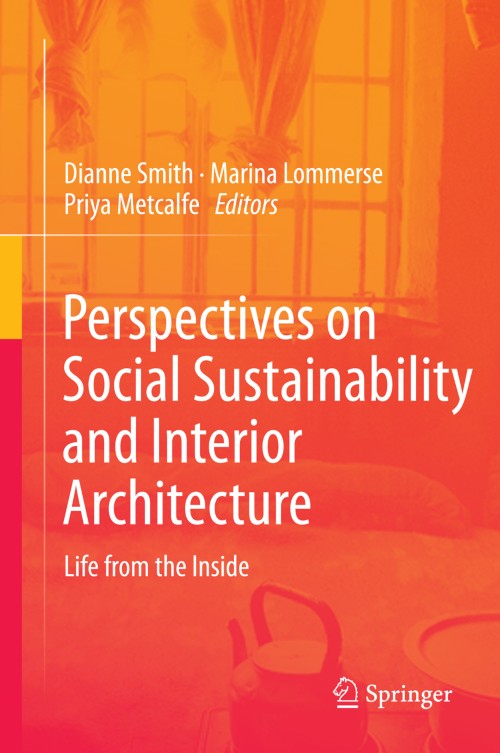
Perspectives on Social Sustainability and Interior Architecture [electronic resource] : Life from the Inside / edited by Dianne Smith, Marina Lommerse, Priya Metcalfe.
Erişim Adresi
ISBN
9789814585392
Dil Kodu
İngilizce
Yer Numarası
DK/10811
Basım Bildirimi
2nd ed. 2014.
Yayın Bilgisi
Singapore : Springer Nature Singapore : Imprint: Springer, 2014.
Fiziksel Niteleme
XXIII, 141 p. 25 illus. online resource.
İçindekiler Notu
Foreword by Tim Costello -- 1. An introduction to social sustainability and interior architecture, by Dianne Smith, Sarah Beeck, Marina Lommerse, Priya Metcalfe.- Part I. Community Engagement and Interior Architecture -- 2. Working together: interior architecture creating with the community, by Marina Lommers -- 3. More than bricks and mortar: lessons in design and world citizenship, by Kelley Beaverford.- Part II. Social Justice and Interior Architecture -- 4. Interiors can address Social Justice: fact or fiction? By Dianne Smith -- 5. The importance of interior design professionals' engagement in policy development to effect change for underprivileged individuals, by Jill Pable and Lisa Waxman .- 6. Interior design by expediency, by Rodney Harber and Angela Buckland.- 7. Inside the remote-area Aboriginal house, by Paul Memmott.- 8. Too ‘nice’ to be socially responsible: reflections of a Danish interior practitioner, by Marianne Frandsen -- Part III. Cultural Heritage and Interior Architecture -- 9. Cultural Heritage practice through socially sustainable adaptive re-use of industrial buildings: a Western Australian narrative, by Priya Metcalfe.- 10. Ambiguity and permeability in historic Modern interiors: a challenge for Cultural Heritage and social sustainability, by Penny Sparke .
Özet, vb.
This book argues that interior architects have a responsibility to practice their profession in collaborative ways that address the needs of communities and of to be the agents of social justice and cultural heritage. The book is divided into three sections, based on three pivotal themes — community engagement, social justice and cultural heritage. Each section has chapters that put forward the principles of these themes, leading into a variety of fascinating case studies that illustrate how socially sustainable design is implemented in diverse communities across the world. The second section includes four concise case studies of community housing issues, including remote-area indigenous housing and housing for the homeless. The third section offers two extensively researched essays on design and cultural heritage — a case study of the development of a redundant industrial site and a historical study of gendered domestic interiors. The book appeals to a wider audience than the design community alone and challenges mainstream interior design/interior architecture practitioners nationally and internationally to take a leading role in the field of socially responsible design. The issues raised by the authors are relevant for individuals, communities, government and non-government organisations, professionals and students. “In the twenty-first century we seem to have entered into a new world of knowledge discovery, where many of the most exciting insights come not from the authority of a traditional discipline, but from the dialogue that happens at the hubs and intersections of thought — the arenas where different disciplines and approaches, different schools and habits of thinking, come together to collaborate and contend. This collection is a good example of this, and I hope the book will be widely read and its lessons learned and applied.” Tim Costello, Officer of the Order of Australia, Chief Executive, World Vision Australia.
Konu
Social structure.
Equality.
Sustainability.
Interior architecture.
Social Structure.
Sustainability.
Interior Architecture.
Equality.
Sustainability.
Interior architecture.
Social Structure.
Sustainability.
Interior Architecture.
Diğer Yazarlar
Kurum Adı
Eseri Alıntıla
Referansları kullanmadan önce gözden geçirmeniz ve varsa gerekli düzeltmeleri yapmanız önerilir.
Dijital Kaynak
MARC Görünümü
LEADER 05269nam a22005415i 4500
001 809522
003 TR_AnAIT
005 20260131023015
007 cr nn 008mamaa
008 140430s2014 si | s |||| 0|eng d
020 |a9789814585392|9978-981-4585-39-2
024 7 |a10.1007/978-981-4585-39-2|2doi
041 |aeng
049 |aTürk Tarih Kurumu Kütüphanesi
050 4|aHM706
050 4|aHM821-821.17
072 7|aJFS|2bicssc
072 7|aSOC050000|2bisacsh
072 7|aJBS|2thema
082 04|a305.5|223
090 |aDK/10811
245 10|aPerspectives on Social Sustainability and Interior Architecture|h[electronic resource] :|bLife from the Inside /|cedited by Dianne Smith, Marina Lommerse, Priya Metcalfe.
250 |a2nd ed. 2014.
264 1|aSingapore :|bSpringer Nature Singapore :|bImprint: Springer,|c2014.
300 |aXXIII, 141 p. 25 illus.|bonline resource.
336 |atext|btxt|2rdacontent
337 |acomputer|bc|2rdamedia
338 |aonline resource|bcr|2rdacarrier
347 |atext file|bPDF|2rda
505 0 |aForeword by Tim Costello -- 1. An introduction to social sustainability and interior architecture, by Dianne Smith, Sarah Beeck, Marina Lommerse, Priya Metcalfe.- Part I. Community Engagement and Interior Architecture -- 2. Working together: interior architecture creating with the community, by Marina Lommers -- 3. More than bricks and mortar: lessons in design and world citizenship, by Kelley Beaverford.- Part II. Social Justice and Interior Architecture -- 4. Interiors can address Social Justice: fact or fiction? By Dianne Smith -- 5. The importance of interior design professionals' engagement in policy development to effect change for underprivileged individuals, by Jill Pable and Lisa Waxman .- 6. Interior design by expediency, by Rodney Harber and Angela Buckland.- 7. Inside the remote-area Aboriginal house, by Paul Memmott.- 8. Too ‘nice’ to be socially responsible: reflections of a Danish interior practitioner, by Marianne Frandsen -- Part III. Cultural Heritage and Interior Architecture -- 9. Cultural Heritage practice through socially sustainable adaptive re-use of industrial buildings: a Western Australian narrative, by Priya Metcalfe.- 10. Ambiguity and permeability in historic Modern interiors: a challenge for Cultural Heritage and social sustainability, by Penny Sparke .
520 |aThis book argues that interior architects have a responsibility to practice their profession in collaborative ways that address the needs of communities and of to be the agents of social justice and cultural heritage. The book is divided into three sections, based on three pivotal themes — community engagement, social justice and cultural heritage. Each section has chapters that put forward the principles of these themes, leading into a variety of fascinating case studies that illustrate how socially sustainable design is implemented in diverse communities across the world. The second section includes four concise case studies of community housing issues, including remote-area indigenous housing and housing for the homeless. The third section offers two extensively researched essays on design and cultural heritage — a case study of the development of a redundant industrial site and a historical study of gendered domestic interiors. The book appeals to a wider audience than the design community alone and challenges mainstream interior design/interior architecture practitioners nationally and internationally to take a leading role in the field of socially responsible design. The issues raised by the authors are relevant for individuals, communities, government and non-government organisations, professionals and students. “In the twenty-first century we seem to have entered into a new world of knowledge discovery, where many of the most exciting insights come not from the authority of a traditional discipline, but from the dialogue that happens at the hubs and intersections of thought — the arenas where different disciplines and approaches, different schools and habits of thinking, come together to collaborate and contend. This collection is a good example of this, and I hope the book will be widely read and its lessons learned and applied.” Tim Costello, Officer of the Order of Australia, Chief Executive, World Vision Australia.
650 0|aSocial structure.
650 0|aEquality.
650 0|aSustainability.
650 0|aInterior architecture.
650 14|aSocial Structure.
650 24|aSustainability.
650 24|aInterior Architecture.
700 1 |aSmith, Dianne.|eeditor.|4edt|4http://id.loc.gov/vocabulary/relators/edt
700 1 |aLommerse, Marina.|eeditor.|4edt|4http://id.loc.gov/vocabulary/relators/edt
700 1 |aMetcalfe, Priya.|eeditor.|4edt|4http://id.loc.gov/vocabulary/relators/edt
710 2 |aSpringerLink (Online service)
773 0 |tSpringer Nature eBook
776 08|iPrinted edition:|z9789814585385
776 08|iPrinted edition:|z9789814585408
776 08|iPrinted edition:|z9789811013492
856 40|uhttps://doi.org/10.1007/978-981-4585-39-2
912 |aZDB-2-SHU
912 |aZDB-2-SXS
950 |aHumanities, Social Sciences and Law (SpringerNature-11648)
950 |aSocial Sciences (R0) (SpringerNature-43726)
001 809522
003 TR_AnAIT
005 20260131023015
007 cr nn 008mamaa
008 140430s2014 si | s |||| 0|eng d
020 |a9789814585392|9978-981-4585-39-2
024 7 |a10.1007/978-981-4585-39-2|2doi
041 |aeng
049 |aTürk Tarih Kurumu Kütüphanesi
050 4|aHM706
050 4|aHM821-821.17
072 7|aJFS|2bicssc
072 7|aSOC050000|2bisacsh
072 7|aJBS|2thema
082 04|a305.5|223
090 |aDK/10811
245 10|aPerspectives on Social Sustainability and Interior Architecture|h[electronic resource] :|bLife from the Inside /|cedited by Dianne Smith, Marina Lommerse, Priya Metcalfe.
250 |a2nd ed. 2014.
264 1|aSingapore :|bSpringer Nature Singapore :|bImprint: Springer,|c2014.
300 |aXXIII, 141 p. 25 illus.|bonline resource.
336 |atext|btxt|2rdacontent
337 |acomputer|bc|2rdamedia
338 |aonline resource|bcr|2rdacarrier
347 |atext file|bPDF|2rda
505 0 |aForeword by Tim Costello -- 1. An introduction to social sustainability and interior architecture, by Dianne Smith, Sarah Beeck, Marina Lommerse, Priya Metcalfe.- Part I. Community Engagement and Interior Architecture -- 2. Working together: interior architecture creating with the community, by Marina Lommers -- 3. More than bricks and mortar: lessons in design and world citizenship, by Kelley Beaverford.- Part II. Social Justice and Interior Architecture -- 4. Interiors can address Social Justice: fact or fiction? By Dianne Smith -- 5. The importance of interior design professionals' engagement in policy development to effect change for underprivileged individuals, by Jill Pable and Lisa Waxman .- 6. Interior design by expediency, by Rodney Harber and Angela Buckland.- 7. Inside the remote-area Aboriginal house, by Paul Memmott.- 8. Too ‘nice’ to be socially responsible: reflections of a Danish interior practitioner, by Marianne Frandsen -- Part III. Cultural Heritage and Interior Architecture -- 9. Cultural Heritage practice through socially sustainable adaptive re-use of industrial buildings: a Western Australian narrative, by Priya Metcalfe.- 10. Ambiguity and permeability in historic Modern interiors: a challenge for Cultural Heritage and social sustainability, by Penny Sparke .
520 |aThis book argues that interior architects have a responsibility to practice their profession in collaborative ways that address the needs of communities and of to be the agents of social justice and cultural heritage. The book is divided into three sections, based on three pivotal themes — community engagement, social justice and cultural heritage. Each section has chapters that put forward the principles of these themes, leading into a variety of fascinating case studies that illustrate how socially sustainable design is implemented in diverse communities across the world. The second section includes four concise case studies of community housing issues, including remote-area indigenous housing and housing for the homeless. The third section offers two extensively researched essays on design and cultural heritage — a case study of the development of a redundant industrial site and a historical study of gendered domestic interiors. The book appeals to a wider audience than the design community alone and challenges mainstream interior design/interior architecture practitioners nationally and internationally to take a leading role in the field of socially responsible design. The issues raised by the authors are relevant for individuals, communities, government and non-government organisations, professionals and students. “In the twenty-first century we seem to have entered into a new world of knowledge discovery, where many of the most exciting insights come not from the authority of a traditional discipline, but from the dialogue that happens at the hubs and intersections of thought — the arenas where different disciplines and approaches, different schools and habits of thinking, come together to collaborate and contend. This collection is a good example of this, and I hope the book will be widely read and its lessons learned and applied.” Tim Costello, Officer of the Order of Australia, Chief Executive, World Vision Australia.
650 0|aSocial structure.
650 0|aEquality.
650 0|aSustainability.
650 0|aInterior architecture.
650 14|aSocial Structure.
650 24|aSustainability.
650 24|aInterior Architecture.
700 1 |aSmith, Dianne.|eeditor.|4edt|4http://id.loc.gov/vocabulary/relators/edt
700 1 |aLommerse, Marina.|eeditor.|4edt|4http://id.loc.gov/vocabulary/relators/edt
700 1 |aMetcalfe, Priya.|eeditor.|4edt|4http://id.loc.gov/vocabulary/relators/edt
710 2 |aSpringerLink (Online service)
773 0 |tSpringer Nature eBook
776 08|iPrinted edition:|z9789814585385
776 08|iPrinted edition:|z9789814585408
776 08|iPrinted edition:|z9789811013492
856 40|uhttps://doi.org/10.1007/978-981-4585-39-2
912 |aZDB-2-SHU
912 |aZDB-2-SXS
950 |aHumanities, Social Sciences and Law (SpringerNature-11648)
950 |aSocial Sciences (R0) (SpringerNature-43726)
Materyaller
Depodan talep edilen materyal sadece kütüphane içerisinde kullanılmaktadır.
Materyal dışarıya ödünç verilmemektedir.
Materyal dışarıya ödünç verilmemektedir.
