

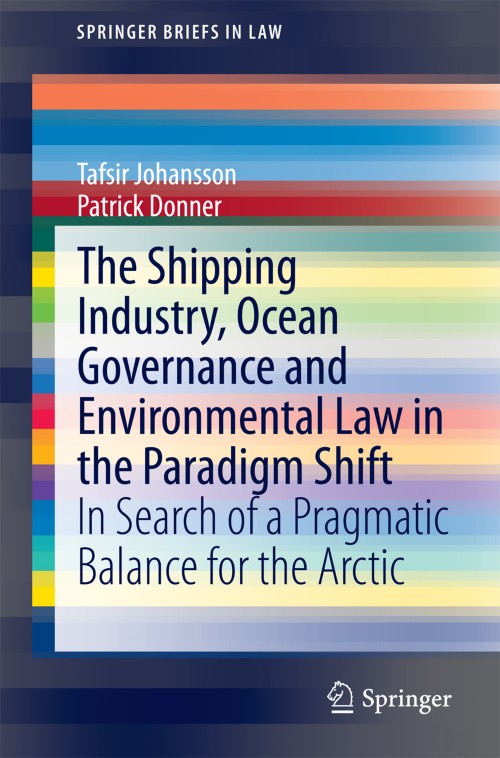
The Shipping Industry, Ocean Governance and Environmental Law in the Paradigm Shift [electronic resource] : In Search of a Pragmatic Balance for the Arctic / by Tafsir Johansson, Patrick Donner.
Erişim Adresi
ISBN
9783319125411
Dil Kodu
İngilizce
Yer Numarası
DK/10851
Yazar
Basım Bildirimi
1st ed. 2015.
Yayın Bilgisi
Cham : Springer International Publishing : Imprint: Springer, 2015.
Fiziksel Niteleme
XXII, 127 p. online resource.
Dizi
SpringerBriefs in Law, 2192-8568
İçindekiler Notu
1. Status Quo of Arctic International Instruments -- 2. Pertinent National Legislation of Arctic States -- 3. Emergence of Geographical Issues Due to Climate Change -- 4. Emanation of Environmental Issues and Regional Responses -- 5. Strict Ocean Governance and Commercial Implications of Arctic Navigation -- 6. Corporate Social Responsibility and the Arctic -- 7. Analysis of Alternatives to set the “Balance” -- 8. Conclusion.
Özet, vb.
This book examines the corpus of status quo environmental legal regime, geographical issues and redundant “stakeholder claims,” which persist in the Arctic. It examines multifarious theories relating not only to conflicting and opposing interests, but also to parties to whom the shipping industry should be accountable. The unique aspect of this book is the Corporate Social responsibility analysis pertaining to the Arctic and alternatives that strike a balance between the increased commercialization of the shipping industry and the laws and concepts of ocean governance. The book relevantly puts forward the concept of “ocean governance” and to what extent it can be addressed in terms of the Arctic. What distinguishes this book from others is the fact that it is not limited to examining the effects of climate change and how it is reshaping the way scholars assume the Arctic will be in the near future. Rather it creates a transparent nexus between opposing claims and increasing commercial interests and proceeds to scrutinize the efforts of the Arctic Council and individual Arctic coastal states. In this context, the book follows a given equation based on initial theories and how the opposing claims and increasing commercialization side of the equation can be balanced with the appropriate legal norm. It also reflects on the critical aspects of “hard law and soft law” which are two opposite ends of the legal pole and core elements of any legal spectrum. The book, after reflecting on those two elements, finally proposes a new Arctic legal regime, which is intricate and detailed and is basically a hierarchy based on logic and reasoning. In doing so, it imports a pristine theory for a pristine territory.
Konu
Law of the sea.
International law.
Aeronautics __ Law and legislation.
Water.
Hydrology.
Climatology.
Trade regulation.
Oceanography.
Law of the Sea, Air and Outer Space.
Water.
Climate Sciences.
International Economic Law, Trade Law.
Sources and Subjects of International Law, International Organizations.
Ocean Sciences.
International law.
Aeronautics __ Law and legislation.
Water.
Hydrology.
Climatology.
Trade regulation.
Oceanography.
Law of the Sea, Air and Outer Space.
Water.
Climate Sciences.
International Economic Law, Trade Law.
Sources and Subjects of International Law, International Organizations.
Ocean Sciences.
Diğer Yazarlar
Kurum Adı
Eseri Alıntıla
Referansları kullanmadan önce gözden geçirmeniz ve varsa gerekli düzeltmeleri yapmanız önerilir.
Dijital Kaynak
MARC Görünümü
LEADER 04454nam a22006255i 4500
001 809562
003 TR_AnAIT
005 20260131022907
007 cr nn 008mamaa
008 141121s2015 sz | s |||| 0|eng d
020 |a9783319125411|9978-3-319-12541-1
024 7 |a10.1007/978-3-319-12541-1|2doi
041 |aeng
049 |aTürk Tarih Kurumu Kütüphanesi
050 4|aKZA1002-5205
050 4|aKZD1002-6715
072 7|aLBB|2bicssc
072 7|aLAW051000|2bisacsh
072 7|aLBB|2thema
082 04|a341.4|223
090 |aDK/10851
100 1 |aJohansson, Tafsir.|eauthor.|4aut|4http://id.loc.gov/vocabulary/relators/aut
245 14|aThe Shipping Industry, Ocean Governance and Environmental Law in the Paradigm Shift|h[electronic resource] :|bIn Search of a Pragmatic Balance for the Arctic /|cby Tafsir Johansson, Patrick Donner.
250 |a1st ed. 2015.
264 1|aCham :|bSpringer International Publishing :|bImprint: Springer,|c2015.
300 |aXXII, 127 p.|bonline resource.
336 |atext|btxt|2rdacontent
337 |acomputer|bc|2rdamedia
338 |aonline resource|bcr|2rdacarrier
347 |atext file|bPDF|2rda
490 1 |aSpringerBriefs in Law,|x2192-8568
505 0 |a1. Status Quo of Arctic International Instruments -- 2. Pertinent National Legislation of Arctic States -- 3. Emergence of Geographical Issues Due to Climate Change -- 4. Emanation of Environmental Issues and Regional Responses -- 5. Strict Ocean Governance and Commercial Implications of Arctic Navigation -- 6. Corporate Social Responsibility and the Arctic -- 7. Analysis of Alternatives to set the “Balance” -- 8. Conclusion.
520 |aThis book examines the corpus of status quo environmental legal regime, geographical issues and redundant “stakeholder claims,” which persist in the Arctic. It examines multifarious theories relating not only to conflicting and opposing interests, but also to parties to whom the shipping industry should be accountable. The unique aspect of this book is the Corporate Social responsibility analysis pertaining to the Arctic and alternatives that strike a balance between the increased commercialization of the shipping industry and the laws and concepts of ocean governance. The book relevantly puts forward the concept of “ocean governance” and to what extent it can be addressed in terms of the Arctic. What distinguishes this book from others is the fact that it is not limited to examining the effects of climate change and how it is reshaping the way scholars assume the Arctic will be in the near future. Rather it creates a transparent nexus between opposing claims and increasing commercial interests and proceeds to scrutinize the efforts of the Arctic Council and individual Arctic coastal states. In this context, the book follows a given equation based on initial theories and how the opposing claims and increasing commercialization side of the equation can be balanced with the appropriate legal norm. It also reflects on the critical aspects of “hard law and soft law” which are two opposite ends of the legal pole and core elements of any legal spectrum. The book, after reflecting on those two elements, finally proposes a new Arctic legal regime, which is intricate and detailed and is basically a hierarchy based on logic and reasoning. In doing so, it imports a pristine theory for a pristine territory.
650 0|aLaw of the sea.
650 0|aInternational law.
650 0|aAeronautics|xLaw and legislation.
650 0|aWater.
650 0|aHydrology.
650 0|aClimatology.
650 0|aTrade regulation.
650 0|aOceanography.
650 14|aLaw of the Sea, Air and Outer Space.
650 24|aWater.
650 24|aClimate Sciences.
650 24|aInternational Economic Law, Trade Law.
650 24|aSources and Subjects of International Law, International Organizations.
650 24|aOcean Sciences.
700 1 |aDonner, Patrick.|eauthor.|4aut|4http://id.loc.gov/vocabulary/relators/aut
710 2 |aSpringerLink (Online service)
773 0 |tSpringer Nature eBook
776 08|iPrinted edition:|z9783319125404
776 08|iPrinted edition:|z9783319125428
830 0|aSpringerBriefs in Law,|x2192-8568
856 40|uhttps://doi.org/10.1007/978-3-319-12541-1
912 |aZDB-2-SHU
912 |aZDB-2-SXLC
950 |aHumanities, Social Sciences and Law (SpringerNature-11648)
950 |aLaw and Criminology (R0) (SpringerNature-43727)
001 809562
003 TR_AnAIT
005 20260131022907
007 cr nn 008mamaa
008 141121s2015 sz | s |||| 0|eng d
020 |a9783319125411|9978-3-319-12541-1
024 7 |a10.1007/978-3-319-12541-1|2doi
041 |aeng
049 |aTürk Tarih Kurumu Kütüphanesi
050 4|aKZA1002-5205
050 4|aKZD1002-6715
072 7|aLBB|2bicssc
072 7|aLAW051000|2bisacsh
072 7|aLBB|2thema
082 04|a341.4|223
090 |aDK/10851
100 1 |aJohansson, Tafsir.|eauthor.|4aut|4http://id.loc.gov/vocabulary/relators/aut
245 14|aThe Shipping Industry, Ocean Governance and Environmental Law in the Paradigm Shift|h[electronic resource] :|bIn Search of a Pragmatic Balance for the Arctic /|cby Tafsir Johansson, Patrick Donner.
250 |a1st ed. 2015.
264 1|aCham :|bSpringer International Publishing :|bImprint: Springer,|c2015.
300 |aXXII, 127 p.|bonline resource.
336 |atext|btxt|2rdacontent
337 |acomputer|bc|2rdamedia
338 |aonline resource|bcr|2rdacarrier
347 |atext file|bPDF|2rda
490 1 |aSpringerBriefs in Law,|x2192-8568
505 0 |a1. Status Quo of Arctic International Instruments -- 2. Pertinent National Legislation of Arctic States -- 3. Emergence of Geographical Issues Due to Climate Change -- 4. Emanation of Environmental Issues and Regional Responses -- 5. Strict Ocean Governance and Commercial Implications of Arctic Navigation -- 6. Corporate Social Responsibility and the Arctic -- 7. Analysis of Alternatives to set the “Balance” -- 8. Conclusion.
520 |aThis book examines the corpus of status quo environmental legal regime, geographical issues and redundant “stakeholder claims,” which persist in the Arctic. It examines multifarious theories relating not only to conflicting and opposing interests, but also to parties to whom the shipping industry should be accountable. The unique aspect of this book is the Corporate Social responsibility analysis pertaining to the Arctic and alternatives that strike a balance between the increased commercialization of the shipping industry and the laws and concepts of ocean governance. The book relevantly puts forward the concept of “ocean governance” and to what extent it can be addressed in terms of the Arctic. What distinguishes this book from others is the fact that it is not limited to examining the effects of climate change and how it is reshaping the way scholars assume the Arctic will be in the near future. Rather it creates a transparent nexus between opposing claims and increasing commercial interests and proceeds to scrutinize the efforts of the Arctic Council and individual Arctic coastal states. In this context, the book follows a given equation based on initial theories and how the opposing claims and increasing commercialization side of the equation can be balanced with the appropriate legal norm. It also reflects on the critical aspects of “hard law and soft law” which are two opposite ends of the legal pole and core elements of any legal spectrum. The book, after reflecting on those two elements, finally proposes a new Arctic legal regime, which is intricate and detailed and is basically a hierarchy based on logic and reasoning. In doing so, it imports a pristine theory for a pristine territory.
650 0|aLaw of the sea.
650 0|aInternational law.
650 0|aAeronautics|xLaw and legislation.
650 0|aWater.
650 0|aHydrology.
650 0|aClimatology.
650 0|aTrade regulation.
650 0|aOceanography.
650 14|aLaw of the Sea, Air and Outer Space.
650 24|aWater.
650 24|aClimate Sciences.
650 24|aInternational Economic Law, Trade Law.
650 24|aSources and Subjects of International Law, International Organizations.
650 24|aOcean Sciences.
700 1 |aDonner, Patrick.|eauthor.|4aut|4http://id.loc.gov/vocabulary/relators/aut
710 2 |aSpringerLink (Online service)
773 0 |tSpringer Nature eBook
776 08|iPrinted edition:|z9783319125404
776 08|iPrinted edition:|z9783319125428
830 0|aSpringerBriefs in Law,|x2192-8568
856 40|uhttps://doi.org/10.1007/978-3-319-12541-1
912 |aZDB-2-SHU
912 |aZDB-2-SXLC
950 |aHumanities, Social Sciences and Law (SpringerNature-11648)
950 |aLaw and Criminology (R0) (SpringerNature-43727)
Materyaller
Depodan talep edilen materyal sadece kütüphane içerisinde kullanılmaktadır.
Materyal dışarıya ödünç verilmemektedir.
Materyal dışarıya ödünç verilmemektedir.
