

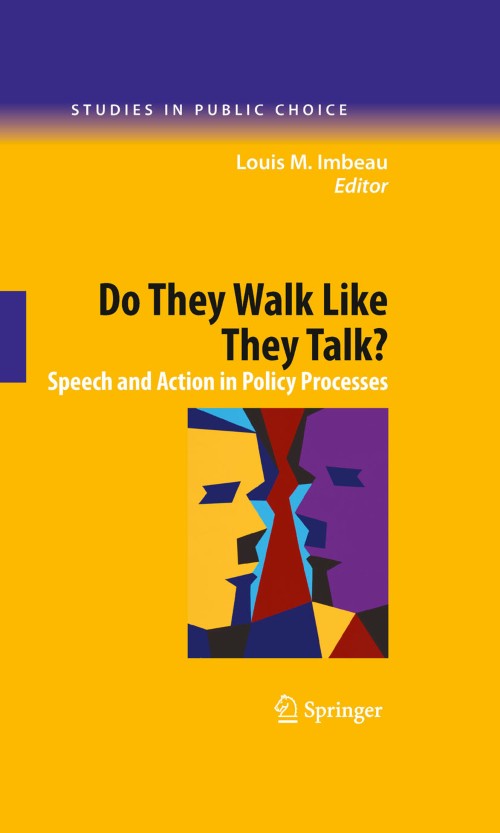
Do They Walk Like They Talk? [electronic resource] : Speech and Action in Policy Processes / edited by Louis M. Imbeau.
Erişim Adresi
ISBN
9780387896724
Dil Kodu
İngilizce
Yer Numarası
DK/10862
Basım Bildirimi
1st ed. 2009.
Yayın Bilgisi
New York, NY : Springer New York : Imprint: Springer, 2009.
Fiziksel Niteleme
XIV, 306 p. 65 illus. online resource.
Dizi
Studies in Public Choice, 2731-5258 ; 15
İçindekiler Notu
Dissonance in Policy Processes: An Introduction -- Disciplinary Perspectives -- The Power of Words: A Philosophical Perspective -- Information Shrouding and the Governmental Supply of Goods and Services: An Economic Perspective -- Party Rhetoric and Practice: A Normative Perspective from Political Science -- Measuring How Political Parties Keep Their Promises: A Positive Perspective from Political Science -- Empirical Studies -- Measuring US Presidents’ Political Commitment for Fiscal Discipline Between 1920 and 2008 -- Would You Trust an Italian Politician? Evidence from Italian Regional Politics -- General Policy Speech of Prime Ministers and Fiscal Choices in France: “Preach Water and Drink Wine!” -- Do Governments Manipulate Their Revenue Forecasts? Budget Speech and Budget Outcomes in the Canadian Provinces -- Dissonance in Fiscal Policy: A Power Approach -- Speeches and Legislative Extremism in the U.S. Senate -- Do Parties Matter? A Qualitative Answer with Numbers -- Talking Like a Tax Collector or a Social Guardian? The Use of Administrative Discourse by U.S. State Lottery Agencies -- The Early European “FederalismFederalism ”: Ambiguities of Talks About How to Walk Toward a Political UnionPolitical Union -- A Semiotic Network Comparison of Technocratic and Populist Discourses in Turkey -- Conclusion -- Do They Walk Like They Talk? A Conclusion.
Özet, vb.
George Bush’s 1988 campaign pledge, "Read my lips: no new taxes," has become a mantra for those who distrust politicians and bureaucrats. The gulf between what political leaders say and do seems to be widening, and in democratic societies around the world, contributing to an atmosphere of cynicism and apathy among the citizenry. Understanding the characteristics and functions of speech in policy processes is a requirement for trying to overcome this problem. However, there has been scant analysis of political discourse; the aim of this book is to help fill this analytical gap, by exploring political speech from a variety of perspectives, including normative, epistemological, and empirical. Incorporating insights from economics, political science, philosophy, and law, and evidence from the United States, Canada, France, Italy, Turkey, and the EU, the book addresses a wide variety of timely issues, including: Fiscal discipline in speeches vs budget balance Revenues forecasted in budget speeches vs realized budget outcomes Electoral pledges vs actual realizations Ideological stance in party publications vs spending and revenues of party governments The political business cycle Other questions explored include: Should policy makers always tell the truth and all the truth? What are the benefits and the costs of transparency? How can we resolve the apparent contradiction between the democratic demand for transparency and the efficiency requirement of secrecy in many policy areas? Under which conditions is secrecy acceptable in a democratic society? To what extent may deception and lies lead to a breach of trust or to power abuse? What are the most efficient institutional mechanisms to prevent such abuse? Collectively, the authors present new insights for understanding political process and government activity, and suggest avenues forfurther research.
Konu
Political science.
Semiotics.
Political science __ Philosophy.
Political Science.
Semiotics.
Political Philosophy.
Semiotics.
Political science __ Philosophy.
Political Science.
Semiotics.
Political Philosophy.
Diğer Yazarlar
Kurum Adı
Eseri Alıntıla
Referansları kullanmadan önce gözden geçirmeniz ve varsa gerekli düzeltmeleri yapmanız önerilir.
Dijital Kaynak
MARC Görünümü
LEADER 05100nam a22005175i 4500
001 809573
003 TR_AnAIT
005 20260131022855
007 cr nn 008mamaa
008 110414s2009 xxu| s |||| 0|eng d
020 |a9780387896724|9978-0-387-89672-4
024 7 |a10.1007/978-0-387-89672-4|2doi
041 |aeng
049 |aTürk Tarih Kurumu Kütüphanesi
050 4|aJA1-92
072 7|aJPA|2bicssc
072 7|aPOL000000|2bisacsh
072 7|aJPA|2thema
082 04|a320|223
090 |aDK/10862
245 10|aDo They Walk Like They Talk?|h[electronic resource] :|bSpeech and Action in Policy Processes /|cedited by Louis M. Imbeau.
250 |a1st ed. 2009.
264 1|aNew York, NY :|bSpringer New York :|bImprint: Springer,|c2009.
300 |aXIV, 306 p. 65 illus.|bonline resource.
336 |atext|btxt|2rdacontent
337 |acomputer|bc|2rdamedia
338 |aonline resource|bcr|2rdacarrier
347 |atext file|bPDF|2rda
490 1 |aStudies in Public Choice,|x2731-5258 ;|v15
505 0 |aDissonance in Policy Processes: An Introduction -- Disciplinary Perspectives -- The Power of Words: A Philosophical Perspective -- Information Shrouding and the Governmental Supply of Goods and Services: An Economic Perspective -- Party Rhetoric and Practice: A Normative Perspective from Political Science -- Measuring How Political Parties Keep Their Promises: A Positive Perspective from Political Science -- Empirical Studies -- Measuring US Presidents’ Political Commitment for Fiscal Discipline Between 1920 and 2008 -- Would You Trust an Italian Politician? Evidence from Italian Regional Politics -- General Policy Speech of Prime Ministers and Fiscal Choices in France: “Preach Water and Drink Wine!” -- Do Governments Manipulate Their Revenue Forecasts? Budget Speech and Budget Outcomes in the Canadian Provinces -- Dissonance in Fiscal Policy: A Power Approach -- Speeches and Legislative Extremism in the U.S. Senate -- Do Parties Matter? A Qualitative Answer with Numbers -- Talking Like a Tax Collector or a Social Guardian? The Use of Administrative Discourse by U.S. State Lottery Agencies -- The Early European “FederalismFederalism ”: Ambiguities of Talks About How to Walk Toward a Political UnionPolitical Union -- A Semiotic Network Comparison of Technocratic and Populist Discourses in Turkey -- Conclusion -- Do They Walk Like They Talk? A Conclusion.
520 |aGeorge Bush’s 1988 campaign pledge, "Read my lips: no new taxes," has become a mantra for those who distrust politicians and bureaucrats. The gulf between what political leaders say and do seems to be widening, and in democratic societies around the world, contributing to an atmosphere of cynicism and apathy among the citizenry. Understanding the characteristics and functions of speech in policy processes is a requirement for trying to overcome this problem. However, there has been scant analysis of political discourse; the aim of this book is to help fill this analytical gap, by exploring political speech from a variety of perspectives, including normative, epistemological, and empirical. Incorporating insights from economics, political science, philosophy, and law, and evidence from the United States, Canada, France, Italy, Turkey, and the EU, the book addresses a wide variety of timely issues, including: Fiscal discipline in speeches vs budget balance Revenues forecasted in budget speeches vs realized budget outcomes Electoral pledges vs actual realizations Ideological stance in party publications vs spending and revenues of party governments The political business cycle Other questions explored include: Should policy makers always tell the truth and all the truth? What are the benefits and the costs of transparency? How can we resolve the apparent contradiction between the democratic demand for transparency and the efficiency requirement of secrecy in many policy areas? Under which conditions is secrecy acceptable in a democratic society? To what extent may deception and lies lead to a breach of trust or to power abuse? What are the most efficient institutional mechanisms to prevent such abuse? Collectively, the authors present new insights for understanding political process and government activity, and suggest avenues forfurther research.
650 0|aPolitical science.
650 0|aSemiotics.
650 0|aPolitical science|xPhilosophy.
650 14|aPolitical Science.
650 24|aSemiotics.
650 24|aPolitical Philosophy.
700 1 |aImbeau, Louis M.|eeditor.|4edt|4http://id.loc.gov/vocabulary/relators/edt
710 2 |aSpringerLink (Online service)
773 0 |tSpringer Nature eBook
776 08|iPrinted edition:|z9780387896717
776 08|iPrinted edition:|z9780387897196
776 08|iPrinted edition:|z9781461417200
830 0|aStudies in Public Choice,|x2731-5258 ;|v15
856 40|uhttps://doi.org/10.1007/978-0-387-89672-4
912 |aZDB-2-SHU
912 |aZDB-2-SXPI
950 |aHumanities, Social Sciences and Law (SpringerNature-11648)
950 |aPolitical Science and International Studies (R0) (SpringerNature-43724)
001 809573
003 TR_AnAIT
005 20260131022855
007 cr nn 008mamaa
008 110414s2009 xxu| s |||| 0|eng d
020 |a9780387896724|9978-0-387-89672-4
024 7 |a10.1007/978-0-387-89672-4|2doi
041 |aeng
049 |aTürk Tarih Kurumu Kütüphanesi
050 4|aJA1-92
072 7|aJPA|2bicssc
072 7|aPOL000000|2bisacsh
072 7|aJPA|2thema
082 04|a320|223
090 |aDK/10862
245 10|aDo They Walk Like They Talk?|h[electronic resource] :|bSpeech and Action in Policy Processes /|cedited by Louis M. Imbeau.
250 |a1st ed. 2009.
264 1|aNew York, NY :|bSpringer New York :|bImprint: Springer,|c2009.
300 |aXIV, 306 p. 65 illus.|bonline resource.
336 |atext|btxt|2rdacontent
337 |acomputer|bc|2rdamedia
338 |aonline resource|bcr|2rdacarrier
347 |atext file|bPDF|2rda
490 1 |aStudies in Public Choice,|x2731-5258 ;|v15
505 0 |aDissonance in Policy Processes: An Introduction -- Disciplinary Perspectives -- The Power of Words: A Philosophical Perspective -- Information Shrouding and the Governmental Supply of Goods and Services: An Economic Perspective -- Party Rhetoric and Practice: A Normative Perspective from Political Science -- Measuring How Political Parties Keep Their Promises: A Positive Perspective from Political Science -- Empirical Studies -- Measuring US Presidents’ Political Commitment for Fiscal Discipline Between 1920 and 2008 -- Would You Trust an Italian Politician? Evidence from Italian Regional Politics -- General Policy Speech of Prime Ministers and Fiscal Choices in France: “Preach Water and Drink Wine!” -- Do Governments Manipulate Their Revenue Forecasts? Budget Speech and Budget Outcomes in the Canadian Provinces -- Dissonance in Fiscal Policy: A Power Approach -- Speeches and Legislative Extremism in the U.S. Senate -- Do Parties Matter? A Qualitative Answer with Numbers -- Talking Like a Tax Collector or a Social Guardian? The Use of Administrative Discourse by U.S. State Lottery Agencies -- The Early European “FederalismFederalism ”: Ambiguities of Talks About How to Walk Toward a Political UnionPolitical Union -- A Semiotic Network Comparison of Technocratic and Populist Discourses in Turkey -- Conclusion -- Do They Walk Like They Talk? A Conclusion.
520 |aGeorge Bush’s 1988 campaign pledge, "Read my lips: no new taxes," has become a mantra for those who distrust politicians and bureaucrats. The gulf between what political leaders say and do seems to be widening, and in democratic societies around the world, contributing to an atmosphere of cynicism and apathy among the citizenry. Understanding the characteristics and functions of speech in policy processes is a requirement for trying to overcome this problem. However, there has been scant analysis of political discourse; the aim of this book is to help fill this analytical gap, by exploring political speech from a variety of perspectives, including normative, epistemological, and empirical. Incorporating insights from economics, political science, philosophy, and law, and evidence from the United States, Canada, France, Italy, Turkey, and the EU, the book addresses a wide variety of timely issues, including: Fiscal discipline in speeches vs budget balance Revenues forecasted in budget speeches vs realized budget outcomes Electoral pledges vs actual realizations Ideological stance in party publications vs spending and revenues of party governments The political business cycle Other questions explored include: Should policy makers always tell the truth and all the truth? What are the benefits and the costs of transparency? How can we resolve the apparent contradiction between the democratic demand for transparency and the efficiency requirement of secrecy in many policy areas? Under which conditions is secrecy acceptable in a democratic society? To what extent may deception and lies lead to a breach of trust or to power abuse? What are the most efficient institutional mechanisms to prevent such abuse? Collectively, the authors present new insights for understanding political process and government activity, and suggest avenues forfurther research.
650 0|aPolitical science.
650 0|aSemiotics.
650 0|aPolitical science|xPhilosophy.
650 14|aPolitical Science.
650 24|aSemiotics.
650 24|aPolitical Philosophy.
700 1 |aImbeau, Louis M.|eeditor.|4edt|4http://id.loc.gov/vocabulary/relators/edt
710 2 |aSpringerLink (Online service)
773 0 |tSpringer Nature eBook
776 08|iPrinted edition:|z9780387896717
776 08|iPrinted edition:|z9780387897196
776 08|iPrinted edition:|z9781461417200
830 0|aStudies in Public Choice,|x2731-5258 ;|v15
856 40|uhttps://doi.org/10.1007/978-0-387-89672-4
912 |aZDB-2-SHU
912 |aZDB-2-SXPI
950 |aHumanities, Social Sciences and Law (SpringerNature-11648)
950 |aPolitical Science and International Studies (R0) (SpringerNature-43724)
Materyaller
Depodan talep edilen materyal sadece kütüphane içerisinde kullanılmaktadır.
Materyal dışarıya ödünç verilmemektedir.
Materyal dışarıya ödünç verilmemektedir.
