

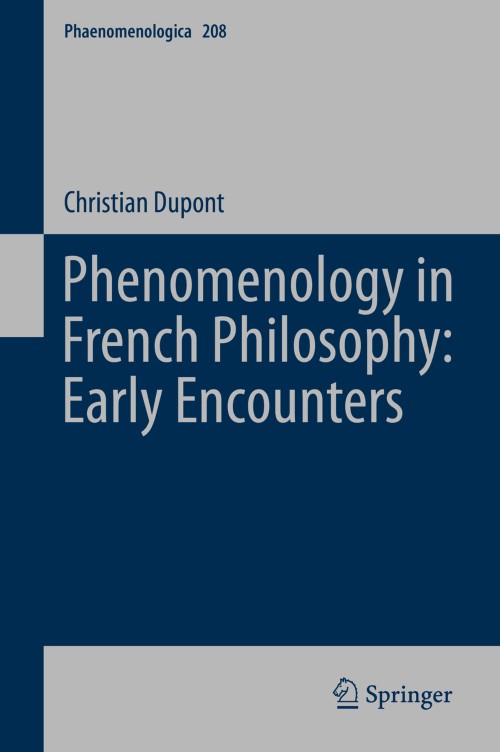
Phenomenology in French Philosophy: Early Encounters [electronic resource] / by Christian Dupont.
Erişim Adresi
ISBN
9789400746411
Dil Kodu
İngilizce
Yer Numarası
DK/10885
Yazar
Basım Bildirimi
1st ed. 2014.
Yayın Bilgisi
Dordrecht : Springer Netherlands : Imprint: Springer, 2014.
Fiziksel Niteleme
XI, 338 p. online resource.
Dizi
Phaenomenologica, Series Founded by H. L. Van Breda and Published Under the Auspices of the Husserl-Archives, 2215-0331
İçindekiler Notu
PREFACE -- CHAPTER 1: INTRODUCTION- I. Occasion -- II. Contribution -- III. Methodology and Terminology -- A. Definition of Reception -- B. Definition of Phenomenology -- C. Definition of Religious Thought -- IV. Plan -- CHAPTER 2: PRECURSORS TO THE RECEPTION OF PHENOMENOLOGY IN FRANCE, 1889-1909 -- I. Three Major Currents in French Philosophy at the End of the Nineteenth Century -- A. Positivism -- B. Idealism -- C Spiritualism -- D. Summary: Anticipations of Phenomenology in French Positivism, Idealism and Spiritualism -- II. Henri Bergson: Lived Duration and Intuition -- A. Bergson’s Original Insight -- B. Bergson’s Principal Themes: Duration and Intuition -- C. Bergson as a Precursor to Husserlian Phenomenology -- D. Bergson’s Influence on French Theologians -- III. Maurice Blondel: A Phenomenology of Action -- A. Blondel’s Original Insight -- B. Blondel’s Principal Theme: Action -- C. Blondel as a Precursor to Husserlian Phenomenology -- D. Blondel’s Influence on French Theologians -- IV. Conclusion: Bergson and Blondel as Precursors to the Reception of Husserlian Phenomenology in France -- CHAPTER 3: FOUR PHASES IN THE RECEPTION OF PHENOMENOLOGY IN FRENCH PHILOSOPHY, 1910-1939 -- I. Léon Noël and Victor Delbos -- A. Léon Noël -- B. Victor Delbos -- C. Noël and Delbos as Interpreters of Phenomenology -- II. Lev Shestov and Jean Héring -- A. Lev Shestov -- B. Jean Héring -- C. Shestov’s Reply to Héring -- D. Héring’s Rebuttal to Shestov -- E. Shestov and Héring as Interpreters of Phenomenology -- III. Bernard Groethuysen and Georges Gurvitch -- A. Bernard Groethuysen -- B. Interlude: German Phenomenologists in France -- C. Georges Gurvitch -- D. Groethuysen and Gurvitch as Interpreters of Phenomenology -- IV. Emmanuel Levinas and Jean-Paul Sartre -- A. Emmanuel Levinas -- B. Jean-Paul Sartre -- C. Levinas and Sartre as Interpreters of Phenomenology -- V. Conclusion: Four Phases in the Reception of Phenomenology in FrenchPhilosophy, 1910-1939 -- A. Phase One: Awareness of Husserl as a Critic of Psychologism -- B. Phase Two: Polemics Over Ideas and the Logos Essay -- C. Phase Three: Popularization of Phenomenology -- D. Phase Four: Original French Appropriations of Phenomenology -- E. Other Figures, Further Aspects -- CHAPTER 4: RECEPTIONS OF PHENOMENOLOGICAL INSIGHTS IN FRENCH RELIGIOUS THOUGHT, 1901-1929 -- I. Édouard Le Roy -- A. His Life and Works -- B. Le Roy and Bergson -- C. Le Roy’s Application of Bergsonian Insights to Religious Thought -- D. Le Roy’s Contribution to the Theological Reception of Phenomenology -- II. Pierre Rousselot -- A. His Life and Works -- B. Rousselot and Blondel -- C. Rousselot’s Application of Blondelian Insights to Religious Thought -- D. Rousselot’s Contribution to the Theological Reception of Phenomenology -- CHAPTER 5: RECEPTIONS OF HUSSERLIAN PHENOMENOLOGY IN FRENCH RELIGIOUS THOUGHT, 1926-1939 -- I. Jean Héring -- A. His Life and Works -- B. Phenomenology and the Philosophy of Religion -- C. Héring’s Application of Phenomenology to Religious Thought -- II. Gaston Rabeau -- A. His Life and Works -- B. Phenomenology and Theological Epistemology -- C. Rabeau’s Application of Phenomenology to Religious Thought -- III. Joseph Maréchal -- A. His Life and Works -- B. Phenomenology and the Critical Justification of Metaphysics -- C. Maréchal’s Application of Phenomenology to Religious Thought -- IV. Neo-Thomist Encounters with Phenomenology -- A. The Société Thomiste and the Journée d’Études -- B. Neo-Thomist Appraisals of Phenomenology V. Conclusion: Two Stages in the Reception of Phenomenology in French Religious Thought Prior to 1939 -- A. Stage One: Integration of Bergsonian and Blondelian Insights, 1901-1929 -- B. Stage Two: Applications and Appraisals of Phenomenology, 1926-1939 -- CHAPTER 6: CONCLUSION -- I. Receptions of Phenomenology in French Academic Circles Prior to 1939 -- II. Appropriations of Phenomenology by French Philosophers -- III.Appropriations of Phenomenology by French Religious Thinkers -- IV. French Receptions of Phenomenology since 1939 -- Index.
Özet, vb.
This work investigates the early encounters of French philosophers and religious thinkers with the phenomenological philosophy of Edmund Husserl. Following an introductory chapter addressing context and methodology, Chapter 2 argues that Henri Bergson’s insights into lived duration and intuition and Maurice Blondel’s genetic description of action functioned as essential precursors to the French reception of phenomenology. Chapter 3 details the presentations of Husserl and his followers by three successive pairs of French academic philosophers: Léon Noël and Victor Delbos, Lev Shestov and Jean Hering, and Bernard Groethuysen and Georges Gurvitch. Chapter 4 then explores the appropriation of Bergsonian and Blondelian phenomenological insights by Catholic theologians Édouard Le Roy and Pierre Rousselot. Chapter 5 examines applications and critiques of phenomenology by French religious philosophers, including Jean Hering, Joseph Maréchal, and neo-Thomists like Jacques Maritain. A concluding chapter expounds the principal finding that philosophical and theological receptions of phenomenology in France prior to 1939 proceeded independently due to differences in how Bergson and Blondel were perceived by French philosophers and religious thinkers and their respective orientations to the Cartesian and Aristotelian/Thomist intellectual traditions.
Konu
Phenomenology .
Philosophy __ History.
Philosophy, Modern.
Religion __ Philosophy.
Knowledge, Theory of.
Phenomenology.
History of Philosophy.
Early Modern Philosophy.
Philosophy of Religion.
Epistemology.
Philosophy __ History.
Philosophy, Modern.
Religion __ Philosophy.
Knowledge, Theory of.
Phenomenology.
History of Philosophy.
Early Modern Philosophy.
Philosophy of Religion.
Epistemology.
Kurum Adı
Eseri Alıntıla
Referansları kullanmadan önce gözden geçirmeniz ve varsa gerekli düzeltmeleri yapmanız önerilir.
Dijital Kaynak
MARC Görünümü
LEADER 07602nam a22005655i 4500
001 809596
003 TR_AnAIT
005 20260131022827
007 cr nn 008mamaa
008 131120s2014 ne | s |||| 0|eng d
020 |a9789400746411|9978-94-007-4641-1
024 7 |a10.1007/978-94-007-4641-1|2doi
041 |aeng
049 |aTürk Tarih Kurumu Kütüphanesi
050 4|aB829.5.A-Z
072 7|aHPCF3|2bicssc
072 7|aPHI018000|2bisacsh
072 7|aQDHR5|2thema
082 04|a142.7|223
090 |aDK/10885
100 1 |aDupont, Christian.|eauthor.|4aut|4http://id.loc.gov/vocabulary/relators/aut
245 10|aPhenomenology in French Philosophy: Early Encounters|h[electronic resource] /|cby Christian Dupont.
250 |a1st ed. 2014.
264 1|aDordrecht :|bSpringer Netherlands :|bImprint: Springer,|c2014.
300 |aXI, 338 p.|bonline resource.
336 |atext|btxt|2rdacontent
337 |acomputer|bc|2rdamedia
338 |aonline resource|bcr|2rdacarrier
347 |atext file|bPDF|2rda
490 1 |aPhaenomenologica, Series Founded by H. L. Van Breda and Published Under the Auspices of the Husserl-Archives,|x2215-0331
505 0 |aPREFACE -- CHAPTER 1: INTRODUCTION- I. Occasion -- II. Contribution -- III. Methodology and Terminology -- A. Definition of Reception -- B. Definition of Phenomenology -- C. Definition of Religious Thought -- IV. Plan -- CHAPTER 2: PRECURSORS TO THE RECEPTION OF PHENOMENOLOGY IN FRANCE, 1889-1909 -- I. Three Major Currents in French Philosophy at the End of the Nineteenth Century -- A. Positivism -- B. Idealism -- C Spiritualism -- D. Summary: Anticipations of Phenomenology in French Positivism, Idealism and Spiritualism -- II. Henri Bergson: Lived Duration and Intuition -- A. Bergson’s Original Insight -- B. Bergson’s Principal Themes: Duration and Intuition -- C. Bergson as a Precursor to Husserlian Phenomenology -- D. Bergson’s Influence on French Theologians -- III. Maurice Blondel: A Phenomenology of Action -- A. Blondel’s Original Insight -- B. Blondel’s Principal Theme: Action -- C. Blondel as a Precursor to Husserlian Phenomenology -- D. Blondel’s Influence on French Theologians -- IV. Conclusion: Bergson and Blondel as Precursors to the Reception of Husserlian Phenomenology in France -- CHAPTER 3: FOUR PHASES IN THE RECEPTION OF PHENOMENOLOGY IN FRENCH PHILOSOPHY, 1910-1939 -- I. Léon Noël and Victor Delbos -- A. Léon Noël -- B. Victor Delbos -- C. Noël and Delbos as Interpreters of Phenomenology -- II. Lev Shestov and Jean Héring -- A. Lev Shestov -- B. Jean Héring -- C. Shestov’s Reply to Héring -- D. Héring’s Rebuttal to Shestov -- E. Shestov and Héring as Interpreters of Phenomenology -- III. Bernard Groethuysen and Georges Gurvitch -- A. Bernard Groethuysen -- B. Interlude: German Phenomenologists in France -- C. Georges Gurvitch -- D. Groethuysen and Gurvitch as Interpreters of Phenomenology -- IV. Emmanuel Levinas and Jean-Paul Sartre -- A. Emmanuel Levinas -- B. Jean-Paul Sartre -- C. Levinas and Sartre as Interpreters of Phenomenology -- V. Conclusion: Four Phases in the Reception of Phenomenology in FrenchPhilosophy, 1910-1939 -- A. Phase One: Awareness of Husserl as a Critic of Psychologism -- B. Phase Two: Polemics Over Ideas and the Logos Essay -- C. Phase Three: Popularization of Phenomenology -- D. Phase Four: Original French Appropriations of Phenomenology -- E. Other Figures, Further Aspects -- CHAPTER 4: RECEPTIONS OF PHENOMENOLOGICAL INSIGHTS IN FRENCH RELIGIOUS THOUGHT, 1901-1929 -- I. Édouard Le Roy -- A. His Life and Works -- B. Le Roy and Bergson -- C. Le Roy’s Application of Bergsonian Insights to Religious Thought -- D. Le Roy’s Contribution to the Theological Reception of Phenomenology -- II. Pierre Rousselot -- A. His Life and Works -- B. Rousselot and Blondel -- C. Rousselot’s Application of Blondelian Insights to Religious Thought -- D. Rousselot’s Contribution to the Theological Reception of Phenomenology -- CHAPTER 5: RECEPTIONS OF HUSSERLIAN PHENOMENOLOGY IN FRENCH RELIGIOUS THOUGHT, 1926-1939 -- I. Jean Héring -- A. His Life and Works -- B. Phenomenology and the Philosophy of Religion -- C. Héring’s Application of Phenomenology to Religious Thought -- II. Gaston Rabeau -- A. His Life and Works -- B. Phenomenology and Theological Epistemology -- C. Rabeau’s Application of Phenomenology to Religious Thought -- III. Joseph Maréchal -- A. His Life and Works -- B. Phenomenology and the Critical Justification of Metaphysics -- C. Maréchal’s Application of Phenomenology to Religious Thought -- IV. Neo-Thomist Encounters with Phenomenology -- A. The Société Thomiste and the Journée d’Études -- B. Neo-Thomist Appraisals of Phenomenology V. Conclusion: Two Stages in the Reception of Phenomenology in French Religious Thought Prior to 1939 -- A. Stage One: Integration of Bergsonian and Blondelian Insights, 1901-1929 -- B. Stage Two: Applications and Appraisals of Phenomenology, 1926-1939 -- CHAPTER 6: CONCLUSION -- I. Receptions of Phenomenology in French Academic Circles Prior to 1939 -- II. Appropriations of Phenomenology by French Philosophers -- III.Appropriations of Phenomenology by French Religious Thinkers -- IV. French Receptions of Phenomenology since 1939 -- Index.
520 |aThis work investigates the early encounters of French philosophers and religious thinkers with the phenomenological philosophy of Edmund Husserl. Following an introductory chapter addressing context and methodology, Chapter 2 argues that Henri Bergson’s insights into lived duration and intuition and Maurice Blondel’s genetic description of action functioned as essential precursors to the French reception of phenomenology. Chapter 3 details the presentations of Husserl and his followers by three successive pairs of French academic philosophers: Léon Noël and Victor Delbos, Lev Shestov and Jean Hering, and Bernard Groethuysen and Georges Gurvitch. Chapter 4 then explores the appropriation of Bergsonian and Blondelian phenomenological insights by Catholic theologians Édouard Le Roy and Pierre Rousselot. Chapter 5 examines applications and critiques of phenomenology by French religious philosophers, including Jean Hering, Joseph Maréchal, and neo-Thomists like Jacques Maritain. A concluding chapter expounds the principal finding that philosophical and theological receptions of phenomenology in France prior to 1939 proceeded independently due to differences in how Bergson and Blondel were perceived by French philosophers and religious thinkers and their respective orientations to the Cartesian and Aristotelian/Thomist intellectual traditions.
650 0|aPhenomenology .
650 0|aPhilosophy|xHistory.
650 0|aPhilosophy, Modern.
650 0|aReligion|xPhilosophy.
650 0|aKnowledge, Theory of.
650 14|aPhenomenology.
650 24|aHistory of Philosophy.
650 24|aEarly Modern Philosophy.
650 24|aPhilosophy of Religion.
650 24|aEpistemology.
710 2 |aSpringerLink (Online service)
773 0 |tSpringer Nature eBook
776 08|iPrinted edition:|z9789400746404
776 08|iPrinted edition:|z9789400746428
776 08|iPrinted edition:|z9789402400069
830 0|aPhaenomenologica, Series Founded by H. L. Van Breda and Published Under the Auspices of the Husserl-Archives,|x2215-0331
856 40|uhttps://doi.org/10.1007/978-94-007-4641-1
912 |aZDB-2-SHU
912 |aZDB-2-SXPR
950 |aHumanities, Social Sciences and Law (SpringerNature-11648)
950 |aPhilosophy and Religion (R0) (SpringerNature-43725)
001 809596
003 TR_AnAIT
005 20260131022827
007 cr nn 008mamaa
008 131120s2014 ne | s |||| 0|eng d
020 |a9789400746411|9978-94-007-4641-1
024 7 |a10.1007/978-94-007-4641-1|2doi
041 |aeng
049 |aTürk Tarih Kurumu Kütüphanesi
050 4|aB829.5.A-Z
072 7|aHPCF3|2bicssc
072 7|aPHI018000|2bisacsh
072 7|aQDHR5|2thema
082 04|a142.7|223
090 |aDK/10885
100 1 |aDupont, Christian.|eauthor.|4aut|4http://id.loc.gov/vocabulary/relators/aut
245 10|aPhenomenology in French Philosophy: Early Encounters|h[electronic resource] /|cby Christian Dupont.
250 |a1st ed. 2014.
264 1|aDordrecht :|bSpringer Netherlands :|bImprint: Springer,|c2014.
300 |aXI, 338 p.|bonline resource.
336 |atext|btxt|2rdacontent
337 |acomputer|bc|2rdamedia
338 |aonline resource|bcr|2rdacarrier
347 |atext file|bPDF|2rda
490 1 |aPhaenomenologica, Series Founded by H. L. Van Breda and Published Under the Auspices of the Husserl-Archives,|x2215-0331
505 0 |aPREFACE -- CHAPTER 1: INTRODUCTION- I. Occasion -- II. Contribution -- III. Methodology and Terminology -- A. Definition of Reception -- B. Definition of Phenomenology -- C. Definition of Religious Thought -- IV. Plan -- CHAPTER 2: PRECURSORS TO THE RECEPTION OF PHENOMENOLOGY IN FRANCE, 1889-1909 -- I. Three Major Currents in French Philosophy at the End of the Nineteenth Century -- A. Positivism -- B. Idealism -- C Spiritualism -- D. Summary: Anticipations of Phenomenology in French Positivism, Idealism and Spiritualism -- II. Henri Bergson: Lived Duration and Intuition -- A. Bergson’s Original Insight -- B. Bergson’s Principal Themes: Duration and Intuition -- C. Bergson as a Precursor to Husserlian Phenomenology -- D. Bergson’s Influence on French Theologians -- III. Maurice Blondel: A Phenomenology of Action -- A. Blondel’s Original Insight -- B. Blondel’s Principal Theme: Action -- C. Blondel as a Precursor to Husserlian Phenomenology -- D. Blondel’s Influence on French Theologians -- IV. Conclusion: Bergson and Blondel as Precursors to the Reception of Husserlian Phenomenology in France -- CHAPTER 3: FOUR PHASES IN THE RECEPTION OF PHENOMENOLOGY IN FRENCH PHILOSOPHY, 1910-1939 -- I. Léon Noël and Victor Delbos -- A. Léon Noël -- B. Victor Delbos -- C. Noël and Delbos as Interpreters of Phenomenology -- II. Lev Shestov and Jean Héring -- A. Lev Shestov -- B. Jean Héring -- C. Shestov’s Reply to Héring -- D. Héring’s Rebuttal to Shestov -- E. Shestov and Héring as Interpreters of Phenomenology -- III. Bernard Groethuysen and Georges Gurvitch -- A. Bernard Groethuysen -- B. Interlude: German Phenomenologists in France -- C. Georges Gurvitch -- D. Groethuysen and Gurvitch as Interpreters of Phenomenology -- IV. Emmanuel Levinas and Jean-Paul Sartre -- A. Emmanuel Levinas -- B. Jean-Paul Sartre -- C. Levinas and Sartre as Interpreters of Phenomenology -- V. Conclusion: Four Phases in the Reception of Phenomenology in FrenchPhilosophy, 1910-1939 -- A. Phase One: Awareness of Husserl as a Critic of Psychologism -- B. Phase Two: Polemics Over Ideas and the Logos Essay -- C. Phase Three: Popularization of Phenomenology -- D. Phase Four: Original French Appropriations of Phenomenology -- E. Other Figures, Further Aspects -- CHAPTER 4: RECEPTIONS OF PHENOMENOLOGICAL INSIGHTS IN FRENCH RELIGIOUS THOUGHT, 1901-1929 -- I. Édouard Le Roy -- A. His Life and Works -- B. Le Roy and Bergson -- C. Le Roy’s Application of Bergsonian Insights to Religious Thought -- D. Le Roy’s Contribution to the Theological Reception of Phenomenology -- II. Pierre Rousselot -- A. His Life and Works -- B. Rousselot and Blondel -- C. Rousselot’s Application of Blondelian Insights to Religious Thought -- D. Rousselot’s Contribution to the Theological Reception of Phenomenology -- CHAPTER 5: RECEPTIONS OF HUSSERLIAN PHENOMENOLOGY IN FRENCH RELIGIOUS THOUGHT, 1926-1939 -- I. Jean Héring -- A. His Life and Works -- B. Phenomenology and the Philosophy of Religion -- C. Héring’s Application of Phenomenology to Religious Thought -- II. Gaston Rabeau -- A. His Life and Works -- B. Phenomenology and Theological Epistemology -- C. Rabeau’s Application of Phenomenology to Religious Thought -- III. Joseph Maréchal -- A. His Life and Works -- B. Phenomenology and the Critical Justification of Metaphysics -- C. Maréchal’s Application of Phenomenology to Religious Thought -- IV. Neo-Thomist Encounters with Phenomenology -- A. The Société Thomiste and the Journée d’Études -- B. Neo-Thomist Appraisals of Phenomenology V. Conclusion: Two Stages in the Reception of Phenomenology in French Religious Thought Prior to 1939 -- A. Stage One: Integration of Bergsonian and Blondelian Insights, 1901-1929 -- B. Stage Two: Applications and Appraisals of Phenomenology, 1926-1939 -- CHAPTER 6: CONCLUSION -- I. Receptions of Phenomenology in French Academic Circles Prior to 1939 -- II. Appropriations of Phenomenology by French Philosophers -- III.Appropriations of Phenomenology by French Religious Thinkers -- IV. French Receptions of Phenomenology since 1939 -- Index.
520 |aThis work investigates the early encounters of French philosophers and religious thinkers with the phenomenological philosophy of Edmund Husserl. Following an introductory chapter addressing context and methodology, Chapter 2 argues that Henri Bergson’s insights into lived duration and intuition and Maurice Blondel’s genetic description of action functioned as essential precursors to the French reception of phenomenology. Chapter 3 details the presentations of Husserl and his followers by three successive pairs of French academic philosophers: Léon Noël and Victor Delbos, Lev Shestov and Jean Hering, and Bernard Groethuysen and Georges Gurvitch. Chapter 4 then explores the appropriation of Bergsonian and Blondelian phenomenological insights by Catholic theologians Édouard Le Roy and Pierre Rousselot. Chapter 5 examines applications and critiques of phenomenology by French religious philosophers, including Jean Hering, Joseph Maréchal, and neo-Thomists like Jacques Maritain. A concluding chapter expounds the principal finding that philosophical and theological receptions of phenomenology in France prior to 1939 proceeded independently due to differences in how Bergson and Blondel were perceived by French philosophers and religious thinkers and their respective orientations to the Cartesian and Aristotelian/Thomist intellectual traditions.
650 0|aPhenomenology .
650 0|aPhilosophy|xHistory.
650 0|aPhilosophy, Modern.
650 0|aReligion|xPhilosophy.
650 0|aKnowledge, Theory of.
650 14|aPhenomenology.
650 24|aHistory of Philosophy.
650 24|aEarly Modern Philosophy.
650 24|aPhilosophy of Religion.
650 24|aEpistemology.
710 2 |aSpringerLink (Online service)
773 0 |tSpringer Nature eBook
776 08|iPrinted edition:|z9789400746404
776 08|iPrinted edition:|z9789400746428
776 08|iPrinted edition:|z9789402400069
830 0|aPhaenomenologica, Series Founded by H. L. Van Breda and Published Under the Auspices of the Husserl-Archives,|x2215-0331
856 40|uhttps://doi.org/10.1007/978-94-007-4641-1
912 |aZDB-2-SHU
912 |aZDB-2-SXPR
950 |aHumanities, Social Sciences and Law (SpringerNature-11648)
950 |aPhilosophy and Religion (R0) (SpringerNature-43725)
Materyaller
Depodan talep edilen materyal sadece kütüphane içerisinde kullanılmaktadır.
Materyal dışarıya ödünç verilmemektedir.
Materyal dışarıya ödünç verilmemektedir.
