

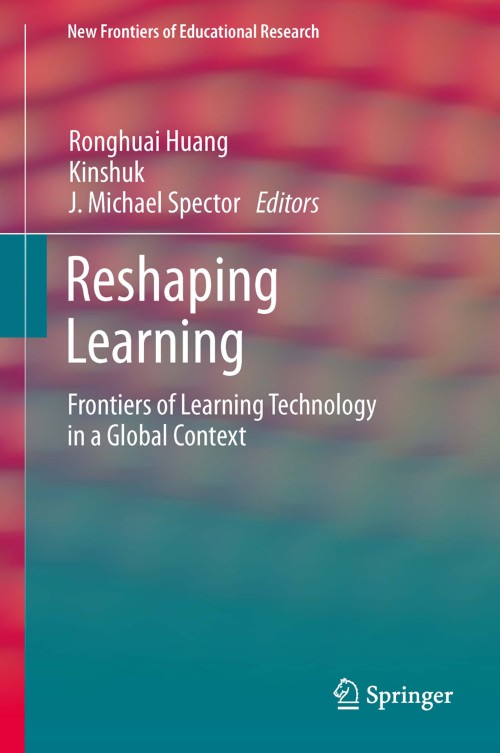
Reshaping Learning [electronic resource] : Frontiers of Learning Technology in a Global Context / edited by Ronghuai Huang, Kinshuk, J. Michael Spector.
Erişim Adresi
ISBN
9783642323010
Dil Kodu
İngilizce
Yer Numarası
DK/10893
Basım Bildirimi
1st ed. 2013.
Yayın Bilgisi
Berlin, Heidelberg : Springer Berlin Heidelberg : Imprint: Springer, 2013.
Fiziksel Niteleme
XVIII, 450 p. 64 illus. online resource.
Dizi
New Frontiers of Educational Research, 2195-349X
İçindekiler Notu
Forward -- Preface -- PART ONE: New shape of learning -- Chapter 1 Emerging Learning mode in the era of transformation: from information society to knowledge society. Ronghuai Huang -- Chapter 2 Emerging dimensions of learning. Erkki Sutinen -- Chapter 3 Schools as Learning Communities. Victoria J. Marsick, Karen E. Watkins, Sarah A. Boswell -- PART TWO: New insights of future students -- Chapter 4 The new shape of the student. Chris Jones -- Chapter5 Digital Natives: Exploring the diversity of young people’s experience with technology. Linda Corrin, Sue Bennett, Lori Lockyer -- Chapter 6 Adapting for a Personalized Learning Experience. Margaret Martinez -- PART THREE: The future of learning content -- Chapter 7 E-books in K-12 education. Guang Chen -- Chapter 8 The changing nature of eLearning Content. Robby Robson -- Chapter 9 The Open Future of Course Content Development and Dissemination. M.S. Vijay Kumar -- Chapter 10 National pilot courses in mainland China. Yanyan Li -- PART FOUR: New dimensions of learning technologies -- Chapter 11 Mobile Learning – Shaping The Frontiers of Learning Technologies in Global Context. John Traxler -- Chapter 12 Paradigm shifts in e-learning: From web-based learning to context-aware ubiquitous learning. Gwo-Jen Hwang -- Chapter 13 Reusable Authentic Learning Scenario Creation inUbiquitous Learning Environments. Kinshuk and Ryan Jesse -- Chapter 14 Educational use of computer games: where're we, and what's next. Morris S. Y. Jong, Jimmy H. M. Lee, Fong-Lok Lee Junjie Shang -- Chapter 15 Supplemental vs Essential Use of Computing Devices in the Classroom: An Analysis. Cathie Norris, Akhlaq Hossain, Elliot Soloway -- PART FIVE: Emerging trends in learning technologies -- Chapter 16 Application of Cloud Technology, Social Networking Sites and Sensing Technology to E-Learning. Yueh-Min Huang, Hsin-Chin Chen, Jan-Pan Hwang, Yong-Ming Huang -- Chapter 17 Design of a Holistic Curriculum Embodied with an Immersive Environment for Learning: Virtual Reality Immersion, Agent Mediation and Teacher Moderation. Longkai Wu, Chee-Kit Looi, Beaumie Kim, Chunyan Miao Chapter 18 Augmented Reality and Education: Applications and Potentials. Steve Chi-Yin Yuen, Gallayanee Yaoyuneyong, Erik Johnson Chapter 19 Facilitating Complex Learning by Mobile Augmented Reality Learning Environments. Dirk Ifenthaler -- Chapter 20“Mobilising” web sites at an open university: The Athabasca University experience. Regina Wasti, Rory McGreal.
Özet, vb.
This edited volume presents selected papers from distinguished experts and professors in learning technologies and related fields, all of them pioneers with innovative approaches to the development of learning technologies. This book will address the main issues concerned with current trends in and the future development of learning processes, innovative pedagogies, the effects of new technologies on education, and future learning content. Learning technologies have been affected by technological advances and changes in the field of education. Today we cannot afford to first observe changes and then adapt to them; instead we need to predict changes and respond to them positively and actively in order to shape trends more beneficially. This book collects the latest concepts at the frontier of learning education and future developments with regard to learning, pedagogies, and learning technologies in order to arrive at an image of learning education in the near future. .
Konu
Educational technology.
Education.
Computer science.
Digital Education and Educational Technology.
Education.
Computer Science.
Education.
Computer science.
Digital Education and Educational Technology.
Education.
Computer Science.
Kurum Adı
Eseri Alıntıla
Referansları kullanmadan önce gözden geçirmeniz ve varsa gerekli düzeltmeleri yapmanız önerilir.
Dijital Kaynak
MARC Görünümü
LEADER 05609nam a22005415i 4500
001 809604
003 TR_AnAIT
005 20260131022818
007 cr nn 008mamaa
008 121227s2013 gw | s |||| 0|eng d
020 |a9783642323010|9978-3-642-32301-0
024 7 |a10.1007/978-3-642-32301-0|2doi
041 |aeng
049 |aTürk Tarih Kurumu Kütüphanesi
050 4|aLB1028.3
072 7|aJNV|2bicssc
072 7|aEDU000000|2bisacsh
072 7|aJNV|2thema
082 04|a371.33|223
090 |aDK/10893
245 10|aReshaping Learning|h[electronic resource] :|bFrontiers of Learning Technology in a Global Context /|cedited by Ronghuai Huang, Kinshuk, J. Michael Spector.
250 |a1st ed. 2013.
264 1|aBerlin, Heidelberg :|bSpringer Berlin Heidelberg :|bImprint: Springer,|c2013.
300 |aXVIII, 450 p. 64 illus.|bonline resource.
336 |atext|btxt|2rdacontent
337 |acomputer|bc|2rdamedia
338 |aonline resource|bcr|2rdacarrier
347 |atext file|bPDF|2rda
490 1 |aNew Frontiers of Educational Research,|x2195-349X
505 0 |aForward -- Preface -- PART ONE: New shape of learning -- Chapter 1 Emerging Learning mode in the era of transformation: from information society to knowledge society. Ronghuai Huang -- Chapter 2 Emerging dimensions of learning. Erkki Sutinen -- Chapter 3 Schools as Learning Communities. Victoria J. Marsick, Karen E. Watkins, Sarah A. Boswell -- PART TWO: New insights of future students -- Chapter 4 The new shape of the student. Chris Jones -- Chapter5 Digital Natives: Exploring the diversity of young people’s experience with technology. Linda Corrin, Sue Bennett, Lori Lockyer -- Chapter 6 Adapting for a Personalized Learning Experience. Margaret Martinez -- PART THREE: The future of learning content -- Chapter 7 E-books in K-12 education. Guang Chen -- Chapter 8 The changing nature of eLearning Content. Robby Robson -- Chapter 9 The Open Future of Course Content Development and Dissemination. M.S. Vijay Kumar -- Chapter 10 National pilot courses in mainland China. Yanyan Li -- PART FOUR: New dimensions of learning technologies -- Chapter 11 Mobile Learning – Shaping The Frontiers of Learning Technologies in Global Context. John Traxler -- Chapter 12 Paradigm shifts in e-learning: From web-based learning to context-aware ubiquitous learning. Gwo-Jen Hwang -- Chapter 13 Reusable Authentic Learning Scenario Creation inUbiquitous Learning Environments. Kinshuk and Ryan Jesse -- Chapter 14 Educational use of computer games: where're we, and what's next. Morris S. Y. Jong, Jimmy H. M. Lee, Fong-Lok Lee Junjie Shang -- Chapter 15 Supplemental vs Essential Use of Computing Devices in the Classroom: An Analysis. Cathie Norris, Akhlaq Hossain, Elliot Soloway -- PART FIVE: Emerging trends in learning technologies -- Chapter 16 Application of Cloud Technology, Social Networking Sites and Sensing Technology to E-Learning. Yueh-Min Huang, Hsin-Chin Chen, Jan-Pan Hwang, Yong-Ming Huang -- Chapter 17 Design of a Holistic Curriculum Embodied with an Immersive Environment for Learning: Virtual Reality Immersion, Agent Mediation and Teacher Moderation. Longkai Wu, Chee-Kit Looi, Beaumie Kim, Chunyan Miao Chapter 18 Augmented Reality and Education: Applications and Potentials. Steve Chi-Yin Yuen, Gallayanee Yaoyuneyong, Erik Johnson Chapter 19 Facilitating Complex Learning by Mobile Augmented Reality Learning Environments. Dirk Ifenthaler -- Chapter 20“Mobilising” web sites at an open university: The Athabasca University experience. Regina Wasti, Rory McGreal.
520 |aThis edited volume presents selected papers from distinguished experts and professors in learning technologies and related fields, all of them pioneers with innovative approaches to the development of learning technologies. This book will address the main issues concerned with current trends in and the future development of learning processes, innovative pedagogies, the effects of new technologies on education, and future learning content. Learning technologies have been affected by technological advances and changes in the field of education. Today we cannot afford to first observe changes and then adapt to them; instead we need to predict changes and respond to them positively and actively in order to shape trends more beneficially. This book collects the latest concepts at the frontier of learning education and future developments with regard to learning, pedagogies, and learning technologies in order to arrive at an image of learning education in the near future. .
650 0|aEducational technology.
650 0|aEducation.
650 0|aComputer science.
650 14|aDigital Education and Educational Technology.
650 24|aEducation.
650 24|aComputer Science.
700 1 |aHuang, Ronghuai.|eeditor.|0(orcid)0000-0003-4651-5248|1https://orcid.org/0000-0003-4651-5248|4edt|4http://id.loc.gov/vocabulary/relators/edt
700 1 |aKinshuk.|eeditor.|4edt|4http://id.loc.gov/vocabulary/relators/edt
700 1 |aSpector, J. Michael.|eeditor.|4edt|4http://id.loc.gov/vocabulary/relators/edt
710 2 |aSpringerLink (Online service)
773 0 |tSpringer Nature eBook
776 08|iPrinted edition:|z9783642323003
776 08|iPrinted edition:|z9783642323027
776 08|iPrinted edition:|z9783642435850
830 0|aNew Frontiers of Educational Research,|x2195-349X
856 40|uhttps://doi.org/10.1007/978-3-642-32301-0
912 |aZDB-2-SHU
912 |aZDB-2-SXED
950 |aHumanities, Social Sciences and Law (SpringerNature-11648)
950 |aEducation (R0) (SpringerNature-43721)
001 809604
003 TR_AnAIT
005 20260131022818
007 cr nn 008mamaa
008 121227s2013 gw | s |||| 0|eng d
020 |a9783642323010|9978-3-642-32301-0
024 7 |a10.1007/978-3-642-32301-0|2doi
041 |aeng
049 |aTürk Tarih Kurumu Kütüphanesi
050 4|aLB1028.3
072 7|aJNV|2bicssc
072 7|aEDU000000|2bisacsh
072 7|aJNV|2thema
082 04|a371.33|223
090 |aDK/10893
245 10|aReshaping Learning|h[electronic resource] :|bFrontiers of Learning Technology in a Global Context /|cedited by Ronghuai Huang, Kinshuk, J. Michael Spector.
250 |a1st ed. 2013.
264 1|aBerlin, Heidelberg :|bSpringer Berlin Heidelberg :|bImprint: Springer,|c2013.
300 |aXVIII, 450 p. 64 illus.|bonline resource.
336 |atext|btxt|2rdacontent
337 |acomputer|bc|2rdamedia
338 |aonline resource|bcr|2rdacarrier
347 |atext file|bPDF|2rda
490 1 |aNew Frontiers of Educational Research,|x2195-349X
505 0 |aForward -- Preface -- PART ONE: New shape of learning -- Chapter 1 Emerging Learning mode in the era of transformation: from information society to knowledge society. Ronghuai Huang -- Chapter 2 Emerging dimensions of learning. Erkki Sutinen -- Chapter 3 Schools as Learning Communities. Victoria J. Marsick, Karen E. Watkins, Sarah A. Boswell -- PART TWO: New insights of future students -- Chapter 4 The new shape of the student. Chris Jones -- Chapter5 Digital Natives: Exploring the diversity of young people’s experience with technology. Linda Corrin, Sue Bennett, Lori Lockyer -- Chapter 6 Adapting for a Personalized Learning Experience. Margaret Martinez -- PART THREE: The future of learning content -- Chapter 7 E-books in K-12 education. Guang Chen -- Chapter 8 The changing nature of eLearning Content. Robby Robson -- Chapter 9 The Open Future of Course Content Development and Dissemination. M.S. Vijay Kumar -- Chapter 10 National pilot courses in mainland China. Yanyan Li -- PART FOUR: New dimensions of learning technologies -- Chapter 11 Mobile Learning – Shaping The Frontiers of Learning Technologies in Global Context. John Traxler -- Chapter 12 Paradigm shifts in e-learning: From web-based learning to context-aware ubiquitous learning. Gwo-Jen Hwang -- Chapter 13 Reusable Authentic Learning Scenario Creation inUbiquitous Learning Environments. Kinshuk and Ryan Jesse -- Chapter 14 Educational use of computer games: where're we, and what's next. Morris S. Y. Jong, Jimmy H. M. Lee, Fong-Lok Lee Junjie Shang -- Chapter 15 Supplemental vs Essential Use of Computing Devices in the Classroom: An Analysis. Cathie Norris, Akhlaq Hossain, Elliot Soloway -- PART FIVE: Emerging trends in learning technologies -- Chapter 16 Application of Cloud Technology, Social Networking Sites and Sensing Technology to E-Learning. Yueh-Min Huang, Hsin-Chin Chen, Jan-Pan Hwang, Yong-Ming Huang -- Chapter 17 Design of a Holistic Curriculum Embodied with an Immersive Environment for Learning: Virtual Reality Immersion, Agent Mediation and Teacher Moderation. Longkai Wu, Chee-Kit Looi, Beaumie Kim, Chunyan Miao Chapter 18 Augmented Reality and Education: Applications and Potentials. Steve Chi-Yin Yuen, Gallayanee Yaoyuneyong, Erik Johnson Chapter 19 Facilitating Complex Learning by Mobile Augmented Reality Learning Environments. Dirk Ifenthaler -- Chapter 20“Mobilising” web sites at an open university: The Athabasca University experience. Regina Wasti, Rory McGreal.
520 |aThis edited volume presents selected papers from distinguished experts and professors in learning technologies and related fields, all of them pioneers with innovative approaches to the development of learning technologies. This book will address the main issues concerned with current trends in and the future development of learning processes, innovative pedagogies, the effects of new technologies on education, and future learning content. Learning technologies have been affected by technological advances and changes in the field of education. Today we cannot afford to first observe changes and then adapt to them; instead we need to predict changes and respond to them positively and actively in order to shape trends more beneficially. This book collects the latest concepts at the frontier of learning education and future developments with regard to learning, pedagogies, and learning technologies in order to arrive at an image of learning education in the near future. .
650 0|aEducational technology.
650 0|aEducation.
650 0|aComputer science.
650 14|aDigital Education and Educational Technology.
650 24|aEducation.
650 24|aComputer Science.
700 1 |aHuang, Ronghuai.|eeditor.|0(orcid)0000-0003-4651-5248|1https://orcid.org/0000-0003-4651-5248|4edt|4http://id.loc.gov/vocabulary/relators/edt
700 1 |aKinshuk.|eeditor.|4edt|4http://id.loc.gov/vocabulary/relators/edt
700 1 |aSpector, J. Michael.|eeditor.|4edt|4http://id.loc.gov/vocabulary/relators/edt
710 2 |aSpringerLink (Online service)
773 0 |tSpringer Nature eBook
776 08|iPrinted edition:|z9783642323003
776 08|iPrinted edition:|z9783642323027
776 08|iPrinted edition:|z9783642435850
830 0|aNew Frontiers of Educational Research,|x2195-349X
856 40|uhttps://doi.org/10.1007/978-3-642-32301-0
912 |aZDB-2-SHU
912 |aZDB-2-SXED
950 |aHumanities, Social Sciences and Law (SpringerNature-11648)
950 |aEducation (R0) (SpringerNature-43721)
Materyaller
Depodan talep edilen materyal sadece kütüphane içerisinde kullanılmaktadır.
Materyal dışarıya ödünç verilmemektedir.
Materyal dışarıya ödünç verilmemektedir.
