

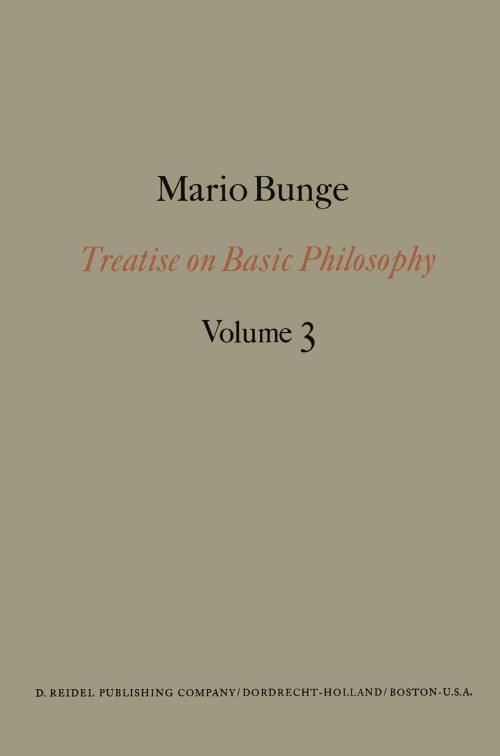
Treatise on Basic Philosophy [electronic resource] : Ontology I: The Furniture of the World / by M. Bunge.
Erişim Adresi
ISBN
9789401099240
Dil Kodu
İngilizce
Yer Numarası
DK/10895
Yazar
Basım Bildirimi
1st ed. 1977.
Yayın Bilgisi
Dordrecht : Springer Netherlands : Imprint: Springer, 1977.
Fiziksel Niteleme
XVI, 354 p. online resource.
Dizi
Treatise on Basic Philosophy ; 3
İçindekiler Notu
of Ontology I -- 1. Ontological Problems -- 2. The Business of Ontology -- 3. Is Ontology Possible? -- 4. The Method of Scientific Ontology -- 5. The Goals of Scientific Ontology -- 6. Ontology and Formal Science -- 7. The Ontology of Science -- 8. Ontological Inputs and Outputs of Science and Technology -- 9. Uses of Ontology -- 10. Concluding Remarks -- 1. Substance -- 1. Association -- 2. Assembly -- 3. Entities and Sets -- 4. Concluding Remarks -- 2. Form -- 1. Property and Attribute -- 2. Analysis -- 3. Theory -- 4. Properties of Properties -- 5. Status of Properties -- 6. Concluding Remarks -- 3. Thing -- 1. Thing and Model Thing -- 2. State -- 3. From Class to Natural Kind -- 4. The World -- 5. Concluding Remarks -- 4. Possibility -- 1. Conceptual Possibility -- 2. Real Possibility -- 3. Disposition -- 4. Probability -- 5. Chance Propensity -- 6. Marginalia -- 7. Concluding Remarks -- 5. Change -- 1. Changeability -- 2. Event -- 3. Process -- 4. Action and Reaction -- 5. Panta Rhei -- 6. Concluding Remarks -- 6. Spacetime -- 1. Conflicting Views -- 2. Space -- 3. Duration -- 4. Spacetime -- 5. Spatiotemporal Properties -- 6. Matters of Existence -- 7. Concluding Remarks -- Index of Names -- Index of Subjects.
Özet, vb.
In this Introduction' we shall sketch the business of ontology, or metaphysics, and shall locate it on the map of learning. This has to be done because there are many ways of construing the word 'ontology' and because of the bad reputation metaphysics has suffered until recently - a well deserved one in most cases. 1. ONTOLOGICAL PROBLEMS Ontological (or metaphysical) views are answers to ontological ques tions. And ontological (or metaphysical) questions are questions with an extremely wide scope, such as 'Is the world material or ideal - or perhaps neutral?" 'Is there radical novelty, and if so how does it come about?', 'Is there objective chance or just an appearance of such due to human ignorance?', 'How is the mental related to the physical?', 'Is a community anything but the set of its members?', and 'Are there laws of history?'. Just as religion was born from helplessness, ideology from conflict, and technology from the need to master the environment, so metaphysics - just liketheoretical science - was probably begotten by the awe and bewilderment at the boundless variety and apparent chaos of the phenomenal world, i. e. the sum total of human experience. Like the scientist, the metaphysician looked and looks for unity in diversity, for pattern in disorder, for structure in the amorphous heap of phenomena - and in some cases even for some sense, direction or finality in reality as a whole.
Konu
Science __ Philosophy.
Ontology.
Philosophy of Science.
Ontology.
Ontology.
Philosophy of Science.
Ontology.
Kurum Adı
Eseri Alıntıla
Referansları kullanmadan önce gözden geçirmeniz ve varsa gerekli düzeltmeleri yapmanız önerilir.
Dijital Kaynak
MARC Görünümü
LEADER 05153nam a22005655i 4500
001 809606
003 TR_AnAIT
005 20260131022816
007 cr nn 008mamaa
008 121227s1977 ne | s |||| 0|eng d
020 |a9789401099240|9978-94-010-9924-0
024 7 |a10.1007/978-94-010-9924-0|2doi
041 |aeng
049 |aTürk Tarih Kurumu Kütüphanesi
050 4|aQ174-175.3
050 4|aB67
072 7|aPDA|2bicssc
072 7|aSCI075000|2bisacsh
072 7|aPDA|2thema
082 04|a501|223
090 |aDK/10895
100 1 |aBunge, M.|eauthor.|4aut|4http://id.loc.gov/vocabulary/relators/aut
245 10|aTreatise on Basic Philosophy|h[electronic resource] :|bOntology I: The Furniture of the World /|cby M. Bunge.
250 |a1st ed. 1977.
264 1|aDordrecht :|bSpringer Netherlands :|bImprint: Springer,|c1977.
300 |aXVI, 354 p.|bonline resource.
336 |atext|btxt|2rdacontent
337 |acomputer|bc|2rdamedia
338 |aonline resource|bcr|2rdacarrier
347 |atext file|bPDF|2rda
490 1 |aTreatise on Basic Philosophy ;|v3
505 0 |aof Ontology I -- 1. Ontological Problems -- 2. The Business of Ontology -- 3. Is Ontology Possible? -- 4. The Method of Scientific Ontology -- 5. The Goals of Scientific Ontology -- 6. Ontology and Formal Science -- 7. The Ontology of Science -- 8. Ontological Inputs and Outputs of Science and Technology -- 9. Uses of Ontology -- 10. Concluding Remarks -- 1. Substance -- 1. Association -- 2. Assembly -- 3. Entities and Sets -- 4. Concluding Remarks -- 2. Form -- 1. Property and Attribute -- 2. Analysis -- 3. Theory -- 4. Properties of Properties -- 5. Status of Properties -- 6. Concluding Remarks -- 3. Thing -- 1. Thing and Model Thing -- 2. State -- 3. From Class to Natural Kind -- 4. The World -- 5. Concluding Remarks -- 4. Possibility -- 1. Conceptual Possibility -- 2. Real Possibility -- 3. Disposition -- 4. Probability -- 5. Chance Propensity -- 6. Marginalia -- 7. Concluding Remarks -- 5. Change -- 1. Changeability -- 2. Event -- 3. Process -- 4. Action and Reaction -- 5. Panta Rhei -- 6. Concluding Remarks -- 6. Spacetime -- 1. Conflicting Views -- 2. Space -- 3. Duration -- 4. Spacetime -- 5. Spatiotemporal Properties -- 6. Matters of Existence -- 7. Concluding Remarks -- Index of Names -- Index of Subjects.
520 |aIn this Introduction' we shall sketch the business of ontology, or metaphysics, and shall locate it on the map of learning. This has to be done because there are many ways of construing the word 'ontology' and because of the bad reputation metaphysics has suffered until recently - a well deserved one in most cases. 1. ONTOLOGICAL PROBLEMS Ontological (or metaphysical) views are answers to ontological ques tions. And ontological (or metaphysical) questions are questions with an extremely wide scope, such as 'Is the world material or ideal - or perhaps neutral?" 'Is there radical novelty, and if so how does it come about?', 'Is there objective chance or just an appearance of such due to human ignorance?', 'How is the mental related to the physical?', 'Is a community anything but the set of its members?', and 'Are there laws of history?'. Just as religion was born from helplessness, ideology from conflict, and technology from the need to master the environment, so metaphysics - just liketheoretical science - was probably begotten by the awe and bewilderment at the boundless variety and apparent chaos of the phenomenal world, i. e. the sum total of human experience. Like the scientist, the metaphysician looked and looks for unity in diversity, for pattern in disorder, for structure in the amorphous heap of phenomena - and in some cases even for some sense, direction or finality in reality as a whole.
532 8 |aAccessibility summary: This PDF is not accessible. It is based on scanned pages and does not support features such as screen reader compatibility or described non-text content (images, graphs etc). However, it likely supports searchable and selectable text based on OCR (Optical Character Recognition). Users with accessibility needs may not be able to use this content effectively. Please contact us at accessibilitysupport@springernature.com if you require assistance or an alternative format.
532 8 |aInaccessible, or known limited accessibility
532 8 |aNo reading system accessibility options actively disabled
532 8 |aPublisher contact for further accessibility information: accessibilitysupport@springernature.com
650 0|aScience|xPhilosophy.
650 0|aOntology.
650 14|aPhilosophy of Science.
650 24|aOntology.
710 2 |aSpringerLink (Online service)
773 0 |tSpringer Nature eBook
776 08|iPrinted edition:|z9789027707802
776 08|iPrinted edition:|z9789027707857
776 08|iPrinted edition:|z9789401099257
830 0|aTreatise on Basic Philosophy ;|v3
856 40|uhttps://doi.org/10.1007/978-94-010-9924-0
912 |aZDB-2-SHU
912 |aZDB-2-SXPR
912 |aZDB-2-BAE
950 |aHumanities, Social Sciences and Law (SpringerNature-11648)
950 |aPhilosophy and Religion (R0) (SpringerNature-43725)
001 809606
003 TR_AnAIT
005 20260131022816
007 cr nn 008mamaa
008 121227s1977 ne | s |||| 0|eng d
020 |a9789401099240|9978-94-010-9924-0
024 7 |a10.1007/978-94-010-9924-0|2doi
041 |aeng
049 |aTürk Tarih Kurumu Kütüphanesi
050 4|aQ174-175.3
050 4|aB67
072 7|aPDA|2bicssc
072 7|aSCI075000|2bisacsh
072 7|aPDA|2thema
082 04|a501|223
090 |aDK/10895
100 1 |aBunge, M.|eauthor.|4aut|4http://id.loc.gov/vocabulary/relators/aut
245 10|aTreatise on Basic Philosophy|h[electronic resource] :|bOntology I: The Furniture of the World /|cby M. Bunge.
250 |a1st ed. 1977.
264 1|aDordrecht :|bSpringer Netherlands :|bImprint: Springer,|c1977.
300 |aXVI, 354 p.|bonline resource.
336 |atext|btxt|2rdacontent
337 |acomputer|bc|2rdamedia
338 |aonline resource|bcr|2rdacarrier
347 |atext file|bPDF|2rda
490 1 |aTreatise on Basic Philosophy ;|v3
505 0 |aof Ontology I -- 1. Ontological Problems -- 2. The Business of Ontology -- 3. Is Ontology Possible? -- 4. The Method of Scientific Ontology -- 5. The Goals of Scientific Ontology -- 6. Ontology and Formal Science -- 7. The Ontology of Science -- 8. Ontological Inputs and Outputs of Science and Technology -- 9. Uses of Ontology -- 10. Concluding Remarks -- 1. Substance -- 1. Association -- 2. Assembly -- 3. Entities and Sets -- 4. Concluding Remarks -- 2. Form -- 1. Property and Attribute -- 2. Analysis -- 3. Theory -- 4. Properties of Properties -- 5. Status of Properties -- 6. Concluding Remarks -- 3. Thing -- 1. Thing and Model Thing -- 2. State -- 3. From Class to Natural Kind -- 4. The World -- 5. Concluding Remarks -- 4. Possibility -- 1. Conceptual Possibility -- 2. Real Possibility -- 3. Disposition -- 4. Probability -- 5. Chance Propensity -- 6. Marginalia -- 7. Concluding Remarks -- 5. Change -- 1. Changeability -- 2. Event -- 3. Process -- 4. Action and Reaction -- 5. Panta Rhei -- 6. Concluding Remarks -- 6. Spacetime -- 1. Conflicting Views -- 2. Space -- 3. Duration -- 4. Spacetime -- 5. Spatiotemporal Properties -- 6. Matters of Existence -- 7. Concluding Remarks -- Index of Names -- Index of Subjects.
520 |aIn this Introduction' we shall sketch the business of ontology, or metaphysics, and shall locate it on the map of learning. This has to be done because there are many ways of construing the word 'ontology' and because of the bad reputation metaphysics has suffered until recently - a well deserved one in most cases. 1. ONTOLOGICAL PROBLEMS Ontological (or metaphysical) views are answers to ontological ques tions. And ontological (or metaphysical) questions are questions with an extremely wide scope, such as 'Is the world material or ideal - or perhaps neutral?" 'Is there radical novelty, and if so how does it come about?', 'Is there objective chance or just an appearance of such due to human ignorance?', 'How is the mental related to the physical?', 'Is a community anything but the set of its members?', and 'Are there laws of history?'. Just as religion was born from helplessness, ideology from conflict, and technology from the need to master the environment, so metaphysics - just liketheoretical science - was probably begotten by the awe and bewilderment at the boundless variety and apparent chaos of the phenomenal world, i. e. the sum total of human experience. Like the scientist, the metaphysician looked and looks for unity in diversity, for pattern in disorder, for structure in the amorphous heap of phenomena - and in some cases even for some sense, direction or finality in reality as a whole.
532 8 |aAccessibility summary: This PDF is not accessible. It is based on scanned pages and does not support features such as screen reader compatibility or described non-text content (images, graphs etc). However, it likely supports searchable and selectable text based on OCR (Optical Character Recognition). Users with accessibility needs may not be able to use this content effectively. Please contact us at accessibilitysupport@springernature.com if you require assistance or an alternative format.
532 8 |aInaccessible, or known limited accessibility
532 8 |aNo reading system accessibility options actively disabled
532 8 |aPublisher contact for further accessibility information: accessibilitysupport@springernature.com
650 0|aScience|xPhilosophy.
650 0|aOntology.
650 14|aPhilosophy of Science.
650 24|aOntology.
710 2 |aSpringerLink (Online service)
773 0 |tSpringer Nature eBook
776 08|iPrinted edition:|z9789027707802
776 08|iPrinted edition:|z9789027707857
776 08|iPrinted edition:|z9789401099257
830 0|aTreatise on Basic Philosophy ;|v3
856 40|uhttps://doi.org/10.1007/978-94-010-9924-0
912 |aZDB-2-SHU
912 |aZDB-2-SXPR
912 |aZDB-2-BAE
950 |aHumanities, Social Sciences and Law (SpringerNature-11648)
950 |aPhilosophy and Religion (R0) (SpringerNature-43725)
Materyaller
Depodan talep edilen materyal sadece kütüphane içerisinde kullanılmaktadır.
Materyal dışarıya ödünç verilmemektedir.
Materyal dışarıya ödünç verilmemektedir.
