LEADER 03920nam a22005295i 4500
001 809608
003 TR_AnAIT
005 20260131022814
007 cr nn 008mamaa
008 100528s2010 gw | s |||| 0|eng d
020 |a9783642123740|9978-3-642-12374-0
024 7 |a10.1007/978-3-642-12374-0|2doi
041 |aeng
049 |aTürk Tarih Kurumu Kütüphanesi
050 4|aJA1-92
072 7|aJPA|2bicssc
072 7|aPOL000000|2bisacsh
072 7|aJPA|2thema
082 04|a320|223
090 |aDK/10897
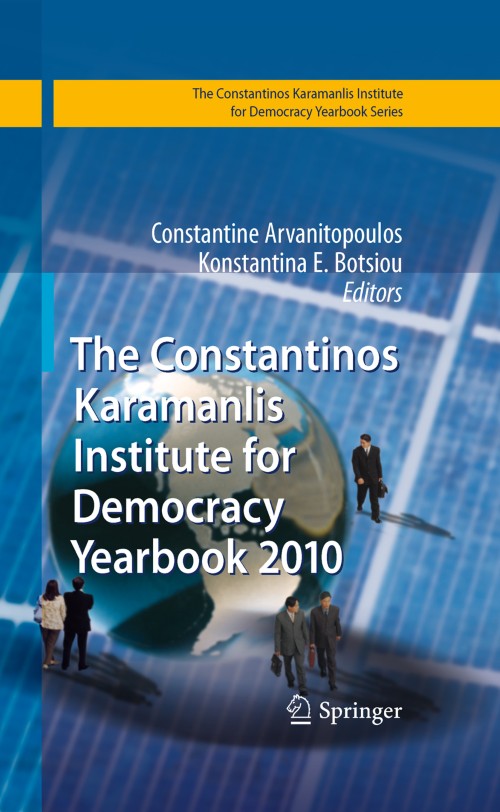
245 14|aThe Constantinos Karamanlis Institute for Democracy Yearbook 2010|h[electronic resource] /|cedited by Constantine Arvanitopoulos, Konstantina E. Botsiou.
250 |a1st ed. 2010.
264 1|aBerlin, Heidelberg :|bSpringer Berlin Heidelberg :|bImprint: Springer,|c2010.
300 |aXIV, 144 p. 8 illus.|bonline resource.
336 |atext|btxt|2rdacontent
337 |acomputer|bc|2rdamedia
338 |aonline resource|bcr|2rdacarrier
347 |atext file|bPDF|2rda
490 1 |aThe Konstantinos Karamanlis Institute for Democracy Yearbook Series,|x1868-212X
505 0 |aEuropean Solidarity: Energy and Security. A Vision for a Common Future -- Europe after the Lisbon Treaty -- Necessary Progress in the Defence of Europe -- Eastern Partnership: The Polish Perspective -- Women’s Participation in Europe’s Social and Political Life -- The Privatisation of Defence and Security: Risks and Opportunities -- The Crisis on the Korean Peninsula: Threats, Prejudices and Solutions -- Greek Foreign Policy: Past, Present and Future Strategies -- The Origins of Greece’s European Policy -- The Greek Economy, 1959–2009: From Association with the EEC to Accession and EMU -- Greek Liberalism in the Twentieth Century: Dilemmas of Research -- Small States in World War II: The Greek Example.
520 |a2010 marks a turning point for international politics. The impact of the global crisis is reflected in the readiness of both national governments and international organisations to rebuild relations between state and market within a safer regulatory framework. New models of development gained ground during the crisis: investments in new energy technologies, medical research, education, security and employment. In Europe, novel ideas interact with major institutional changes put into effect by the Lisbon Treaty. A wide range of policies, from the field of European security to the problems of migration and from EU enlargement to Euro-American cooperation, are affected by the changes on all these levels. The Constantinos Karamanlis Institute for Democracy Yearbook 2010 addresses vital aspects of the European and international agenda, bringing together prominent scholars and policymakers from a variety of national backgrounds. This special thematic issue on recent history illustrates the long-term interplay between Greek politics, on the one hand, and Europeanisation, liberalism and historical memory, on the other hand.
650 0|aPolitical science.
650 0|aEurope|xEconomic integration.
650 0|aHistory.
650 14|aPolitical Science.
650 24|aEuropean Economic Integration.
650 24|aHistory.
700 1 |aArvanitopoulos, Constantine.|eeditor.|4edt|4http://id.loc.gov/vocabulary/relators/edt
700 1 |aBotsiou, Konstantina E.|eeditor.|4edt|4http://id.loc.gov/vocabulary/relators/edt
710 2 |aSpringerLink (Online service)
773 0 |tSpringer Nature eBook
776 08|iPrinted edition:|z9783642123733
776 08|iPrinted edition:|z9783642123757
776 08|iPrinted edition:|z9783642263743
830 0|aThe Konstantinos Karamanlis Institute for Democracy Yearbook Series,|x1868-212X
856 40|uhttps://doi.org/10.1007/978-3-642-12374-0
912 |aZDB-2-SHU
912 |aZDB-2-SXPI
950 |aHumanities, Social Sciences and Law (SpringerNature-11648)
950 |aPolitical Science and International Studies (R0) (SpringerNature-43724)