

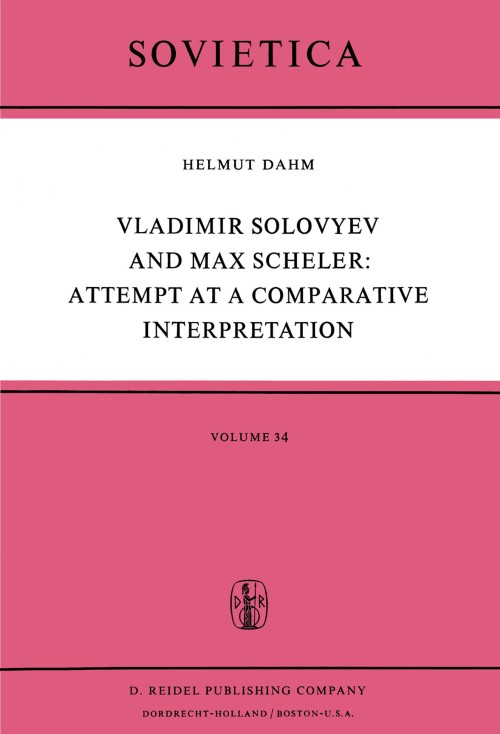
Vladimir Solovyev and Max Scheler: Attempt at a Comparative Interpretation [electronic resource] : A Contribution to the History of Phenomenology / by Helmut Dahm.
Erişim Adresi
ISBN
9789401017480
Dil Kodu
İngilizce
Yer Numarası
DK/10915
Yazar
Basım Bildirimi
1st ed. 1975.
Yayın Bilgisi
Dordrecht : Springer Netherlands : Imprint: Springer, 1975.
Fiziksel Niteleme
344 p. online resource.
Dizi
Sovietica ; 34
İçindekiler Notu
I. The Idea of Philosophy -- I. The Concept of “Something” and of the “Absolute Being” -- II. Solovyev’s “Absolute Being” and Scheler’s “The Eternally Astonishing Roofing of the Abyss of Absolute Nothing” -- III. Summary -- II. Solovyev’s Idea of “Integral Knowledge” and Scheler’s “System of Conformity” -- I. The Meta-Anthropological Aspect -- II. The Historical Aspect -- III. The Epistemological Aspect -- III. The Relation Between Religion and Metaphysics -- I. Typology -- II. The Problems -- IV. Systematic Philosophy -- I. “Organic Logic” -- II. “Organic Metaphysics” -- III. “Organic Ethics” -- IV. The Philosophy of Eros -- V. Special Problems -- I. The Feminist Issue and the Idea of God -- II. On the Question of Influence -- VI. Retrospect -- VII. Russian Philosophy from Solovyev to Shestov — Revision of a Soviet Taboo -- I. The Argument over Russian Philosophy -- II. From Theosophy to Phenomenology -- III. The New Religious Philosophy -- VIII. Soviet Judgement and Criticism of Solovyev -- I. The Great Soviet Encyclopaedia, 1 st edition 1947 -- II. The Great Soviet Encyclopaedia, 2nd edition 1957 -- III. Against Contemporary Falsifiers of the History of Russian Philosophy, 1960 -- IV. History of Russian Philosophy, 1961 -- IX. Soviet Appropriation of Scheler’s Phenomenology -- Notes -- Bibliography — A Summary of the Works by and on Vladimir Solovyev and Max Scheler -- Index of Names.
Özet, vb.
This comparative study of the works of Vladimir Solovyev and Max Scheler explores some of the areas in which their thoughts seem to bear a direct relation to one another. The author shows, however, that such a correlation is not based on any factual influence of the earlier Russian on the later philosophy of Scheler. The similarities in their spiritual and philosophical development are significant as the author demonstrates in his chapter on systematic philosophy. This comparison is not just of historical interest. It is meant to contri bute to a better understanding between the East and the West. The author provides a basis for future discussions by establishing a common area of inquiry and by demonstrating a convergence of viewpoints already in regard to these problems. The author also discusses the potential role of the ideas of Solovyev and Scheler in the formation of a consciousness which he sees now emerging in the Soviet Union - a consciousness critical of any misrepresentation both of non-Marxist Russian philosophy as well as of Western philosophy in general. In regard to the translation itself, three things should be mentioned. First of all, the distinction between the important German words "Sein" and "Seiendes" is often difficult to preserve in translation. Unless otherwise noted all references to "being" refer to "Seiendes." Second, the abbreviations of the works of Solovyev and Scheler used in the footnotes are clarified in the summary of the works of these authors found on page 31Off. below.
Konu
Ethnology.
Culture.
Regional Cultural Studies.
Culture.
Regional Cultural Studies.
Kurum Adı
Eseri Alıntıla
Referansları kullanmadan önce gözden geçirmeniz ve varsa gerekli düzeltmeleri yapmanız önerilir.
Dijital Kaynak
MARC Görünümü
LEADER 05474nam a22005415i 4500
001 809626
003 TR_AnAIT
005 20260131022733
007 cr nn 008mamaa
008 121227s1975 ne | s |||| 0|eng d
020 |a9789401017480|9978-94-010-1748-0
024 7 |a10.1007/978-94-010-1748-0|2doi
041 |aeng
049 |aTürk Tarih Kurumu Kütüphanesi
050 4|aGN550-674
072 7|aJFC|2bicssc
072 7|aSOC053000|2bisacsh
072 7|aJBCC|2thema
082 04|a306.091|223
090 |aDK/10915
100 1 |aDahm, Helmut.|eauthor.|4aut|4http://id.loc.gov/vocabulary/relators/aut
245 10|aVladimir Solovyev and Max Scheler: Attempt at a Comparative Interpretation|h[electronic resource] :|bA Contribution to the History of Phenomenology /|cby Helmut Dahm.
250 |a1st ed. 1975.
264 1|aDordrecht :|bSpringer Netherlands :|bImprint: Springer,|c1975.
300 |a344 p.|bonline resource.
336 |atext|btxt|2rdacontent
337 |acomputer|bc|2rdamedia
338 |aonline resource|bcr|2rdacarrier
347 |atext file|bPDF|2rda
490 1 |aSovietica ;|v34
505 0 |aI. The Idea of Philosophy -- I. The Concept of “Something” and of the “Absolute Being” -- II. Solovyev’s “Absolute Being” and Scheler’s “The Eternally Astonishing Roofing of the Abyss of Absolute Nothing” -- III. Summary -- II. Solovyev’s Idea of “Integral Knowledge” and Scheler’s “System of Conformity” -- I. The Meta-Anthropological Aspect -- II. The Historical Aspect -- III. The Epistemological Aspect -- III. The Relation Between Religion and Metaphysics -- I. Typology -- II. The Problems -- IV. Systematic Philosophy -- I. “Organic Logic” -- II. “Organic Metaphysics” -- III. “Organic Ethics” -- IV. The Philosophy of Eros -- V. Special Problems -- I. The Feminist Issue and the Idea of God -- II. On the Question of Influence -- VI. Retrospect -- VII. Russian Philosophy from Solovyev to Shestov — Revision of a Soviet Taboo -- I. The Argument over Russian Philosophy -- II. From Theosophy to Phenomenology -- III. The New Religious Philosophy -- VIII. Soviet Judgement and Criticism of Solovyev -- I. The Great Soviet Encyclopaedia, 1 st edition 1947 -- II. The Great Soviet Encyclopaedia, 2nd edition 1957 -- III. Against Contemporary Falsifiers of the History of Russian Philosophy, 1960 -- IV. History of Russian Philosophy, 1961 -- IX. Soviet Appropriation of Scheler’s Phenomenology -- Notes -- Bibliography — A Summary of the Works by and on Vladimir Solovyev and Max Scheler -- Index of Names.
520 |aThis comparative study of the works of Vladimir Solovyev and Max Scheler explores some of the areas in which their thoughts seem to bear a direct relation to one another. The author shows, however, that such a correlation is not based on any factual influence of the earlier Russian on the later philosophy of Scheler. The similarities in their spiritual and philosophical development are significant as the author demonstrates in his chapter on systematic philosophy. This comparison is not just of historical interest. It is meant to contri bute to a better understanding between the East and the West. The author provides a basis for future discussions by establishing a common area of inquiry and by demonstrating a convergence of viewpoints already in regard to these problems. The author also discusses the potential role of the ideas of Solovyev and Scheler in the formation of a consciousness which he sees now emerging in the Soviet Union - a consciousness critical of any misrepresentation both of non-Marxist Russian philosophy as well as of Western philosophy in general. In regard to the translation itself, three things should be mentioned. First of all, the distinction between the important German words "Sein" and "Seiendes" is often difficult to preserve in translation. Unless otherwise noted all references to "being" refer to "Seiendes." Second, the abbreviations of the works of Solovyev and Scheler used in the footnotes are clarified in the summary of the works of these authors found on page 31Off. below.
532 8 |aAccessibility summary: This PDF is not accessible. It is based on scanned pages and does not support features such as screen reader compatibility or described non-text content (images, graphs etc). However, it likely supports searchable and selectable text based on OCR (Optical Character Recognition). Users with accessibility needs may not be able to use this content effectively. Please contact us at accessibilitysupport@springernature.com if you require assistance or an alternative format.
532 8 |aInaccessible, or known limited accessibility
532 8 |aNo reading system accessibility options actively disabled
532 8 |aPublisher contact for further accessibility information: accessibilitysupport@springernature.com
650 0|aEthnology.
650 0|aCulture.
650 14|aRegional Cultural Studies.
710 2 |aSpringerLink (Online service)
773 0 |tSpringer Nature eBook
776 08|iPrinted edition:|z9789027705075
776 08|iPrinted edition:|z9789401017497
776 08|iPrinted edition:|z9789401017503
830 0|aSovietica ;|v34
856 40|uhttps://doi.org/10.1007/978-94-010-1748-0
912 |aZDB-2-SHU
912 |aZDB-2-SXL
912 |aZDB-2-BAE
950 |aHumanities, Social Sciences and Law (SpringerNature-11648)
950 |aLiterature, Cultural and Media Studies (R0) (SpringerNature-43723)
001 809626
003 TR_AnAIT
005 20260131022733
007 cr nn 008mamaa
008 121227s1975 ne | s |||| 0|eng d
020 |a9789401017480|9978-94-010-1748-0
024 7 |a10.1007/978-94-010-1748-0|2doi
041 |aeng
049 |aTürk Tarih Kurumu Kütüphanesi
050 4|aGN550-674
072 7|aJFC|2bicssc
072 7|aSOC053000|2bisacsh
072 7|aJBCC|2thema
082 04|a306.091|223
090 |aDK/10915
100 1 |aDahm, Helmut.|eauthor.|4aut|4http://id.loc.gov/vocabulary/relators/aut
245 10|aVladimir Solovyev and Max Scheler: Attempt at a Comparative Interpretation|h[electronic resource] :|bA Contribution to the History of Phenomenology /|cby Helmut Dahm.
250 |a1st ed. 1975.
264 1|aDordrecht :|bSpringer Netherlands :|bImprint: Springer,|c1975.
300 |a344 p.|bonline resource.
336 |atext|btxt|2rdacontent
337 |acomputer|bc|2rdamedia
338 |aonline resource|bcr|2rdacarrier
347 |atext file|bPDF|2rda
490 1 |aSovietica ;|v34
505 0 |aI. The Idea of Philosophy -- I. The Concept of “Something” and of the “Absolute Being” -- II. Solovyev’s “Absolute Being” and Scheler’s “The Eternally Astonishing Roofing of the Abyss of Absolute Nothing” -- III. Summary -- II. Solovyev’s Idea of “Integral Knowledge” and Scheler’s “System of Conformity” -- I. The Meta-Anthropological Aspect -- II. The Historical Aspect -- III. The Epistemological Aspect -- III. The Relation Between Religion and Metaphysics -- I. Typology -- II. The Problems -- IV. Systematic Philosophy -- I. “Organic Logic” -- II. “Organic Metaphysics” -- III. “Organic Ethics” -- IV. The Philosophy of Eros -- V. Special Problems -- I. The Feminist Issue and the Idea of God -- II. On the Question of Influence -- VI. Retrospect -- VII. Russian Philosophy from Solovyev to Shestov — Revision of a Soviet Taboo -- I. The Argument over Russian Philosophy -- II. From Theosophy to Phenomenology -- III. The New Religious Philosophy -- VIII. Soviet Judgement and Criticism of Solovyev -- I. The Great Soviet Encyclopaedia, 1 st edition 1947 -- II. The Great Soviet Encyclopaedia, 2nd edition 1957 -- III. Against Contemporary Falsifiers of the History of Russian Philosophy, 1960 -- IV. History of Russian Philosophy, 1961 -- IX. Soviet Appropriation of Scheler’s Phenomenology -- Notes -- Bibliography — A Summary of the Works by and on Vladimir Solovyev and Max Scheler -- Index of Names.
520 |aThis comparative study of the works of Vladimir Solovyev and Max Scheler explores some of the areas in which their thoughts seem to bear a direct relation to one another. The author shows, however, that such a correlation is not based on any factual influence of the earlier Russian on the later philosophy of Scheler. The similarities in their spiritual and philosophical development are significant as the author demonstrates in his chapter on systematic philosophy. This comparison is not just of historical interest. It is meant to contri bute to a better understanding between the East and the West. The author provides a basis for future discussions by establishing a common area of inquiry and by demonstrating a convergence of viewpoints already in regard to these problems. The author also discusses the potential role of the ideas of Solovyev and Scheler in the formation of a consciousness which he sees now emerging in the Soviet Union - a consciousness critical of any misrepresentation both of non-Marxist Russian philosophy as well as of Western philosophy in general. In regard to the translation itself, three things should be mentioned. First of all, the distinction between the important German words "Sein" and "Seiendes" is often difficult to preserve in translation. Unless otherwise noted all references to "being" refer to "Seiendes." Second, the abbreviations of the works of Solovyev and Scheler used in the footnotes are clarified in the summary of the works of these authors found on page 31Off. below.
532 8 |aAccessibility summary: This PDF is not accessible. It is based on scanned pages and does not support features such as screen reader compatibility or described non-text content (images, graphs etc). However, it likely supports searchable and selectable text based on OCR (Optical Character Recognition). Users with accessibility needs may not be able to use this content effectively. Please contact us at accessibilitysupport@springernature.com if you require assistance or an alternative format.
532 8 |aInaccessible, or known limited accessibility
532 8 |aNo reading system accessibility options actively disabled
532 8 |aPublisher contact for further accessibility information: accessibilitysupport@springernature.com
650 0|aEthnology.
650 0|aCulture.
650 14|aRegional Cultural Studies.
710 2 |aSpringerLink (Online service)
773 0 |tSpringer Nature eBook
776 08|iPrinted edition:|z9789027705075
776 08|iPrinted edition:|z9789401017497
776 08|iPrinted edition:|z9789401017503
830 0|aSovietica ;|v34
856 40|uhttps://doi.org/10.1007/978-94-010-1748-0
912 |aZDB-2-SHU
912 |aZDB-2-SXL
912 |aZDB-2-BAE
950 |aHumanities, Social Sciences and Law (SpringerNature-11648)
950 |aLiterature, Cultural and Media Studies (R0) (SpringerNature-43723)
Materyaller
Depodan talep edilen materyal sadece kütüphane içerisinde kullanılmaktadır.
Materyal dışarıya ödünç verilmemektedir.
Materyal dışarıya ödünç verilmemektedir.
