LEADER 04214nam a22005775i 4500
001 809660
003 TR_AnAIT
005 20260131022645
007 cr nn 008mamaa
008 130125s2001 ne | s |||| 0|eng d
020 |a9789401597135|9978-94-015-9713-5
024 7 |a10.1007/978-94-015-9713-5|2doi
041 |aeng
049 |aTürk Tarih Kurumu Kütüphanesi
050 4|aBC1-199
072 7|aHPL|2bicssc
072 7|aPHI011000|2bisacsh
072 7|aQDTL|2thema
082 04|a160|223
090 |aDK/10949
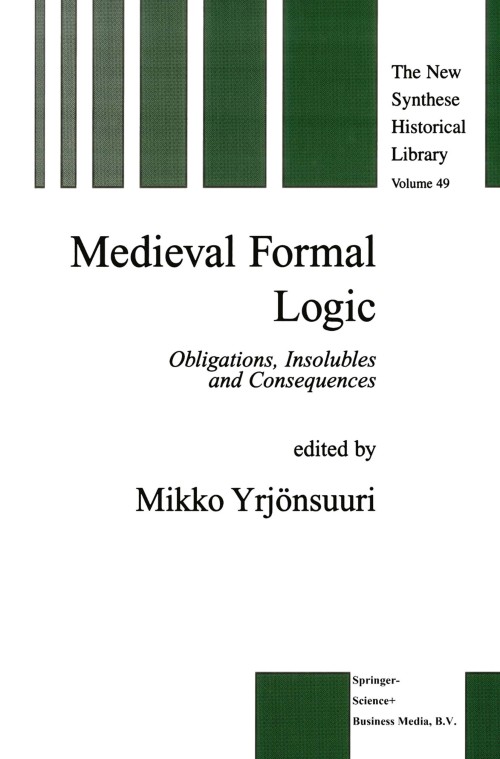
245 10|aMedieval Formal Logic|h[electronic resource] :|bObligations, Insolubles and Consequences /|cedited by Mikko Yrjönsuuri.
250 |a1st ed. 2001.
264 1|aDordrecht :|bSpringer Netherlands :|bImprint: Springer,|c2001.
300 |aXII, 242 p.|bonline resource.
336 |atext|btxt|2rdacontent
337 |acomputer|bc|2rdamedia
338 |aonline resource|bcr|2rdacarrier
347 |atext file|bPDF|2rda
490 1 |aThe New Synthese Historical Library, Texts and Studies in the History of Philosophy,|x2352-2585 ;|v49
505 0 |aI Obligations and Insolubles -- Duties, Rules and Interpretations in Obligational Disputations -- Disputation and Change of Belief—Burley’s Theory of Obligationes as a Theory of Belief Revision -- Obligations and Liars -- The Relations between Insolubles and Obligations in Medieval Disputations -- II Consequences -- Consequence as Inference: Mediaeval Proof Theory 1300–1350 -- Consequence and Rules of Consequence in the Post-Ockham Period -- Self-reference and Validity Revisited -- III Translations -- The Emmeran Treatise on False Positio -- The Emmeran Treatise on Impossible Positio -- Questions on Aristotle’s Prior Analytics Opposite of the Consequent? -- Index of Names.
520 |aCentral topics in medieval logic are here treated in a way that is congenial to the modern reader, without compromising historical reliability. The achievements of medieval logic are made available to a wider philosophical public then the medievalists themselves. The three genres of logica moderna arising in a later Middle Ages are covered: obligations, insolubles and consequences - the first time these have been treated in such a unified way. The articles on obligations look at the role of logical consistence in medieval disputation techniques. Those on insolubles concentrate on medieval solutions to the Liar Paradox. There is also a systematic account of how medieval authors described the logical content of an inference, and how they thought that the validity of an inference could be guaranteed.
532 8 |aAccessibility summary: This PDF is not accessible. It is based on scanned pages and does not support features such as screen reader compatibility or described non-text content (images, graphs etc). However, it likely supports searchable and selectable text based on OCR (Optical Character Recognition). Users with accessibility needs may not be able to use this content effectively. Please contact us at accessibilitysupport@springernature.com if you require assistance or an alternative format.
532 8 |aInaccessible, or known limited accessibility
532 8 |aNo reading system accessibility options actively disabled
532 8 |aPublisher contact for further accessibility information: accessibilitysupport@springernature.com
650 0|aLogic.
650 0|aPhilosophy, Medieval.
650 0|aLanguage and languages|xPhilosophy.
650 14|aLogic.
650 24|aMedieval Philosophy.
650 24|aPhilosophy of Language.
700 1 |aYrjönsuuri, Mikko.|eeditor.|4edt|4http://id.loc.gov/vocabulary/relators/edt
710 2 |aSpringerLink (Online service)
773 0 |tSpringer Nature eBook
776 08|iPrinted edition:|z9780792366744
776 08|iPrinted edition:|z9789048156047
776 08|iPrinted edition:|z9789401597142
830 0|aThe New Synthese Historical Library, Texts and Studies in the History of Philosophy,|x2352-2585 ;|v49
856 40|uhttps://doi.org/10.1007/978-94-015-9713-5
912 |aZDB-2-SHU
912 |aZDB-2-SXPR
912 |aZDB-2-BAE
950 |aHumanities, Social Sciences and Law (SpringerNature-11648)
950 |aPhilosophy and Religion (R0) (SpringerNature-43725)