

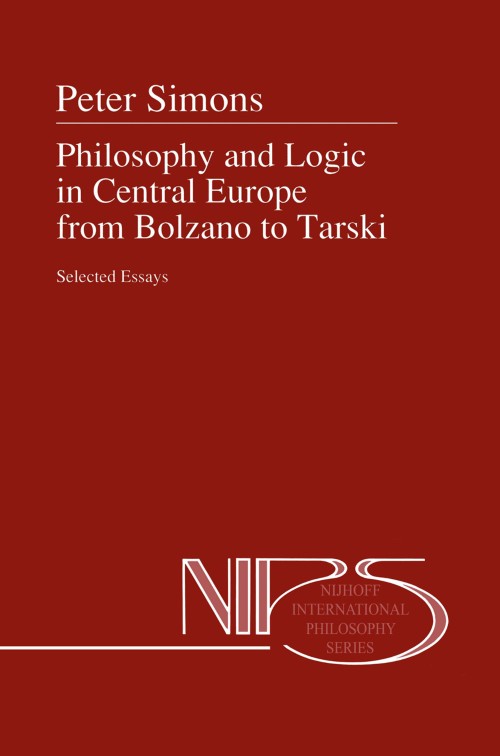
Philosophy and Logic in Central Europe from Bolzano to Tarski [electronic resource] : Selected Essays / by Peter M. Simons.
Erişim Adresi
ISBN
9789401580946
Dil Kodu
İngilizce
Yer Numarası
DK/10950
Yazar
Basım Bildirimi
1st ed. 1992.
Yayın Bilgisi
Dordrecht : Springer Netherlands : Imprint: Springer, 1992.
Fiziksel Niteleme
XIV, 445 p. online resource.
Dizi
Nijhoff International Philosophy Series ; 45
İçindekiler Notu
1. Introduction: Central Europe in the history of philosophy -- 2. Bolzano, Tarski, and the limits of logic -- 3. Brentano’s reform of logic -- 4. The formalization of Husserl’s theory of wholes and parts -- 5. Frege’s theory of real numbers -- 6. The Anglo-Austrian Analytic Axis -- 7. On what there isn’t: the Meinong-Russell dispute -- 8. ?ukasiewicz, Meinong, and many-valued logic -- 9. On understanding Le?niewski -- 10. A Brentanian basis for Lesniewskian logic -- 11. Le?niewski’s logic and its relations to classical and free logics -- 12. A semantics for Ontology -- 13. The old problem of complex and fact -- 14. Tractatus-Mereologico-Philosophicus? A Brentanian look at Wittgenstein, and a moral -- 15. Wittgenstein, Schlick and the a priori -- 16. Categories and ways of being -- Index of Persons -- Index of Subjects -- Index of Cities.
Özet, vb.
ways of doing it, but it is wrong to project it far into the past: it did not exist at the turn of the century and only became clearly apparent after the Second World War. I recently taught at an American university on the his tory of philosophy from Balzano to Husserl. The course title had to come from a fixed pool and gave trouble. Was it philosophical logic, the nine teenth century, or phenomenology? A logic title would connote over this period Frege, Russell, Carnap, perhaps a mention of Boole: not continental enough. The nineteenth century? The century of Kant's successors: Fichte, Hegel, Schopenhauer, Feuer bach, Marx, Nietzsche? What have they to do with Balzano, Lotze, Brentano, Meinong, Husserl and Twardowski? Even tually 'Phenomenology' was chosen, misdescribing more than half of the course. That illustrates the problems one faces in trying to work against the picture of the period which is ingrained in minds and syllabuses. This book arises from my efforts to combat that picture. I backed into writing about the history of recent philosophy rather than setting out to do so. The beginning was chance. In Manchester in the early seventies, at a time when most English philosophy departments breathed re cycled Oxford air, the intellectual atmosphere derived from Cambridge and Warsaw, spiced with a breath of Freiburg and Paris.
Konu
Logic.
Ontology.
History.
Logic.
Ontology.
History.
Ontology.
History.
Logic.
Ontology.
History.
Kurum Adı
Eseri Alıntıla
Referansları kullanmadan önce gözden geçirmeniz ve varsa gerekli düzeltmeleri yapmanız önerilir.
Dijital Kaynak
MARC Görünümü
LEADER 04764nam a22005775i 4500
001 809661
003 TR_AnAIT
005 20260131022643
007 cr nn 008mamaa
008 130220s1992 ne | s |||| 0|eng d
020 |a9789401580946|9978-94-015-8094-6
024 7 |a10.1007/978-94-015-8094-6|2doi
041 |aeng
049 |aTürk Tarih Kurumu Kütüphanesi
050 4|aBC1-199
072 7|aHPL|2bicssc
072 7|aPHI011000|2bisacsh
072 7|aQDTL|2thema
082 04|a160|223
090 |aDK/10950
100 1 |aSimons, Peter M.|eauthor.|4aut|4http://id.loc.gov/vocabulary/relators/aut
245 10|aPhilosophy and Logic in Central Europe from Bolzano to Tarski|h[electronic resource] :|bSelected Essays /|cby Peter M. Simons.
250 |a1st ed. 1992.
264 1|aDordrecht :|bSpringer Netherlands :|bImprint: Springer,|c1992.
300 |aXIV, 445 p.|bonline resource.
336 |atext|btxt|2rdacontent
337 |acomputer|bc|2rdamedia
338 |aonline resource|bcr|2rdacarrier
347 |atext file|bPDF|2rda
490 1 |aNijhoff International Philosophy Series ;|v45
505 0 |a1. Introduction: Central Europe in the history of philosophy -- 2. Bolzano, Tarski, and the limits of logic -- 3. Brentano’s reform of logic -- 4. The formalization of Husserl’s theory of wholes and parts -- 5. Frege’s theory of real numbers -- 6. The Anglo-Austrian Analytic Axis -- 7. On what there isn’t: the Meinong-Russell dispute -- 8. ?ukasiewicz, Meinong, and many-valued logic -- 9. On understanding Le?niewski -- 10. A Brentanian basis for Lesniewskian logic -- 11. Le?niewski’s logic and its relations to classical and free logics -- 12. A semantics for Ontology -- 13. The old problem of complex and fact -- 14. Tractatus-Mereologico-Philosophicus? A Brentanian look at Wittgenstein, and a moral -- 15. Wittgenstein, Schlick and the a priori -- 16. Categories and ways of being -- Index of Persons -- Index of Subjects -- Index of Cities.
520 |aways of doing it, but it is wrong to project it far into the past: it did not exist at the turn of the century and only became clearly apparent after the Second World War. I recently taught at an American university on the his tory of philosophy from Balzano to Husserl. The course title had to come from a fixed pool and gave trouble. Was it philosophical logic, the nine teenth century, or phenomenology? A logic title would connote over this period Frege, Russell, Carnap, perhaps a mention of Boole: not continental enough. The nineteenth century? The century of Kant's successors: Fichte, Hegel, Schopenhauer, Feuer bach, Marx, Nietzsche? What have they to do with Balzano, Lotze, Brentano, Meinong, Husserl and Twardowski? Even tually 'Phenomenology' was chosen, misdescribing more than half of the course. That illustrates the problems one faces in trying to work against the picture of the period which is ingrained in minds and syllabuses. This book arises from my efforts to combat that picture. I backed into writing about the history of recent philosophy rather than setting out to do so. The beginning was chance. In Manchester in the early seventies, at a time when most English philosophy departments breathed re cycled Oxford air, the intellectual atmosphere derived from Cambridge and Warsaw, spiced with a breath of Freiburg and Paris.
532 8 |aAccessibility summary: This PDF is not accessible. It is based on scanned pages and does not support features such as screen reader compatibility or described non-text content (images, graphs etc). However, it likely supports searchable and selectable text based on OCR (Optical Character Recognition). Users with accessibility needs may not be able to use this content effectively. Please contact us at accessibilitysupport@springernature.com if you require assistance or an alternative format.
532 8 |aInaccessible, or known limited accessibility
532 8 |aNo reading system accessibility options actively disabled
532 8 |aPublisher contact for further accessibility information: accessibilitysupport@springernature.com
650 0|aLogic.
650 0|aOntology.
650 0|aHistory.
650 14|aLogic.
650 24|aOntology.
650 24|aHistory.
710 2 |aSpringerLink (Online service)
773 0 |tSpringer Nature eBook
776 08|iPrinted edition:|z9780792316213
776 08|iPrinted edition:|z9789048141296
776 08|iPrinted edition:|z9789401580953
830 0|aNijhoff International Philosophy Series ;|v45
856 40|uhttps://doi.org/10.1007/978-94-015-8094-6
912 |aZDB-2-SHU
912 |aZDB-2-SXPR
912 |aZDB-2-BAE
950 |aHumanities, Social Sciences and Law (SpringerNature-11648)
950 |aPhilosophy and Religion (R0) (SpringerNature-43725)
001 809661
003 TR_AnAIT
005 20260131022643
007 cr nn 008mamaa
008 130220s1992 ne | s |||| 0|eng d
020 |a9789401580946|9978-94-015-8094-6
024 7 |a10.1007/978-94-015-8094-6|2doi
041 |aeng
049 |aTürk Tarih Kurumu Kütüphanesi
050 4|aBC1-199
072 7|aHPL|2bicssc
072 7|aPHI011000|2bisacsh
072 7|aQDTL|2thema
082 04|a160|223
090 |aDK/10950
100 1 |aSimons, Peter M.|eauthor.|4aut|4http://id.loc.gov/vocabulary/relators/aut
245 10|aPhilosophy and Logic in Central Europe from Bolzano to Tarski|h[electronic resource] :|bSelected Essays /|cby Peter M. Simons.
250 |a1st ed. 1992.
264 1|aDordrecht :|bSpringer Netherlands :|bImprint: Springer,|c1992.
300 |aXIV, 445 p.|bonline resource.
336 |atext|btxt|2rdacontent
337 |acomputer|bc|2rdamedia
338 |aonline resource|bcr|2rdacarrier
347 |atext file|bPDF|2rda
490 1 |aNijhoff International Philosophy Series ;|v45
505 0 |a1. Introduction: Central Europe in the history of philosophy -- 2. Bolzano, Tarski, and the limits of logic -- 3. Brentano’s reform of logic -- 4. The formalization of Husserl’s theory of wholes and parts -- 5. Frege’s theory of real numbers -- 6. The Anglo-Austrian Analytic Axis -- 7. On what there isn’t: the Meinong-Russell dispute -- 8. ?ukasiewicz, Meinong, and many-valued logic -- 9. On understanding Le?niewski -- 10. A Brentanian basis for Lesniewskian logic -- 11. Le?niewski’s logic and its relations to classical and free logics -- 12. A semantics for Ontology -- 13. The old problem of complex and fact -- 14. Tractatus-Mereologico-Philosophicus? A Brentanian look at Wittgenstein, and a moral -- 15. Wittgenstein, Schlick and the a priori -- 16. Categories and ways of being -- Index of Persons -- Index of Subjects -- Index of Cities.
520 |aways of doing it, but it is wrong to project it far into the past: it did not exist at the turn of the century and only became clearly apparent after the Second World War. I recently taught at an American university on the his tory of philosophy from Balzano to Husserl. The course title had to come from a fixed pool and gave trouble. Was it philosophical logic, the nine teenth century, or phenomenology? A logic title would connote over this period Frege, Russell, Carnap, perhaps a mention of Boole: not continental enough. The nineteenth century? The century of Kant's successors: Fichte, Hegel, Schopenhauer, Feuer bach, Marx, Nietzsche? What have they to do with Balzano, Lotze, Brentano, Meinong, Husserl and Twardowski? Even tually 'Phenomenology' was chosen, misdescribing more than half of the course. That illustrates the problems one faces in trying to work against the picture of the period which is ingrained in minds and syllabuses. This book arises from my efforts to combat that picture. I backed into writing about the history of recent philosophy rather than setting out to do so. The beginning was chance. In Manchester in the early seventies, at a time when most English philosophy departments breathed re cycled Oxford air, the intellectual atmosphere derived from Cambridge and Warsaw, spiced with a breath of Freiburg and Paris.
532 8 |aAccessibility summary: This PDF is not accessible. It is based on scanned pages and does not support features such as screen reader compatibility or described non-text content (images, graphs etc). However, it likely supports searchable and selectable text based on OCR (Optical Character Recognition). Users with accessibility needs may not be able to use this content effectively. Please contact us at accessibilitysupport@springernature.com if you require assistance or an alternative format.
532 8 |aInaccessible, or known limited accessibility
532 8 |aNo reading system accessibility options actively disabled
532 8 |aPublisher contact for further accessibility information: accessibilitysupport@springernature.com
650 0|aLogic.
650 0|aOntology.
650 0|aHistory.
650 14|aLogic.
650 24|aOntology.
650 24|aHistory.
710 2 |aSpringerLink (Online service)
773 0 |tSpringer Nature eBook
776 08|iPrinted edition:|z9780792316213
776 08|iPrinted edition:|z9789048141296
776 08|iPrinted edition:|z9789401580953
830 0|aNijhoff International Philosophy Series ;|v45
856 40|uhttps://doi.org/10.1007/978-94-015-8094-6
912 |aZDB-2-SHU
912 |aZDB-2-SXPR
912 |aZDB-2-BAE
950 |aHumanities, Social Sciences and Law (SpringerNature-11648)
950 |aPhilosophy and Religion (R0) (SpringerNature-43725)
Materyaller
Depodan talep edilen materyal sadece kütüphane içerisinde kullanılmaktadır.
Materyal dışarıya ödünç verilmemektedir.
Materyal dışarıya ödünç verilmemektedir.
