

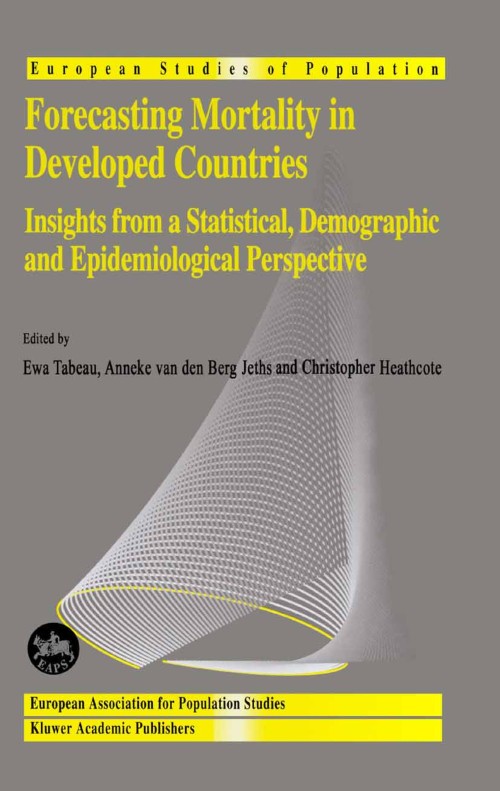
Forecasting Mortality in Developed Countries [electronic resource] : Insights from a Statistical, Demographic and Epidemiological Perspective / edited by E. Tabeau, Anneke van den Berg Jeths, Christopher Heathcote.
Erişim Adresi
ISBN
9780306475627
Dil Kodu
İngilizce
Yer Numarası
DK/11059
Basım Bildirimi
1st ed. 2001.
Yayın Bilgisi
Dordrecht : Springer Netherlands : Imprint: Springer, 2001.
Fiziksel Niteleme
XXVIII, 306 p. online resource.
Dizi
European Studies of Population, 2542-8977 ; 9
İçindekiler Notu
A Review of Demographic Forecasting Models for Mortality -- A Review of Epidemiological Approaches to Forecasting Mortality and Morbidity -- Theoretical Perspectives on Forecasting Mortality -- A Regression Model of Mortality, with Application to the Netherlands -- Forecasting Mortality from Regression Models: The Case of the Netherlands -- Gompertz in Context: The Gompertz and Related Distributions -- Comparing Theoretical Age Patterns of Mortality Beyond the Age of 80 -- From Theory to Practice -- Predicting Mortality from Period, Cohort or Cause-specific Trends: A Study of Four European Countries -- Incorporating Risk Factor Epidemiology in Mortality Projections -- Projecting Mortality in Population Forecasts in the Netherlands -- The Latest Mortality Forecasts in the European Union -- Issues for the Future: More Consistency and Transparency -- Mortality Models Incorporating Theoretical Concepts of Ageing -- Towards an Integration of the Statistical, Demographic and Epidemiological Perspectives in Forecasting Mortality.
Özet, vb.
Information on future mortality trends is essential for population forecasts, public health policy, actuarial studies, and many other purposes. Realising the importance of such needs, this volume contains contributions to the theory and practice of forecasting mortality in the relatively favourable circumstances in developed countries of Western Europe. In this context techniques from mathematical statistics and econometrics can provide useful descriptions of past mortality. The naive forecast obtained by extrapolating a fitted model may give as good a forecast as any but forecasting by extrapolation requires careful justification since it assumes the prolongation of historical conditions. On the other hand, whilst it is generally accepted that scientific and other advances will continue to impact on mortality, perhaps dramatically so, it is impossible to quantify more than the outline of future consequences with a strong degree of confidence. The decision to modify an extrapolation of a model fitted to historical data (or conversely choosing not to modify it) in order to obtain a forecast is therefore strongly influenced by subjective and judgmental elements, with the quality of the latter dependent on demographic, epidemiological and indeed perhaps more general considerations. The thread running through the book reflects therefore the necessity of integrating demographic, epidemiological, and statistical factors to obtain an improvement in the prediction of mortality.
Konu
Demography.
Population.
Population __ Economic aspects.
Epidemiology.
Public health.
Business.
Management science.
Sociology __ Methodology.
Population and Demography.
Population Economics.
Epidemiology.
Public Health.
Business and Management.
Sociological Methods.
Population.
Population __ Economic aspects.
Epidemiology.
Public health.
Business.
Management science.
Sociology __ Methodology.
Population and Demography.
Population Economics.
Epidemiology.
Public Health.
Business and Management.
Sociological Methods.
Diğer Yazarlar
Kurum Adı
Eseri Alıntıla
Referansları kullanmadan önce gözden geçirmeniz ve varsa gerekli düzeltmeleri yapmanız önerilir.
Dijital Kaynak
MARC Görünümü
LEADER 04932nam a22006495i 4500
001 809770
003 TR_AnAIT
005 20260131022335
007 cr nn 008mamaa
008 100301s2001 ne | s |||| 0|eng d
020 |a9780306475627|9978-0-306-47562-7
024 7 |a10.1007/0-306-47562-6|2doi
041 |aeng
049 |aTürk Tarih Kurumu Kütüphanesi
050 4|aHB848-3697
072 7|aJHBD|2bicssc
072 7|aSOC006000|2bisacsh
072 7|aJHBD|2thema
082 04|a304.6|223
090 |aDK/11059
245 10|aForecasting Mortality in Developed Countries|h[electronic resource] :|bInsights from a Statistical, Demographic and Epidemiological Perspective /|cedited by E. Tabeau, Anneke van den Berg Jeths, Christopher Heathcote.
250 |a1st ed. 2001.
264 1|aDordrecht :|bSpringer Netherlands :|bImprint: Springer,|c2001.
300 |aXXVIII, 306 p.|bonline resource.
336 |atext|btxt|2rdacontent
337 |acomputer|bc|2rdamedia
338 |aonline resource|bcr|2rdacarrier
347 |atext file|bPDF|2rda
490 1 |aEuropean Studies of Population,|x2542-8977 ;|v9
505 0 |aA Review of Demographic Forecasting Models for Mortality -- A Review of Epidemiological Approaches to Forecasting Mortality and Morbidity -- Theoretical Perspectives on Forecasting Mortality -- A Regression Model of Mortality, with Application to the Netherlands -- Forecasting Mortality from Regression Models: The Case of the Netherlands -- Gompertz in Context: The Gompertz and Related Distributions -- Comparing Theoretical Age Patterns of Mortality Beyond the Age of 80 -- From Theory to Practice -- Predicting Mortality from Period, Cohort or Cause-specific Trends: A Study of Four European Countries -- Incorporating Risk Factor Epidemiology in Mortality Projections -- Projecting Mortality in Population Forecasts in the Netherlands -- The Latest Mortality Forecasts in the European Union -- Issues for the Future: More Consistency and Transparency -- Mortality Models Incorporating Theoretical Concepts of Ageing -- Towards an Integration of the Statistical, Demographic and Epidemiological Perspectives in Forecasting Mortality.
520 |aInformation on future mortality trends is essential for population forecasts, public health policy, actuarial studies, and many other purposes. Realising the importance of such needs, this volume contains contributions to the theory and practice of forecasting mortality in the relatively favourable circumstances in developed countries of Western Europe. In this context techniques from mathematical statistics and econometrics can provide useful descriptions of past mortality. The naive forecast obtained by extrapolating a fitted model may give as good a forecast as any but forecasting by extrapolation requires careful justification since it assumes the prolongation of historical conditions. On the other hand, whilst it is generally accepted that scientific and other advances will continue to impact on mortality, perhaps dramatically so, it is impossible to quantify more than the outline of future consequences with a strong degree of confidence. The decision to modify an extrapolation of a model fitted to historical data (or conversely choosing not to modify it) in order to obtain a forecast is therefore strongly influenced by subjective and judgmental elements, with the quality of the latter dependent on demographic, epidemiological and indeed perhaps more general considerations. The thread running through the book reflects therefore the necessity of integrating demographic, epidemiological, and statistical factors to obtain an improvement in the prediction of mortality.
650 0|aDemography.
650 0|aPopulation.
650 0|aPopulation|xEconomic aspects.
650 0|aEpidemiology.
650 0|aPublic health.
650 0|aBusiness.
650 0|aManagement science.
650 0|aSociology|xMethodology.
650 14|aPopulation and Demography.
650 24|aPopulation Economics.
650 24|aEpidemiology.
650 24|aPublic Health.
650 24|aBusiness and Management.
650 24|aSociological Methods.
700 1 |aTabeau, E.|eeditor.|4edt|4http://id.loc.gov/vocabulary/relators/edt
700 1 |avan den Berg Jeths, Anneke.|eeditor.|4edt|4http://id.loc.gov/vocabulary/relators/edt
700 1 |aHeathcote, Christopher.|eeditor.|4edt|4http://id.loc.gov/vocabulary/relators/edt
710 2 |aSpringerLink (Online service)
773 0 |tSpringer Nature eBook
776 08|iPrinted edition:|z9780792368335
776 08|iPrinted edition:|z9789048156603
776 08|iPrinted edition:|z9789401739177
830 0|aEuropean Studies of Population,|x2542-8977 ;|v9
856 40|uhttps://doi.org/10.1007/0-306-47562-6
912 |aZDB-2-SHU
912 |aZDB-2-SXS
912 |aZDB-2-BAE
950 |aHumanities, Social Sciences and Law (SpringerNature-11648)
950 |aSocial Sciences (R0) (SpringerNature-43726)
001 809770
003 TR_AnAIT
005 20260131022335
007 cr nn 008mamaa
008 100301s2001 ne | s |||| 0|eng d
020 |a9780306475627|9978-0-306-47562-7
024 7 |a10.1007/0-306-47562-6|2doi
041 |aeng
049 |aTürk Tarih Kurumu Kütüphanesi
050 4|aHB848-3697
072 7|aJHBD|2bicssc
072 7|aSOC006000|2bisacsh
072 7|aJHBD|2thema
082 04|a304.6|223
090 |aDK/11059
245 10|aForecasting Mortality in Developed Countries|h[electronic resource] :|bInsights from a Statistical, Demographic and Epidemiological Perspective /|cedited by E. Tabeau, Anneke van den Berg Jeths, Christopher Heathcote.
250 |a1st ed. 2001.
264 1|aDordrecht :|bSpringer Netherlands :|bImprint: Springer,|c2001.
300 |aXXVIII, 306 p.|bonline resource.
336 |atext|btxt|2rdacontent
337 |acomputer|bc|2rdamedia
338 |aonline resource|bcr|2rdacarrier
347 |atext file|bPDF|2rda
490 1 |aEuropean Studies of Population,|x2542-8977 ;|v9
505 0 |aA Review of Demographic Forecasting Models for Mortality -- A Review of Epidemiological Approaches to Forecasting Mortality and Morbidity -- Theoretical Perspectives on Forecasting Mortality -- A Regression Model of Mortality, with Application to the Netherlands -- Forecasting Mortality from Regression Models: The Case of the Netherlands -- Gompertz in Context: The Gompertz and Related Distributions -- Comparing Theoretical Age Patterns of Mortality Beyond the Age of 80 -- From Theory to Practice -- Predicting Mortality from Period, Cohort or Cause-specific Trends: A Study of Four European Countries -- Incorporating Risk Factor Epidemiology in Mortality Projections -- Projecting Mortality in Population Forecasts in the Netherlands -- The Latest Mortality Forecasts in the European Union -- Issues for the Future: More Consistency and Transparency -- Mortality Models Incorporating Theoretical Concepts of Ageing -- Towards an Integration of the Statistical, Demographic and Epidemiological Perspectives in Forecasting Mortality.
520 |aInformation on future mortality trends is essential for population forecasts, public health policy, actuarial studies, and many other purposes. Realising the importance of such needs, this volume contains contributions to the theory and practice of forecasting mortality in the relatively favourable circumstances in developed countries of Western Europe. In this context techniques from mathematical statistics and econometrics can provide useful descriptions of past mortality. The naive forecast obtained by extrapolating a fitted model may give as good a forecast as any but forecasting by extrapolation requires careful justification since it assumes the prolongation of historical conditions. On the other hand, whilst it is generally accepted that scientific and other advances will continue to impact on mortality, perhaps dramatically so, it is impossible to quantify more than the outline of future consequences with a strong degree of confidence. The decision to modify an extrapolation of a model fitted to historical data (or conversely choosing not to modify it) in order to obtain a forecast is therefore strongly influenced by subjective and judgmental elements, with the quality of the latter dependent on demographic, epidemiological and indeed perhaps more general considerations. The thread running through the book reflects therefore the necessity of integrating demographic, epidemiological, and statistical factors to obtain an improvement in the prediction of mortality.
650 0|aDemography.
650 0|aPopulation.
650 0|aPopulation|xEconomic aspects.
650 0|aEpidemiology.
650 0|aPublic health.
650 0|aBusiness.
650 0|aManagement science.
650 0|aSociology|xMethodology.
650 14|aPopulation and Demography.
650 24|aPopulation Economics.
650 24|aEpidemiology.
650 24|aPublic Health.
650 24|aBusiness and Management.
650 24|aSociological Methods.
700 1 |aTabeau, E.|eeditor.|4edt|4http://id.loc.gov/vocabulary/relators/edt
700 1 |avan den Berg Jeths, Anneke.|eeditor.|4edt|4http://id.loc.gov/vocabulary/relators/edt
700 1 |aHeathcote, Christopher.|eeditor.|4edt|4http://id.loc.gov/vocabulary/relators/edt
710 2 |aSpringerLink (Online service)
773 0 |tSpringer Nature eBook
776 08|iPrinted edition:|z9780792368335
776 08|iPrinted edition:|z9789048156603
776 08|iPrinted edition:|z9789401739177
830 0|aEuropean Studies of Population,|x2542-8977 ;|v9
856 40|uhttps://doi.org/10.1007/0-306-47562-6
912 |aZDB-2-SHU
912 |aZDB-2-SXS
912 |aZDB-2-BAE
950 |aHumanities, Social Sciences and Law (SpringerNature-11648)
950 |aSocial Sciences (R0) (SpringerNature-43726)
Materyaller
Depodan talep edilen materyal sadece kütüphane içerisinde kullanılmaktadır.
Materyal dışarıya ödünç verilmemektedir.
Materyal dışarıya ödünç verilmemektedir.
