

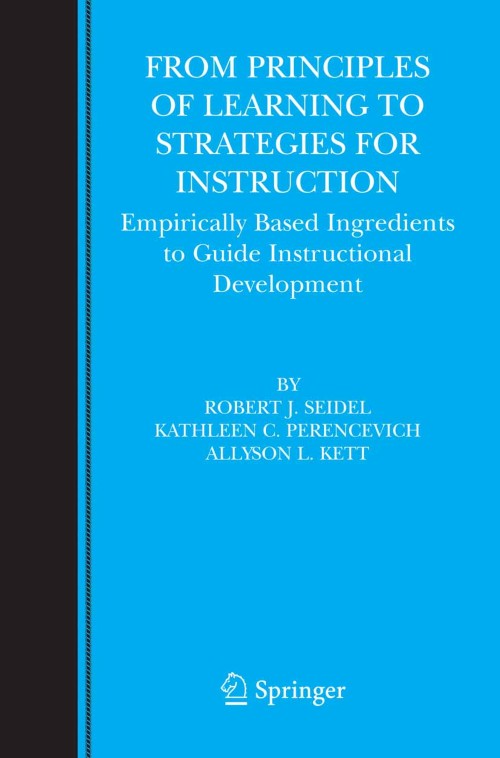
From Principles of Learning to Strategies for Instruction [electronic resource] : Empirically Based Ingredients to Guide Instructional Development / by Robert J. Seidel, Kathleen C. Perencevich, Allyson L. Kett.
Erişim Adresi
ISBN
9780387234816
Dil Kodu
İngilizce
Yer Numarası
DK/11071
Yazar
Basım Bildirimi
1st ed. 2005.
Yayın Bilgisi
New York, NY : Springer US : Imprint: Springer, 2005.
Fiziksel Niteleme
XXVI, 230 p. online resource.
İçindekiler Notu
Heuristics and Taxonomy -- A Cognitive Domain Example: Reading -- Psychomotor Domain -- Affective Domain -- Interpersonal Domain -- Suggestions for the Integration of Technology -- Summary.
Özet, vb.
The purpose of this volume is to help educators and training developers to improve the quality of their instruction. Unlike other books, which have appeared so far, this volume is not limited to a particular theoretical position. Nor is it like many of the instructional design texts, which ignore the learning literature. Rather, it draws upon any and all of those research-based principles regardless of learning theory, which suggest heuristics to guide instructional strategies. The approach of the authors is unique in that they develop a framework or model taxonomy for tasks, through which the principles of learning can be related to particular learning processes, suggesting distinctive strategies for specific instructional tasks. The authors present a four-stage model that includes Acquisition, Automaticity, Near Term Transfer, and Far Term Transfer. The book is a practical guide for developing instructional strategies across the four principal domains, cognitive, affective, psychomotor, and interpersonal; and is backed by empirically supported learning principles. It is useful both to the experienced as well as the novice developer (e.g. the student). "The current volume strikes a nice balance between theory and practice and provides a straightforward model of instruction that is easily connected with relevant research but equally easy to apply to instructional development projects… The detailed treatment of the interpersonal domain and the emphasis on technology integration clearly distinguish the book as a modern treatment of instructional development that goes well beyond traditional instructional system development models… Therefore, this volume should provide a well-grounded and useful tool for instructional developers." From the Preface by Michael Spector, Florida State University. "This book represents a major milestone in the literature on learning because it brings togetherresearch from the fields of psychology, education, and the training in a format which is highly useful to practitioners. It will be very valuable to teachers, trainers, students, and researchers alike." Greg Kearsley, University of Wisconsin, Madison and, UMUC, University of Maryland.
Konu
Learning, Psychology of.
Education.
Teachers __ Training of.
Instructional Psychology.
Education.
Teaching and Teacher Education.
Education.
Teachers __ Training of.
Instructional Psychology.
Education.
Teaching and Teacher Education.
Diğer Yazarlar
Kurum Adı
Eseri Alıntıla
Referansları kullanmadan önce gözden geçirmeniz ve varsa gerekli düzeltmeleri yapmanız önerilir.
Dijital Kaynak
MARC Görünümü
LEADER 05120nam a22005655i 4500
001 809782
003 TR_AnAIT
005 20260131022311
007 cr nn 008mamaa
008 100301s2005 xxu| s |||| 0|eng d
020 |a9780387234816|9978-0-387-23481-6
024 7 |a10.1007/0-387-23481-0|2doi
041 |aeng
049 |aTürk Tarih Kurumu Kütüphanesi
050 4|aLB1060-1077
072 7|aJNC|2bicssc
072 7|aEDU009000|2bisacsh
072 7|aJNC|2thema
082 04|a370.15|223
090 |aDK/11071
100 1 |aSeidel, Robert J.|eauthor.|4aut|4http://id.loc.gov/vocabulary/relators/aut
245 10|aFrom Principles of Learning to Strategies for Instruction|h[electronic resource] :|bEmpirically Based Ingredients to Guide Instructional Development /|cby Robert J. Seidel, Kathleen C. Perencevich, Allyson L. Kett.
250 |a1st ed. 2005.
264 1|aNew York, NY :|bSpringer US :|bImprint: Springer,|c2005.
300 |aXXVI, 230 p.|bonline resource.
336 |atext|btxt|2rdacontent
337 |acomputer|bc|2rdamedia
338 |aonline resource|bcr|2rdacarrier
347 |atext file|bPDF|2rda
505 0 |aHeuristics and Taxonomy -- A Cognitive Domain Example: Reading -- Psychomotor Domain -- Affective Domain -- Interpersonal Domain -- Suggestions for the Integration of Technology -- Summary.
520 |aThe purpose of this volume is to help educators and training developers to improve the quality of their instruction. Unlike other books, which have appeared so far, this volume is not limited to a particular theoretical position. Nor is it like many of the instructional design texts, which ignore the learning literature. Rather, it draws upon any and all of those research-based principles regardless of learning theory, which suggest heuristics to guide instructional strategies. The approach of the authors is unique in that they develop a framework or model taxonomy for tasks, through which the principles of learning can be related to particular learning processes, suggesting distinctive strategies for specific instructional tasks. The authors present a four-stage model that includes Acquisition, Automaticity, Near Term Transfer, and Far Term Transfer. The book is a practical guide for developing instructional strategies across the four principal domains, cognitive, affective, psychomotor, and interpersonal; and is backed by empirically supported learning principles. It is useful both to the experienced as well as the novice developer (e.g. the student). "The current volume strikes a nice balance between theory and practice and provides a straightforward model of instruction that is easily connected with relevant research but equally easy to apply to instructional development projects… The detailed treatment of the interpersonal domain and the emphasis on technology integration clearly distinguish the book as a modern treatment of instructional development that goes well beyond traditional instructional system development models… Therefore, this volume should provide a well-grounded and useful tool for instructional developers." From the Preface by Michael Spector, Florida State University. "This book represents a major milestone in the literature on learning because it brings togetherresearch from the fields of psychology, education, and the training in a format which is highly useful to practitioners. It will be very valuable to teachers, trainers, students, and researchers alike." Greg Kearsley, University of Wisconsin, Madison and, UMUC, University of Maryland.
532 8 |aAccessibility summary: This PDF is not accessible. It is based on scanned pages and does not support features such as screen reader compatibility or described non-text content (images, graphs etc). However, it likely supports searchable and selectable text based on OCR (Optical Character Recognition). Users with accessibility needs may not be able to use this content effectively. Please contact us at accessibilitysupport@springernature.com if you require assistance or an alternative format.
532 8 |aInaccessible, or known limited accessibility
532 8 |aNo reading system accessibility options actively disabled
532 8 |aPublisher contact for further accessibility information: accessibilitysupport@springernature.com
650 0|aLearning, Psychology of.
650 0|aEducation.
650 0|aTeachers|xTraining of.
650 14|aInstructional Psychology.
650 24|aEducation.
650 24|aTeaching and Teacher Education.
700 1 |aPerencevich, Kathleen C.|eauthor.|4aut|4http://id.loc.gov/vocabulary/relators/aut
700 1 |aKett, Allyson L.|eauthor.|4aut|4http://id.loc.gov/vocabulary/relators/aut
710 2 |aSpringerLink (Online service)
773 0 |tSpringer Nature eBook
776 08|iPrinted edition:|z9780387234762
776 08|iPrinted edition:|z9780387503349
776 08|iPrinted edition:|z9781441936325
856 40|uhttps://doi.org/10.1007/0-387-23481-0
912 |aZDB-2-SHU
912 |aZDB-2-SXED
950 |aHumanities, Social Sciences and Law (SpringerNature-11648)
950 |aEducation (R0) (SpringerNature-43721)
001 809782
003 TR_AnAIT
005 20260131022311
007 cr nn 008mamaa
008 100301s2005 xxu| s |||| 0|eng d
020 |a9780387234816|9978-0-387-23481-6
024 7 |a10.1007/0-387-23481-0|2doi
041 |aeng
049 |aTürk Tarih Kurumu Kütüphanesi
050 4|aLB1060-1077
072 7|aJNC|2bicssc
072 7|aEDU009000|2bisacsh
072 7|aJNC|2thema
082 04|a370.15|223
090 |aDK/11071
100 1 |aSeidel, Robert J.|eauthor.|4aut|4http://id.loc.gov/vocabulary/relators/aut
245 10|aFrom Principles of Learning to Strategies for Instruction|h[electronic resource] :|bEmpirically Based Ingredients to Guide Instructional Development /|cby Robert J. Seidel, Kathleen C. Perencevich, Allyson L. Kett.
250 |a1st ed. 2005.
264 1|aNew York, NY :|bSpringer US :|bImprint: Springer,|c2005.
300 |aXXVI, 230 p.|bonline resource.
336 |atext|btxt|2rdacontent
337 |acomputer|bc|2rdamedia
338 |aonline resource|bcr|2rdacarrier
347 |atext file|bPDF|2rda
505 0 |aHeuristics and Taxonomy -- A Cognitive Domain Example: Reading -- Psychomotor Domain -- Affective Domain -- Interpersonal Domain -- Suggestions for the Integration of Technology -- Summary.
520 |aThe purpose of this volume is to help educators and training developers to improve the quality of their instruction. Unlike other books, which have appeared so far, this volume is not limited to a particular theoretical position. Nor is it like many of the instructional design texts, which ignore the learning literature. Rather, it draws upon any and all of those research-based principles regardless of learning theory, which suggest heuristics to guide instructional strategies. The approach of the authors is unique in that they develop a framework or model taxonomy for tasks, through which the principles of learning can be related to particular learning processes, suggesting distinctive strategies for specific instructional tasks. The authors present a four-stage model that includes Acquisition, Automaticity, Near Term Transfer, and Far Term Transfer. The book is a practical guide for developing instructional strategies across the four principal domains, cognitive, affective, psychomotor, and interpersonal; and is backed by empirically supported learning principles. It is useful both to the experienced as well as the novice developer (e.g. the student). "The current volume strikes a nice balance between theory and practice and provides a straightforward model of instruction that is easily connected with relevant research but equally easy to apply to instructional development projects… The detailed treatment of the interpersonal domain and the emphasis on technology integration clearly distinguish the book as a modern treatment of instructional development that goes well beyond traditional instructional system development models… Therefore, this volume should provide a well-grounded and useful tool for instructional developers." From the Preface by Michael Spector, Florida State University. "This book represents a major milestone in the literature on learning because it brings togetherresearch from the fields of psychology, education, and the training in a format which is highly useful to practitioners. It will be very valuable to teachers, trainers, students, and researchers alike." Greg Kearsley, University of Wisconsin, Madison and, UMUC, University of Maryland.
532 8 |aAccessibility summary: This PDF is not accessible. It is based on scanned pages and does not support features such as screen reader compatibility or described non-text content (images, graphs etc). However, it likely supports searchable and selectable text based on OCR (Optical Character Recognition). Users with accessibility needs may not be able to use this content effectively. Please contact us at accessibilitysupport@springernature.com if you require assistance or an alternative format.
532 8 |aInaccessible, or known limited accessibility
532 8 |aNo reading system accessibility options actively disabled
532 8 |aPublisher contact for further accessibility information: accessibilitysupport@springernature.com
650 0|aLearning, Psychology of.
650 0|aEducation.
650 0|aTeachers|xTraining of.
650 14|aInstructional Psychology.
650 24|aEducation.
650 24|aTeaching and Teacher Education.
700 1 |aPerencevich, Kathleen C.|eauthor.|4aut|4http://id.loc.gov/vocabulary/relators/aut
700 1 |aKett, Allyson L.|eauthor.|4aut|4http://id.loc.gov/vocabulary/relators/aut
710 2 |aSpringerLink (Online service)
773 0 |tSpringer Nature eBook
776 08|iPrinted edition:|z9780387234762
776 08|iPrinted edition:|z9780387503349
776 08|iPrinted edition:|z9781441936325
856 40|uhttps://doi.org/10.1007/0-387-23481-0
912 |aZDB-2-SHU
912 |aZDB-2-SXED
950 |aHumanities, Social Sciences and Law (SpringerNature-11648)
950 |aEducation (R0) (SpringerNature-43721)
Materyaller
Depodan talep edilen materyal sadece kütüphane içerisinde kullanılmaktadır.
Materyal dışarıya ödünç verilmemektedir.
Materyal dışarıya ödünç verilmemektedir.
