

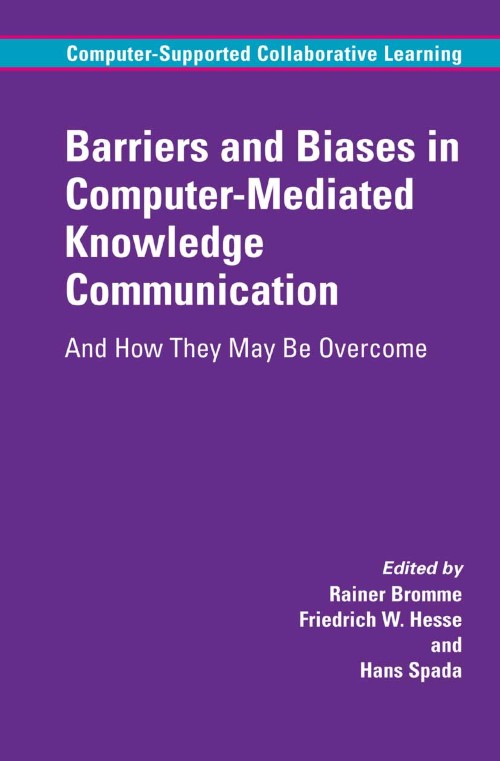
Barriers and Biases in Computer-Mediated Knowledge Communication [electronic resource] : And How They May Be Overcome / edited by Rainer Bromme, Friedrich W. Hesse, Hans Spada.
Erişim Adresi
ISBN
9780387243191
Dil Kodu
İngilizce
Yer Numarası
DK/11073
Basım Bildirimi
1st ed. 2005.
Yayın Bilgisi
New York, NY : Springer US : Imprint: Springer, 2005.
Fiziksel Niteleme
XII, 334 p. online resource.
Dizi
Computer-Supported Collaborative Learning Series, 2543-0157 ; 5
İçindekiler Notu
Barriers, Biases and Opportunities of Communication and Cooperation with Computers: Introduction and Overview -- Facilitating Collaborative Knowledge Construction in Computer-Mediated Learning Environments with Cooperation Scripts -- How to Support Synchronous Net-Based Learning Discourses: Principles and Perspectives -- Instructional Support for Collaboration in Desktop Videoconference Settings -- Barriers and Biases in Computer-Mediated Expert-Layperson-Communication -- Exploring Why Virtual Teamworking is Effective in the Lab but More Difficult in the Workplace -- Social Dilemma in Knowledge Communication via Shared Databases -- Enhancing Sociability of Computer-Supported Collaborative Learning Environments -- Knowledge Sharing in Teams of Heterogeneous Experts -- Knowledge Communication in Design Communities -- Designing Biases That Augment Socio-Cognitive Interactions -- How Do People Learn? -- Technology Affordances for Intersubjective Learning, and How They May Be Exploited.
Özet, vb.
This books deals with computer-mediated cooperation and communication scenarios in teaching and learning situations, leisure activities (e.g. laypersons looking for expert information on the internet), and net-based communication at work. Such scenarios will become increasingly important. But the successful use of such computer-mediated settings is not trivial. Cooperative learning and work itself requires special skills and strategies. And the technical settings with sometimes restricted, sometimes new possibilities for communication add problems on top of the cooperation itself. What are the barriers in computer-mediated communication for cooperative learning and work? Which are the most relevant biases in computer-mediated information processing? Based on empirical research the contributors from psychology, education and computer sciences offer different perspectives on the nature and causes of such barriers. The chapters also give an answer to the question how it might be possible to overcome these barriers and biases to fully gain advantage from the new technical opportunities. These results and answers are of interest for students as well as for researchers in all fields related to the use and evaluation of computer software in communication settings.
Konu
Educational technology.
User interfaces (Computer systems).
Human-computer interaction.
Education.
Learning, Psychology of.
Personality.
Difference (Psychology).
Digital Education and Educational Technology.
User Interfaces and Human Computer Interaction.
Education.
Instructional Psychology.
Personality and Differential Psychology.
User interfaces (Computer systems).
Human-computer interaction.
Education.
Learning, Psychology of.
Personality.
Difference (Psychology).
Digital Education and Educational Technology.
User Interfaces and Human Computer Interaction.
Education.
Instructional Psychology.
Personality and Differential Psychology.
Diğer Yazarlar
Kurum Adı
Eseri Alıntıla
Referansları kullanmadan önce gözden geçirmeniz ve varsa gerekli düzeltmeleri yapmanız önerilir.
Dijital Kaynak
MARC Görünümü
LEADER 05402nam a22006615i 4500
001 809784
003 TR_AnAIT
005 20260131022257
007 cr nn 008mamaa
008 100301s2005 xxu| s |||| 0|eng d
020 |a9780387243191|9978-0-387-24319-1
024 7 |a10.1007/b105100|2doi
041 |aeng
049 |aTürk Tarih Kurumu Kütüphanesi
050 4|aLB1028.3
072 7|aJNV|2bicssc
072 7|aEDU000000|2bisacsh
072 7|aJNV|2thema
082 04|a371.33|223
090 |aDK/11073
245 10|aBarriers and Biases in Computer-Mediated Knowledge Communication|h[electronic resource] :|bAnd How They May Be Overcome /|cedited by Rainer Bromme, Friedrich W. Hesse, Hans Spada.
250 |a1st ed. 2005.
264 1|aNew York, NY :|bSpringer US :|bImprint: Springer,|c2005.
300 |aXII, 334 p.|bonline resource.
336 |atext|btxt|2rdacontent
337 |acomputer|bc|2rdamedia
338 |aonline resource|bcr|2rdacarrier
347 |atext file|bPDF|2rda
490 1 |aComputer-Supported Collaborative Learning Series,|x2543-0157 ;|v5
505 0 |aBarriers, Biases and Opportunities of Communication and Cooperation with Computers: Introduction and Overview -- Facilitating Collaborative Knowledge Construction in Computer-Mediated Learning Environments with Cooperation Scripts -- How to Support Synchronous Net-Based Learning Discourses: Principles and Perspectives -- Instructional Support for Collaboration in Desktop Videoconference Settings -- Barriers and Biases in Computer-Mediated Expert-Layperson-Communication -- Exploring Why Virtual Teamworking is Effective in the Lab but More Difficult in the Workplace -- Social Dilemma in Knowledge Communication via Shared Databases -- Enhancing Sociability of Computer-Supported Collaborative Learning Environments -- Knowledge Sharing in Teams of Heterogeneous Experts -- Knowledge Communication in Design Communities -- Designing Biases That Augment Socio-Cognitive Interactions -- How Do People Learn? -- Technology Affordances for Intersubjective Learning, and How They May Be Exploited.
520 |aThis books deals with computer-mediated cooperation and communication scenarios in teaching and learning situations, leisure activities (e.g. laypersons looking for expert information on the internet), and net-based communication at work. Such scenarios will become increasingly important. But the successful use of such computer-mediated settings is not trivial. Cooperative learning and work itself requires special skills and strategies. And the technical settings with sometimes restricted, sometimes new possibilities for communication add problems on top of the cooperation itself. What are the barriers in computer-mediated communication for cooperative learning and work? Which are the most relevant biases in computer-mediated information processing? Based on empirical research the contributors from psychology, education and computer sciences offer different perspectives on the nature and causes of such barriers. The chapters also give an answer to the question how it might be possible to overcome these barriers and biases to fully gain advantage from the new technical opportunities. These results and answers are of interest for students as well as for researchers in all fields related to the use and evaluation of computer software in communication settings.
532 8 |aAccessibility summary: This PDF is not accessible. It is based on scanned pages and does not support features such as screen reader compatibility or described non-text content (images, graphs etc). However, it likely supports searchable and selectable text based on OCR (Optical Character Recognition). Users with accessibility needs may not be able to use this content effectively. Please contact us at accessibilitysupport@springernature.com if you require assistance or an alternative format.
532 8 |aInaccessible, or known limited accessibility
532 8 |aNo reading system accessibility options actively disabled
532 8 |aPublisher contact for further accessibility information: accessibilitysupport@springernature.com
650 0|aEducational technology.
650 0|aUser interfaces (Computer systems).
650 0|aHuman-computer interaction.
650 0|aEducation.
650 0|aLearning, Psychology of.
650 0|aPersonality.
650 0|aDifference (Psychology).
650 14|aDigital Education and Educational Technology.
650 24|aUser Interfaces and Human Computer Interaction.
650 24|aEducation.
650 24|aInstructional Psychology.
650 24|aPersonality and Differential Psychology.
700 1 |aBromme, Rainer.|eeditor.|4edt|4http://id.loc.gov/vocabulary/relators/edt
700 1 |aHesse, Friedrich W.|eeditor.|4edt|4http://id.loc.gov/vocabulary/relators/edt
700 1 |aSpada, Hans.|eeditor.|4edt|4http://id.loc.gov/vocabulary/relators/edt
710 2 |aSpringerLink (Online service)
773 0 |tSpringer Nature eBook
776 08|iPrinted edition:|z9780387243177
776 08|iPrinted edition:|z9780387504827
776 08|iPrinted edition:|z9781441937209
830 0|aComputer-Supported Collaborative Learning Series,|x2543-0157 ;|v5
856 40|uhttps://doi.org/10.1007/b105100
912 |aZDB-2-SHU
912 |aZDB-2-SXED
950 |aHumanities, Social Sciences and Law (SpringerNature-11648)
950 |aEducation (R0) (SpringerNature-43721)
001 809784
003 TR_AnAIT
005 20260131022257
007 cr nn 008mamaa
008 100301s2005 xxu| s |||| 0|eng d
020 |a9780387243191|9978-0-387-24319-1
024 7 |a10.1007/b105100|2doi
041 |aeng
049 |aTürk Tarih Kurumu Kütüphanesi
050 4|aLB1028.3
072 7|aJNV|2bicssc
072 7|aEDU000000|2bisacsh
072 7|aJNV|2thema
082 04|a371.33|223
090 |aDK/11073
245 10|aBarriers and Biases in Computer-Mediated Knowledge Communication|h[electronic resource] :|bAnd How They May Be Overcome /|cedited by Rainer Bromme, Friedrich W. Hesse, Hans Spada.
250 |a1st ed. 2005.
264 1|aNew York, NY :|bSpringer US :|bImprint: Springer,|c2005.
300 |aXII, 334 p.|bonline resource.
336 |atext|btxt|2rdacontent
337 |acomputer|bc|2rdamedia
338 |aonline resource|bcr|2rdacarrier
347 |atext file|bPDF|2rda
490 1 |aComputer-Supported Collaborative Learning Series,|x2543-0157 ;|v5
505 0 |aBarriers, Biases and Opportunities of Communication and Cooperation with Computers: Introduction and Overview -- Facilitating Collaborative Knowledge Construction in Computer-Mediated Learning Environments with Cooperation Scripts -- How to Support Synchronous Net-Based Learning Discourses: Principles and Perspectives -- Instructional Support for Collaboration in Desktop Videoconference Settings -- Barriers and Biases in Computer-Mediated Expert-Layperson-Communication -- Exploring Why Virtual Teamworking is Effective in the Lab but More Difficult in the Workplace -- Social Dilemma in Knowledge Communication via Shared Databases -- Enhancing Sociability of Computer-Supported Collaborative Learning Environments -- Knowledge Sharing in Teams of Heterogeneous Experts -- Knowledge Communication in Design Communities -- Designing Biases That Augment Socio-Cognitive Interactions -- How Do People Learn? -- Technology Affordances for Intersubjective Learning, and How They May Be Exploited.
520 |aThis books deals with computer-mediated cooperation and communication scenarios in teaching and learning situations, leisure activities (e.g. laypersons looking for expert information on the internet), and net-based communication at work. Such scenarios will become increasingly important. But the successful use of such computer-mediated settings is not trivial. Cooperative learning and work itself requires special skills and strategies. And the technical settings with sometimes restricted, sometimes new possibilities for communication add problems on top of the cooperation itself. What are the barriers in computer-mediated communication for cooperative learning and work? Which are the most relevant biases in computer-mediated information processing? Based on empirical research the contributors from psychology, education and computer sciences offer different perspectives on the nature and causes of such barriers. The chapters also give an answer to the question how it might be possible to overcome these barriers and biases to fully gain advantage from the new technical opportunities. These results and answers are of interest for students as well as for researchers in all fields related to the use and evaluation of computer software in communication settings.
532 8 |aAccessibility summary: This PDF is not accessible. It is based on scanned pages and does not support features such as screen reader compatibility or described non-text content (images, graphs etc). However, it likely supports searchable and selectable text based on OCR (Optical Character Recognition). Users with accessibility needs may not be able to use this content effectively. Please contact us at accessibilitysupport@springernature.com if you require assistance or an alternative format.
532 8 |aInaccessible, or known limited accessibility
532 8 |aNo reading system accessibility options actively disabled
532 8 |aPublisher contact for further accessibility information: accessibilitysupport@springernature.com
650 0|aEducational technology.
650 0|aUser interfaces (Computer systems).
650 0|aHuman-computer interaction.
650 0|aEducation.
650 0|aLearning, Psychology of.
650 0|aPersonality.
650 0|aDifference (Psychology).
650 14|aDigital Education and Educational Technology.
650 24|aUser Interfaces and Human Computer Interaction.
650 24|aEducation.
650 24|aInstructional Psychology.
650 24|aPersonality and Differential Psychology.
700 1 |aBromme, Rainer.|eeditor.|4edt|4http://id.loc.gov/vocabulary/relators/edt
700 1 |aHesse, Friedrich W.|eeditor.|4edt|4http://id.loc.gov/vocabulary/relators/edt
700 1 |aSpada, Hans.|eeditor.|4edt|4http://id.loc.gov/vocabulary/relators/edt
710 2 |aSpringerLink (Online service)
773 0 |tSpringer Nature eBook
776 08|iPrinted edition:|z9780387243177
776 08|iPrinted edition:|z9780387504827
776 08|iPrinted edition:|z9781441937209
830 0|aComputer-Supported Collaborative Learning Series,|x2543-0157 ;|v5
856 40|uhttps://doi.org/10.1007/b105100
912 |aZDB-2-SHU
912 |aZDB-2-SXED
950 |aHumanities, Social Sciences and Law (SpringerNature-11648)
950 |aEducation (R0) (SpringerNature-43721)
Materyaller
Depodan talep edilen materyal sadece kütüphane içerisinde kullanılmaktadır.
Materyal dışarıya ödünç verilmemektedir.
Materyal dışarıya ödünç verilmemektedir.
