

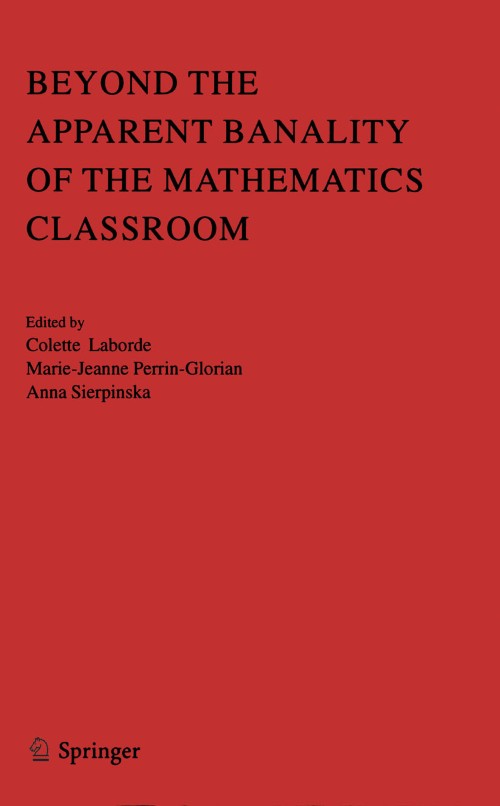
Beyond the Apparent Banality of the Mathematics Classroom [electronic resource] / edited by Colette Laborde, Marie-Jeanne Perrin-Glorian, Anna Sierpinska.
Erişim Adresi
ISBN
9780387304519
Dil Kodu
İngilizce
Yer Numarası
DK/11080
Basım Bildirimi
1st ed. 2005.
Yayın Bilgisi
New York, NY : Springer US : Imprint: Springer, 2005.
Fiziksel Niteleme
VIII, 325 p. online resource.
İçindekiler Notu
Teaching Situations as Object of Research: Empirical Studies within Theoretical Perspectives -- Didactical Handling of Students’ Reasoning Processes in Problem Solving Situations -- Macro-Situation and Numerical Knowledge Building: The Role of Pupils’ Didactic Memory in Classroom Interactions -- The Adidactic Interaction with the Procedures of Peers in the Transition from Arithmetic to Algebra: A Milieu for the Emergence of New Questions -- Characterization of an Ordinary Teaching Practice with the Help of the Theory of Didactic Situations -- An Attempt to Model the Teacher’s Action in the Mathematics Class -- Time Management in the Work Economy of a Class, a Case Study: Integration of Cabri in Primary School Mathematics Teaching -- What Can the Teacher Learn in the Classroom? -- Didactic Restrictions on the Teacher’s Practice: The Case of Limits of Functions in Spanish High Schools -- A Cross-Analysis of the Mathematics Teacher’s Activity. An Example in a French 10th-Grade Class -- When Classroom Situation is the Unit of Analysis: The Potential Impact on Research in Mathematics Education -- Analyzing Mathematical Teaching-Learning Situations — the Interplay of Communicational and Epistemological Constraints.
Özet, vb.
New research in mathematics education deals with the complexity of the mathematics’ classroom. The classroom teaching situation constitutes a pertinent unit of analysis for research into the ternary didactic relationship which binds teachers, students and mathematical knowledge. The classroom is considered as a complex didactic system, which offers the researcher an opportunity to gauge the boundaries of the freedom that is left with regard to choices about the knowledge to be taught and the ways of organizing the students’ learning, while giveing rise to the study of interrelations between three main elements of the teaching process the: mathematical content to be taught and learned, management of the various time dimensions, and activity of the teacher who prepares and manages the class, to the benefit of the students' knowledge and the teachers' own experience. This volume, reprinted from Educational Studies in Mathematics, Volume 59, focuses on classroom situations as a unit of analysis, the work of the teacher, and is strongly anchored in original theoretical frameworks. The contributions are formulated from the perspective of one or more theoretical frameworks but they are tackled by means of empirical investigations.
Konu
Mathematics __ Study and teaching .
Learning, Psychology of.
Mathematics Education.
Instructional Psychology.
Learning, Psychology of.
Mathematics Education.
Instructional Psychology.
Kurum Adı
Eseri Alıntıla
Referansları kullanmadan önce gözden geçirmeniz ve varsa gerekli düzeltmeleri yapmanız önerilir.
Dijital Kaynak
MARC Görünümü
LEADER 05161nam a22005655i 4500
001 809791
003 TR_AnAIT
005 20260131022238
007 cr nn 008mamaa
008 100301s2005 xxu| s |||| 0|eng d
020 |a9780387304519|9978-0-387-30451-9
024 7 |a10.1007/0-387-30451-7|2doi
041 |aeng
049 |aTürk Tarih Kurumu Kütüphanesi
050 4|aQA10.92-20
072 7|aJNU|2bicssc
072 7|aPB|2bicssc
072 7|aEDU029010|2bisacsh
072 7|aJNU|2thema
072 7|aPB|2thema
082 04|a510.71|223
090 |aDK/11080
245 10|aBeyond the Apparent Banality of the Mathematics Classroom|h[electronic resource] /|cedited by Colette Laborde, Marie-Jeanne Perrin-Glorian, Anna Sierpinska.
250 |a1st ed. 2005.
264 1|aNew York, NY :|bSpringer US :|bImprint: Springer,|c2005.
300 |aVIII, 325 p.|bonline resource.
336 |atext|btxt|2rdacontent
337 |acomputer|bc|2rdamedia
338 |aonline resource|bcr|2rdacarrier
347 |atext file|bPDF|2rda
505 0 |aTeaching Situations as Object of Research: Empirical Studies within Theoretical Perspectives -- Didactical Handling of Students’ Reasoning Processes in Problem Solving Situations -- Macro-Situation and Numerical Knowledge Building: The Role of Pupils’ Didactic Memory in Classroom Interactions -- The Adidactic Interaction with the Procedures of Peers in the Transition from Arithmetic to Algebra: A Milieu for the Emergence of New Questions -- Characterization of an Ordinary Teaching Practice with the Help of the Theory of Didactic Situations -- An Attempt to Model the Teacher’s Action in the Mathematics Class -- Time Management in the Work Economy of a Class, a Case Study: Integration of Cabri in Primary School Mathematics Teaching -- What Can the Teacher Learn in the Classroom? -- Didactic Restrictions on the Teacher’s Practice: The Case of Limits of Functions in Spanish High Schools -- A Cross-Analysis of the Mathematics Teacher’s Activity. An Example in a French 10th-Grade Class -- When Classroom Situation is the Unit of Analysis: The Potential Impact on Research in Mathematics Education -- Analyzing Mathematical Teaching-Learning Situations — the Interplay of Communicational and Epistemological Constraints.
520 |aNew research in mathematics education deals with the complexity of the mathematics’ classroom. The classroom teaching situation constitutes a pertinent unit of analysis for research into the ternary didactic relationship which binds teachers, students and mathematical knowledge. The classroom is considered as a complex didactic system, which offers the researcher an opportunity to gauge the boundaries of the freedom that is left with regard to choices about the knowledge to be taught and the ways of organizing the students’ learning, while giveing rise to the study of interrelations between three main elements of the teaching process the: mathematical content to be taught and learned, management of the various time dimensions, and activity of the teacher who prepares and manages the class, to the benefit of the students' knowledge and the teachers' own experience. This volume, reprinted from Educational Studies in Mathematics, Volume 59, focuses on classroom situations as a unit of analysis, the work of the teacher, and is strongly anchored in original theoretical frameworks. The contributions are formulated from the perspective of one or more theoretical frameworks but they are tackled by means of empirical investigations.
532 8 |aAccessibility summary: This PDF is not accessible. It is based on scanned pages and does not support features such as screen reader compatibility or described non-text content (images, graphs etc). However, it likely supports searchable and selectable text based on OCR (Optical Character Recognition). Users with accessibility needs may not be able to use this content effectively. Please contact us at accessibilitysupport@springernature.com if you require assistance or an alternative format.
532 8 |aInaccessible, or known limited accessibility
532 8 |aNo reading system accessibility options actively disabled
532 8 |aPublisher contact for further accessibility information: accessibilitysupport@springernature.com
650 0|aMathematics|xStudy and teaching .
650 0|aLearning, Psychology of.
650 14|aMathematics Education.
650 24|aInstructional Psychology.
700 1 |aLaborde, Colette.|eeditor.|4edt|4http://id.loc.gov/vocabulary/relators/edt
700 1 |aPerrin-Glorian, Marie-Jeanne.|eeditor.|4edt|4http://id.loc.gov/vocabulary/relators/edt
700 1 |aSierpinska, Anna.|eeditor.|4edt|4http://id.loc.gov/vocabulary/relators/edt
710 2 |aSpringerLink (Online service)
773 0 |tSpringer Nature eBook
776 08|iPrinted edition:|z9780387253534
776 08|iPrinted edition:|z9780387506081
776 08|iPrinted edition:|z9781441937889
856 40|uhttps://doi.org/10.1007/0-387-30451-7
912 |aZDB-2-SHU
912 |aZDB-2-SXED
950 |aHumanities, Social Sciences and Law (SpringerNature-11648)
950 |aEducation (R0) (SpringerNature-43721)
001 809791
003 TR_AnAIT
005 20260131022238
007 cr nn 008mamaa
008 100301s2005 xxu| s |||| 0|eng d
020 |a9780387304519|9978-0-387-30451-9
024 7 |a10.1007/0-387-30451-7|2doi
041 |aeng
049 |aTürk Tarih Kurumu Kütüphanesi
050 4|aQA10.92-20
072 7|aJNU|2bicssc
072 7|aPB|2bicssc
072 7|aEDU029010|2bisacsh
072 7|aJNU|2thema
072 7|aPB|2thema
082 04|a510.71|223
090 |aDK/11080
245 10|aBeyond the Apparent Banality of the Mathematics Classroom|h[electronic resource] /|cedited by Colette Laborde, Marie-Jeanne Perrin-Glorian, Anna Sierpinska.
250 |a1st ed. 2005.
264 1|aNew York, NY :|bSpringer US :|bImprint: Springer,|c2005.
300 |aVIII, 325 p.|bonline resource.
336 |atext|btxt|2rdacontent
337 |acomputer|bc|2rdamedia
338 |aonline resource|bcr|2rdacarrier
347 |atext file|bPDF|2rda
505 0 |aTeaching Situations as Object of Research: Empirical Studies within Theoretical Perspectives -- Didactical Handling of Students’ Reasoning Processes in Problem Solving Situations -- Macro-Situation and Numerical Knowledge Building: The Role of Pupils’ Didactic Memory in Classroom Interactions -- The Adidactic Interaction with the Procedures of Peers in the Transition from Arithmetic to Algebra: A Milieu for the Emergence of New Questions -- Characterization of an Ordinary Teaching Practice with the Help of the Theory of Didactic Situations -- An Attempt to Model the Teacher’s Action in the Mathematics Class -- Time Management in the Work Economy of a Class, a Case Study: Integration of Cabri in Primary School Mathematics Teaching -- What Can the Teacher Learn in the Classroom? -- Didactic Restrictions on the Teacher’s Practice: The Case of Limits of Functions in Spanish High Schools -- A Cross-Analysis of the Mathematics Teacher’s Activity. An Example in a French 10th-Grade Class -- When Classroom Situation is the Unit of Analysis: The Potential Impact on Research in Mathematics Education -- Analyzing Mathematical Teaching-Learning Situations — the Interplay of Communicational and Epistemological Constraints.
520 |aNew research in mathematics education deals with the complexity of the mathematics’ classroom. The classroom teaching situation constitutes a pertinent unit of analysis for research into the ternary didactic relationship which binds teachers, students and mathematical knowledge. The classroom is considered as a complex didactic system, which offers the researcher an opportunity to gauge the boundaries of the freedom that is left with regard to choices about the knowledge to be taught and the ways of organizing the students’ learning, while giveing rise to the study of interrelations between three main elements of the teaching process the: mathematical content to be taught and learned, management of the various time dimensions, and activity of the teacher who prepares and manages the class, to the benefit of the students' knowledge and the teachers' own experience. This volume, reprinted from Educational Studies in Mathematics, Volume 59, focuses on classroom situations as a unit of analysis, the work of the teacher, and is strongly anchored in original theoretical frameworks. The contributions are formulated from the perspective of one or more theoretical frameworks but they are tackled by means of empirical investigations.
532 8 |aAccessibility summary: This PDF is not accessible. It is based on scanned pages and does not support features such as screen reader compatibility or described non-text content (images, graphs etc). However, it likely supports searchable and selectable text based on OCR (Optical Character Recognition). Users with accessibility needs may not be able to use this content effectively. Please contact us at accessibilitysupport@springernature.com if you require assistance or an alternative format.
532 8 |aInaccessible, or known limited accessibility
532 8 |aNo reading system accessibility options actively disabled
532 8 |aPublisher contact for further accessibility information: accessibilitysupport@springernature.com
650 0|aMathematics|xStudy and teaching .
650 0|aLearning, Psychology of.
650 14|aMathematics Education.
650 24|aInstructional Psychology.
700 1 |aLaborde, Colette.|eeditor.|4edt|4http://id.loc.gov/vocabulary/relators/edt
700 1 |aPerrin-Glorian, Marie-Jeanne.|eeditor.|4edt|4http://id.loc.gov/vocabulary/relators/edt
700 1 |aSierpinska, Anna.|eeditor.|4edt|4http://id.loc.gov/vocabulary/relators/edt
710 2 |aSpringerLink (Online service)
773 0 |tSpringer Nature eBook
776 08|iPrinted edition:|z9780387253534
776 08|iPrinted edition:|z9780387506081
776 08|iPrinted edition:|z9781441937889
856 40|uhttps://doi.org/10.1007/0-387-30451-7
912 |aZDB-2-SHU
912 |aZDB-2-SXED
950 |aHumanities, Social Sciences and Law (SpringerNature-11648)
950 |aEducation (R0) (SpringerNature-43721)
Materyaller
Depodan talep edilen materyal sadece kütüphane içerisinde kullanılmaktadır.
Materyal dışarıya ödünç verilmemektedir.
Materyal dışarıya ödünç verilmemektedir.
