

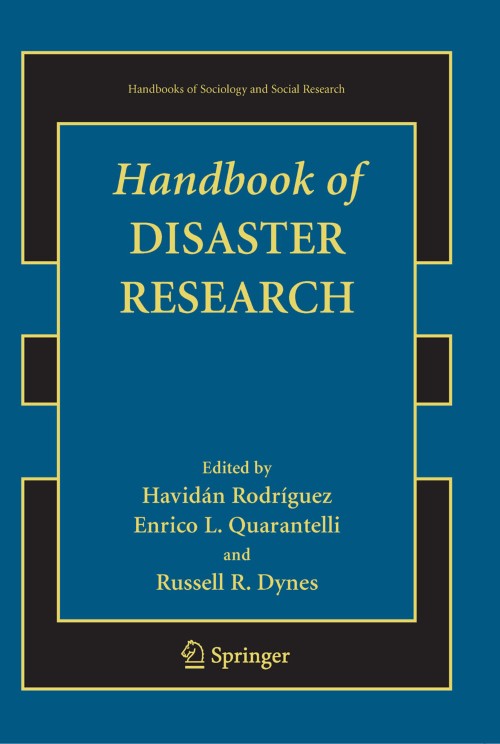
Handbook of Disaster Research [electronic resource] / edited by Havidan Rodriguez, Enrico L. Quarantelli, Russell Dynes.
Erişim Adresi
ISBN
9780387323534
Dil Kodu
İngilizce
Yer Numarası
DK/11083
Basım Bildirimi
1st ed. 2007.
Yayın Bilgisi
New York, NY : Springer New York : Imprint: Springer, 2007.
Fiziksel Niteleme
XXXI, 611 p. online resource.
Dizi
Handbooks of Sociology and Social Research, 2542-839X
İçindekiler Notu
What Is a Disaster? -- A Heuristic Approach to Future Disasters and Crises: New, Old, and In-Between Types -- The Crisis Approach -- Methodological Issues -- The Role of Geographic Information Systems/Remote Sensing in Disaster Management -- Morbidity and Mortality Associated with Disasters -- Race, Class, Ethnicity, and Disaster Vulnerability -- Gender and Disaster: Foundations and Directions -- Globalization and Localization: An Economic Approach -- Local Emergency Management Organizations -- Community Processes: Warning and Evacuation -- Search and Rescue Activities in Disasters -- Community Processes: Coordination -- Sustainable Disaster Recovery: Operationalizing An Existing Agenda -- Sheltering and Housing Recovery Following Disaster* -- Businesses and Disasters: Vulnerability, Impacts, and Recovery -- Organizational Adaptation to Disaster -- Community Innovation and Disasters -- Disaster and Development Research and Practice: A Necessary Eclecticism? -- National Planning and Response: National Systems -- Disaster and Crisis Management in Transitional Societies: Commonalities and Peculiarities -- Terrorism as Disaster -- Recent Developments in U.S. Homeland Security Policies and Their Implications for the Management of Extreme Events -- Unwelcome Irritant or Useful Ally? The Mass Media in Emergencies -- The Popular Culture of Disaster: Exploring a New Dimension of Disaster Research -- Remembering: Community Commemoration After Disaster -- Research Applications in the Classroom -- From Research to Praxis: The Relevance of Disaster Research for Emergency Management -- Communicating Risk and Uncertainty: Science, Technology, and Disasters at the Crossroads -- Crisis Management in the Twenty-First Century: “Unthinkable” Events in “Inconceivable” Contexts -- New Dimensions: The Growth of a Market in Fear -- Disasters Ever More? Reducing U.S. Vulnerabilities.
Özet, vb.
From the reviews: "The Handbook of Disaster Research will, without a doubt, be the most important publication of its type during this decade. Just about everyone who is anyone in the disaster research community has shared their knowledge on the important topics of the day. The authors and the publisher are to be congratulated for completing the book that will be widely sought after by practitioners, researchers and students of disaster planning and response. Thank you for this outstanding contribution to the field." Henry W. Fischer III, Director, Center for Disaster Research & Education, Millersville University "The Handbook of Disaster Research will generate considerable excitement amongst international disaster research and management professionals. Finally, a volume that takes on the task of articulating and unpacking the many social complexities of modern disasters and catastrophes. By taking a multi-disciplinary perspective, the Handbook addresses the very pressing need to better understand the social dimensions of disaster. ... offers a very balanced set of analyses that will undoubtedly appeal to not only the researcher, but the practitioner and the policy-maker alike." Dr. Derek Bopping, Defence Science and Technology Organisation, Department of Defence, Australia "This is an amazing handbook. .... A "must have" for anyone who wants to know the cutting edges of disaster research. The Handbook of Disaster Research is unlike any other handbook I’ve seen. .....I’m impressed, too, with the breadth of expertise that is represented. Practitioners as well as academics, the "old guard" of disaster research as well as the young, rising stars, and the refreshing appearance of scholars from places other than the United States. I need this book on my shelf." Lee Clarke, Rutgers, The State University of New Jersey Author of Worst Cases: Terror and Catastrophe in the Popular Imagination; Mission Improbable: Using Fantasy Documents to Tame Disaster; and Terrorism and Disaster: New Threats, New Ideas. Recent disasters, such as the Indian Ocean Tsunami, bomb explosions in London, Hurricane Katrina, the Pakistan Earthquake, floods in Central America, landslides in Indonesia, and September 11, 2001 among many others, have resulted in an extensive loss of life, social disruption, significant economic impacts to local and national economies, and have made headline news in countries throughout the world. Thus the Handbook of Disaster Research is a timely and much needed contribution to the field of disasters. The Hand.
Konu
Sociology.
Public health.
Demography.
Population.
Sociology.
Public Health.
Population and Demography.
Public health.
Demography.
Population.
Sociology.
Public Health.
Population and Demography.
Diğer Yazarlar
Kurum Adı
Eseri Alıntıla
Referansları kullanmadan önce gözden geçirmeniz ve varsa gerekli düzeltmeleri yapmanız önerilir.
Dijital Kaynak
MARC Görünümü
LEADER 06521nam a22005775i 4500
001 809794
003 TR_AnAIT
005 20260131022229
007 cr nn 008mamaa
008 100301s2007 xxu| s |||| 0|eng d
020 |a9780387323534|9978-0-387-32353-4
024 7 |a10.1007/978-0-387-32353-4|2doi
041 |aeng
049 |aTürk Tarih Kurumu Kütüphanesi
050 4|aHM
072 7|aJHB|2bicssc
072 7|aJHB|2bicssc
072 7|aSOC026000|2bisacsh
072 7|aJHB|2thema
072 7|aJHB|2thema
082 04|a301|223
090 |aDK/11083
245 10|aHandbook of Disaster Research|h[electronic resource] /|cedited by Havidan Rodriguez, Enrico L. Quarantelli, Russell Dynes.
250 |a1st ed. 2007.
264 1|aNew York, NY :|bSpringer New York :|bImprint: Springer,|c2007.
300 |aXXXI, 611 p.|bonline resource.
336 |atext|btxt|2rdacontent
337 |acomputer|bc|2rdamedia
338 |aonline resource|bcr|2rdacarrier
347 |atext file|bPDF|2rda
490 1 |aHandbooks of Sociology and Social Research,|x2542-839X
505 0 |aWhat Is a Disaster? -- A Heuristic Approach to Future Disasters and Crises: New, Old, and In-Between Types -- The Crisis Approach -- Methodological Issues -- The Role of Geographic Information Systems/Remote Sensing in Disaster Management -- Morbidity and Mortality Associated with Disasters -- Race, Class, Ethnicity, and Disaster Vulnerability -- Gender and Disaster: Foundations and Directions -- Globalization and Localization: An Economic Approach -- Local Emergency Management Organizations -- Community Processes: Warning and Evacuation -- Search and Rescue Activities in Disasters -- Community Processes: Coordination -- Sustainable Disaster Recovery: Operationalizing An Existing Agenda -- Sheltering and Housing Recovery Following Disaster* -- Businesses and Disasters: Vulnerability, Impacts, and Recovery -- Organizational Adaptation to Disaster -- Community Innovation and Disasters -- Disaster and Development Research and Practice: A Necessary Eclecticism? -- National Planning and Response: National Systems -- Disaster and Crisis Management in Transitional Societies: Commonalities and Peculiarities -- Terrorism as Disaster -- Recent Developments in U.S. Homeland Security Policies and Their Implications for the Management of Extreme Events -- Unwelcome Irritant or Useful Ally? The Mass Media in Emergencies -- The Popular Culture of Disaster: Exploring a New Dimension of Disaster Research -- Remembering: Community Commemoration After Disaster -- Research Applications in the Classroom -- From Research to Praxis: The Relevance of Disaster Research for Emergency Management -- Communicating Risk and Uncertainty: Science, Technology, and Disasters at the Crossroads -- Crisis Management in the Twenty-First Century: “Unthinkable” Events in “Inconceivable” Contexts -- New Dimensions: The Growth of a Market in Fear -- Disasters Ever More? Reducing U.S. Vulnerabilities.
520 |aFrom the reviews: "The Handbook of Disaster Research will, without a doubt, be the most important publication of its type during this decade. Just about everyone who is anyone in the disaster research community has shared their knowledge on the important topics of the day. The authors and the publisher are to be congratulated for completing the book that will be widely sought after by practitioners, researchers and students of disaster planning and response. Thank you for this outstanding contribution to the field." Henry W. Fischer III, Director, Center for Disaster Research & Education, Millersville University "The Handbook of Disaster Research will generate considerable excitement amongst international disaster research and management professionals. Finally, a volume that takes on the task of articulating and unpacking the many social complexities of modern disasters and catastrophes. By taking a multi-disciplinary perspective, the Handbook addresses the very pressing need to better understand the social dimensions of disaster. ... offers a very balanced set of analyses that will undoubtedly appeal to not only the researcher, but the practitioner and the policy-maker alike." Dr. Derek Bopping, Defence Science and Technology Organisation, Department of Defence, Australia "This is an amazing handbook. .... A "must have" for anyone who wants to know the cutting edges of disaster research. The Handbook of Disaster Research is unlike any other handbook I’ve seen. .....I’m impressed, too, with the breadth of expertise that is represented. Practitioners as well as academics, the "old guard" of disaster research as well as the young, rising stars, and the refreshing appearance of scholars from places other than the United States. I need this book on my shelf." Lee Clarke, Rutgers, The State University of New Jersey Author of Worst Cases: Terror and Catastrophe in the Popular Imagination; Mission Improbable: Using Fantasy Documents to Tame Disaster; and Terrorism and Disaster: New Threats, New Ideas. Recent disasters, such as the Indian Ocean Tsunami, bomb explosions in London, Hurricane Katrina, the Pakistan Earthquake, floods in Central America, landslides in Indonesia, and September 11, 2001 among many others, have resulted in an extensive loss of life, social disruption, significant economic impacts to local and national economies, and have made headline news in countries throughout the world. Thus the Handbook of Disaster Research is a timely and much needed contribution to the field of disasters. The Hand.
650 0|aSociology.
650 0|aPublic health.
650 0|aDemography.
650 0|aPopulation.
650 14|aSociology.
650 24|aPublic Health.
650 24|aPopulation and Demography.
700 1 |aRodriguez, Havidan.|eeditor.|4edt|4http://id.loc.gov/vocabulary/relators/edt
700 1 |aQuarantelli, Enrico L.|eeditor.|4edt|4http://id.loc.gov/vocabulary/relators/edt
700 1 |aDynes, Russell.|eeditor.|4edt|4http://id.loc.gov/vocabulary/relators/edt
710 2 |aSpringerLink (Online service)
773 0 |tSpringer Nature eBook
776 08|iPrinted edition:|z9780387323312
776 08|iPrinted edition:|z9780387739526
776 08|iPrinted edition:|z9780387520483
830 0|aHandbooks of Sociology and Social Research,|x2542-839X
856 40|uhttps://doi.org/10.1007/978-0-387-32353-4
912 |aZDB-2-SHU
912 |aZDB-2-SXS
950 |aHumanities, Social Sciences and Law (SpringerNature-11648)
950 |aSocial Sciences (R0) (SpringerNature-43726)
001 809794
003 TR_AnAIT
005 20260131022229
007 cr nn 008mamaa
008 100301s2007 xxu| s |||| 0|eng d
020 |a9780387323534|9978-0-387-32353-4
024 7 |a10.1007/978-0-387-32353-4|2doi
041 |aeng
049 |aTürk Tarih Kurumu Kütüphanesi
050 4|aHM
072 7|aJHB|2bicssc
072 7|aJHB|2bicssc
072 7|aSOC026000|2bisacsh
072 7|aJHB|2thema
072 7|aJHB|2thema
082 04|a301|223
090 |aDK/11083
245 10|aHandbook of Disaster Research|h[electronic resource] /|cedited by Havidan Rodriguez, Enrico L. Quarantelli, Russell Dynes.
250 |a1st ed. 2007.
264 1|aNew York, NY :|bSpringer New York :|bImprint: Springer,|c2007.
300 |aXXXI, 611 p.|bonline resource.
336 |atext|btxt|2rdacontent
337 |acomputer|bc|2rdamedia
338 |aonline resource|bcr|2rdacarrier
347 |atext file|bPDF|2rda
490 1 |aHandbooks of Sociology and Social Research,|x2542-839X
505 0 |aWhat Is a Disaster? -- A Heuristic Approach to Future Disasters and Crises: New, Old, and In-Between Types -- The Crisis Approach -- Methodological Issues -- The Role of Geographic Information Systems/Remote Sensing in Disaster Management -- Morbidity and Mortality Associated with Disasters -- Race, Class, Ethnicity, and Disaster Vulnerability -- Gender and Disaster: Foundations and Directions -- Globalization and Localization: An Economic Approach -- Local Emergency Management Organizations -- Community Processes: Warning and Evacuation -- Search and Rescue Activities in Disasters -- Community Processes: Coordination -- Sustainable Disaster Recovery: Operationalizing An Existing Agenda -- Sheltering and Housing Recovery Following Disaster* -- Businesses and Disasters: Vulnerability, Impacts, and Recovery -- Organizational Adaptation to Disaster -- Community Innovation and Disasters -- Disaster and Development Research and Practice: A Necessary Eclecticism? -- National Planning and Response: National Systems -- Disaster and Crisis Management in Transitional Societies: Commonalities and Peculiarities -- Terrorism as Disaster -- Recent Developments in U.S. Homeland Security Policies and Their Implications for the Management of Extreme Events -- Unwelcome Irritant or Useful Ally? The Mass Media in Emergencies -- The Popular Culture of Disaster: Exploring a New Dimension of Disaster Research -- Remembering: Community Commemoration After Disaster -- Research Applications in the Classroom -- From Research to Praxis: The Relevance of Disaster Research for Emergency Management -- Communicating Risk and Uncertainty: Science, Technology, and Disasters at the Crossroads -- Crisis Management in the Twenty-First Century: “Unthinkable” Events in “Inconceivable” Contexts -- New Dimensions: The Growth of a Market in Fear -- Disasters Ever More? Reducing U.S. Vulnerabilities.
520 |aFrom the reviews: "The Handbook of Disaster Research will, without a doubt, be the most important publication of its type during this decade. Just about everyone who is anyone in the disaster research community has shared their knowledge on the important topics of the day. The authors and the publisher are to be congratulated for completing the book that will be widely sought after by practitioners, researchers and students of disaster planning and response. Thank you for this outstanding contribution to the field." Henry W. Fischer III, Director, Center for Disaster Research & Education, Millersville University "The Handbook of Disaster Research will generate considerable excitement amongst international disaster research and management professionals. Finally, a volume that takes on the task of articulating and unpacking the many social complexities of modern disasters and catastrophes. By taking a multi-disciplinary perspective, the Handbook addresses the very pressing need to better understand the social dimensions of disaster. ... offers a very balanced set of analyses that will undoubtedly appeal to not only the researcher, but the practitioner and the policy-maker alike." Dr. Derek Bopping, Defence Science and Technology Organisation, Department of Defence, Australia "This is an amazing handbook. .... A "must have" for anyone who wants to know the cutting edges of disaster research. The Handbook of Disaster Research is unlike any other handbook I’ve seen. .....I’m impressed, too, with the breadth of expertise that is represented. Practitioners as well as academics, the "old guard" of disaster research as well as the young, rising stars, and the refreshing appearance of scholars from places other than the United States. I need this book on my shelf." Lee Clarke, Rutgers, The State University of New Jersey Author of Worst Cases: Terror and Catastrophe in the Popular Imagination; Mission Improbable: Using Fantasy Documents to Tame Disaster; and Terrorism and Disaster: New Threats, New Ideas. Recent disasters, such as the Indian Ocean Tsunami, bomb explosions in London, Hurricane Katrina, the Pakistan Earthquake, floods in Central America, landslides in Indonesia, and September 11, 2001 among many others, have resulted in an extensive loss of life, social disruption, significant economic impacts to local and national economies, and have made headline news in countries throughout the world. Thus the Handbook of Disaster Research is a timely and much needed contribution to the field of disasters. The Hand.
650 0|aSociology.
650 0|aPublic health.
650 0|aDemography.
650 0|aPopulation.
650 14|aSociology.
650 24|aPublic Health.
650 24|aPopulation and Demography.
700 1 |aRodriguez, Havidan.|eeditor.|4edt|4http://id.loc.gov/vocabulary/relators/edt
700 1 |aQuarantelli, Enrico L.|eeditor.|4edt|4http://id.loc.gov/vocabulary/relators/edt
700 1 |aDynes, Russell.|eeditor.|4edt|4http://id.loc.gov/vocabulary/relators/edt
710 2 |aSpringerLink (Online service)
773 0 |tSpringer Nature eBook
776 08|iPrinted edition:|z9780387323312
776 08|iPrinted edition:|z9780387739526
776 08|iPrinted edition:|z9780387520483
830 0|aHandbooks of Sociology and Social Research,|x2542-839X
856 40|uhttps://doi.org/10.1007/978-0-387-32353-4
912 |aZDB-2-SHU
912 |aZDB-2-SXS
950 |aHumanities, Social Sciences and Law (SpringerNature-11648)
950 |aSocial Sciences (R0) (SpringerNature-43726)
Materyaller
Depodan talep edilen materyal sadece kütüphane içerisinde kullanılmaktadır.
Materyal dışarıya ödünç verilmemektedir.
Materyal dışarıya ödünç verilmemektedir.
