LEADER 04152nam a22005895i 4500
001 809808
003 TR_AnAIT
005 20260131022210
007 cr nn 008mamaa
008 100301s2009 ne | s |||| 0|eng d
020 |a9781402096044|9978-1-4020-9604-4
024 7 |a10.1007/978-1-4020-9604-4|2doi
041 |aeng
049 |aTürk Tarih Kurumu Kütüphanesi
050 4|aQ124.6-127.2
072 7|aPDX|2bicssc
072 7|aSCI034000|2bisacsh
072 7|aPDX|2thema
082 04|a509|223
090 |aDK/11097
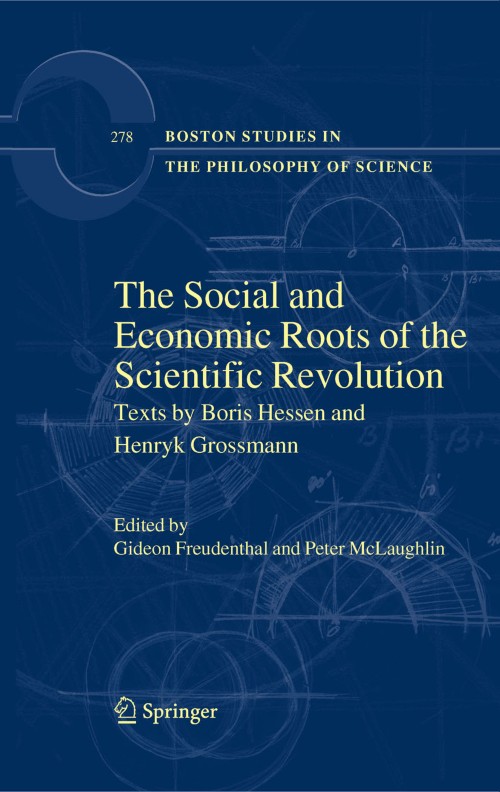
245 14|aThe Social and Economic Roots of the Scientific Revolution|h[electronic resource] :|bTexts by Boris Hessen and Henryk Grossmann /|cedited by Gideon Freudenthal, Peter McLaughlin.
250 |a1st ed. 2009.
264 1|aDordrecht :|bSpringer Netherlands :|bImprint: Springer,|c2009.
300 |aXI, 273 p.|bonline resource.
336 |atext|btxt|2rdacontent
337 |acomputer|bc|2rdamedia
338 |aonline resource|bcr|2rdacarrier
347 |atext file|bPDF|2rda
490 1 |aBoston Studies in the Philosophy and History of Science,|x2214-7942 ;|v278
505 0 |aClassical Marxist Historiography of Science: The Hessen-Grossmann-Thesis -- The Social and Economic Roots of Newton’s Principia -- The Social Foundations of the Mechanistic Philosophy and Manufacture -- Descartes and the Social Origins of the Mechanistic Concept of the World -- Additional Texts on Mechanism -- Henryk Grossman: A Biographical Sketch -- Boris Hessen: In Lieu of a Biography.
520 |aThe texts of Boris Hessen and Henryk Grossmann assembled in this volume are important contributions to the historiography of the Scienti?c Revolution and to the methodology of the historiography of science. They are of course also historical documents, not only testifying to Marxist discourse of the time but also illustrating typical European fates in the ?rst half of the twentieth century. Hessen was born a Jewish subject of the Russian Czar in the Ukraine, participated in the October Revolution and was executed in the Soviet Union at the beginning of the purges. Grossmann was born a Jewish subject of the Austro-Hungarian Kaiser in Poland and served as an Austrian of?cer in the First World War; afterwards he was forced to return to Poland and then because of his revolutionary political activities to emigrate to Germany; with the rise to power of the Nazis he had to ?ee to France and then Americawhilehisfamily,whichremainedinEurope,perishedinNaziconcentration camps. Our own acquaintance with the work of these two authors is also indebted to historical context (under incomparably more fortunate circumstances): the revival of Marxist scholarship in Europe in the wake of the student movement and the p- fessionalization of history of science on the Continent. We hope that under the again very different conditions of the early twenty-?rst century these texts will contribute to the further development of a philosophically informed socio-historical approach to the study of science.
650 0|aScience|xHistory.
650 0|aScience|xPhilosophy.
650 0|aSocial sciences.
650 0|aHumanities.
650 0|aPhilosophy and social sciences.
650 0|aPhysics|xPhilosophy.
650 14|aHistory of Science.
650 24|aPhilosophy of Science.
650 24|aHumanities and Social Sciences.
650 24|aPhilosophy of the Social Sciences.
650 24|aPhilosophical Foundations of Physics and Astronomy.
700 1 |aFreudenthal, Gideon.|eeditor.|4edt|4http://id.loc.gov/vocabulary/relators/edt
700 1 |aMcLaughlin, Peter.|eeditor.|4edt|4http://id.loc.gov/vocabulary/relators/edt
710 2 |aSpringerLink (Online service)
773 0 |tSpringer Nature eBook
776 08|iPrinted edition:|z9781402096037
776 08|iPrinted edition:|z9781402096174
776 08|iPrinted edition:|z9789400791930
830 0|aBoston Studies in the Philosophy and History of Science,|x2214-7942 ;|v278
856 40|uhttps://doi.org/10.1007/978-1-4020-9604-4
912 |aZDB-2-SHU
912 |aZDB-2-SXH
950 |aHumanities, Social Sciences and Law (SpringerNature-11648)
950 |aHistory (R0) (SpringerNature-43722)